
AdKit vs quickseo.ai
Side-by-side comparison to help you choose the right product.

AdKit is an AI-powered platform that helps SaaS and mobile app businesses research, generate, and optimize effective.
Last updated: March 1, 2026

QuickSEO.ai provides a unified dashboard to track and improve your brand's visibility across both Google Search and leading AI chatbots.
Last updated: March 11, 2026
Visual Comparison
AdKit
quickseo.ai
Feature Comparison
AdKit
Unified Ad Intelligence Library
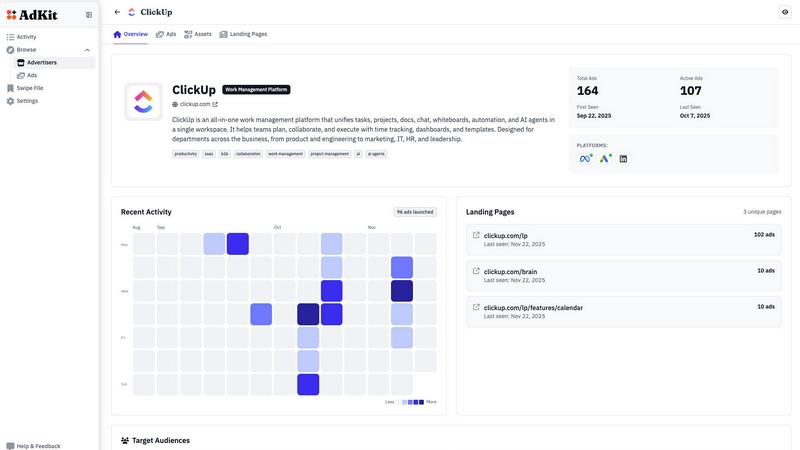
AdKit's centralized library aggregates advertisements from major platforms including Meta (Facebook & Instagram), Google, and LinkedIn into one dashboard, eliminating the need to manually jump between multiple sources. Users can browse a curated feed of 100,000+ ads, apply smart filters by format, audience, or platform, and track the complete ad history of specific competitors. The library provides extra insights not commonly available elsewhere, such as video transcripts and asset reuse tracking, offering a deeper understanding of competitor strategies.
AI-Powered Static Ad Generator
This feature allows users with no design skills to generate visually compelling static advertisements in minutes. Users can either create ads from scratch by inputting project details for AI-tailored concepts or instantly clone any ad they find in the library using a dedicated Chrome extension. The built-in editor enables quick resizing for any platform format and AI-assisted editing of text and visual elements, facilitating rapid iteration and A/B testing without requiring external software.
Competitor Tracking & Alerts
AdKit enables proactive competitive intelligence by allowing users to add specific competitors for continuous monitoring. The system automatically scans for new campaigns and notifies users when a tracked competitor launches a new ad. This ensures marketers are always aware of market shifts and emerging creative trends, allowing them to adapt their strategies in real-time rather than relying on sporadic, manual checks.
Save, Organize & Collaborate Hub
Users can bookmark high-performing or inspirational ads from the library and systematically organize them into custom collections. This functionality serves as a personal inspiration board and strategic repository. Collections can be easily shared with team members, streamlining collaboration and ensuring alignment on creative direction and competitive benchmarks across marketing teams.
About quickseo.ai
Unified Search & AI Dashboard
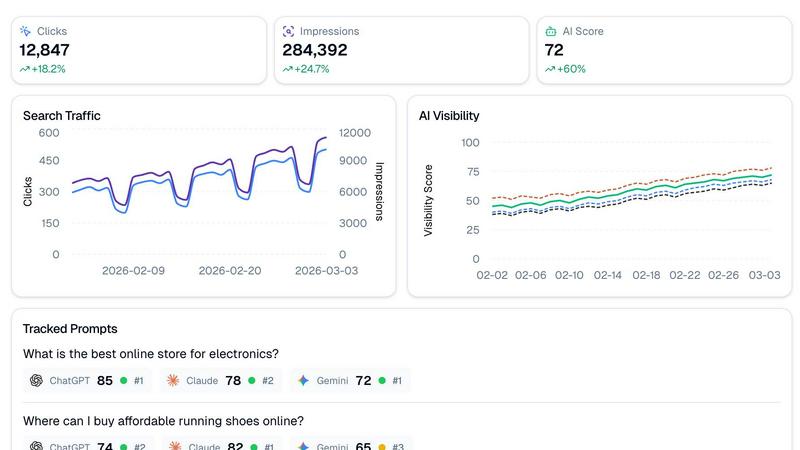
This foundational feature consolidates Google Search Console data and AI visibility metrics into a single, coherent interface. Users can view traditional SEO performance indicators like clicks, impressions, and ranking trends alongside AI-specific scores from ChatGPT, Claude, and Gemini. This side-by-side comparison eliminates the need to juggle multiple tools and provides a holistic, real-time overview of a brand's complete search ecosystem, from web pages to AI chatbot responses, facilitating integrated strategy development.
AI Visibility Scoring & Prompt Tracking
QuickSEO.ai actively monitors and scores a brand's visibility across key AI platforms on a daily basis. Users can define and track specific prompts—such as "best online store for electronics"—that their target customers are likely to ask. The dashboard then displays the brand's ranking position and a visibility score (e.g., 85/100) for each tracked prompt across each AI model, providing clear, quantifiable metrics on AI search performance and competitive standing within conversational answers.
Sentiment Analysis & Cited Page Monitoring
Beyond mere visibility, the platform analyzes the tone and context of AI mentions. Sentiment analysis categorizes references to a brand as positive, neutral, or negative, offering crucial insights into brand perception within AI ecosystems. Simultaneously, the tool identifies and monitors which specific pages from the user's website are cited as sources by the AI chatbots, allowing content teams to understand which assets are driving AI authority and optimize accordingly.
Page Group Organization & Competitor Tracking
For deeper analysis, QuickSEO.ai allows users to group website pages by URL patterns (e.g., /blog/, /products/) to see which sections drive the most search and AI traffic. Furthermore, it automatically extracts and lists competitor brands that appear alongside the user's brand in AI responses for tracked prompts. This provides strategic intelligence on the competitive landscape within AI search, revealing which rivals are also capturing mindshare in this new channel.
Use Cases
AdKit
Startup Launch Campaign Development
For a new startup with limited marketing resources and brand awareness, AdKit is invaluable for rapidly building a foundational ad strategy. The team can research successful ads within their SaaS or mobile app niche, identify proven messaging and visual hooks, and use the AI generator to produce a suite of launch-ready creatives that resonate with their target audience, all without hiring a dedicated designer or copywriter.
Competitive Analysis and Market Research
Marketing agencies and in-house teams can use AdKit to conduct deep, ongoing competitive analysis. By tracking key competitors and filtering the ad library by specific formats (e.g., video, lead gen) or platforms, they can deconstruct winning campaigns, understand audience targeting strategies, and gather data-driven insights to inform their own media planning and creative development, staying one step ahead in the market.
Scaling Creative Production for Small Teams
Small e-commerce or DTC brands that need to produce a high volume of ads for different products, seasons, or promotions can leverage AdKit to scale their creative output. The ability to clone a winning ad template and quickly adapt it with AI for new products or offers saves countless hours, enabling a small team to maintain a consistent yet varied ad presence across multiple digital channels efficiently.
Inspiration Curation for Creative Teams
Creative directors and content strategists can use AdKit's save and organize features to build curated collections of exemplary advertisements. These collections can be used to train new team members, pitch creative concepts to stakeholders with concrete examples, and establish internal benchmarks for quality and innovation, fostering a data-informed and inspired creative culture.
quickseo.ai
E-commerce & Retail Brands
Online retailers can use QuickSEO.ai to track prompts related to product recommendations and purchasing advice (e.g., "where to buy affordable running shoes"). By monitoring their rankings and sentiment in AI responses, they can optimize product pages and content to become a cited source, directly capturing high-intent AI-driven traffic that bypasses traditional search engine results pages.
SaaS & Technology Companies
B2B and SaaS companies can track visibility for industry-specific queries and competitor comparisons within AI chatbots. By analyzing which documentation or blog pages are cited by AI, they can strengthen their topical authority, improve their positioning as a thought leader, and identify content gaps that, when filled, can make them a more frequent recommendation in AI-generated professional advice.
Digital Marketing & SEO Agencies
Agencies managing multiple client portfolios require efficient, data-driven reporting. QuickSEO.ai provides a unified platform to demonstrate tangible value by reporting on both traditional SEO gains (via GSC integration) and emerging AI visibility metrics. This allows agencies to offer a future-proof service, proactively managing and optimizing for the AI search shift for all their clients.
Content Publishers & Media Sites
Publishers relying on organic traffic must understand how their articles and guides are referenced by AI. This tool helps them see which content is sourced by chatbots for summarization or Q&A, enabling them to create more authoritative, AI-friendly content that maintains citation relevance and drives referral traffic as AI search usage grows.
Overview
About AdKit
AdKit is a comprehensive, AI-powered advertising platform engineered to solve the fundamental challenges of modern digital marketing for startups, small teams, and solo entrepreneurs. It functions as an all-in-one toolkit that consolidates the entire ad lifecycle—from initial research and competitive analysis to the actual creation and optimization of ad creatives. The platform's core mission is to eliminate the inefficiency of manually scouring disparate ad libraries and to lower the barrier to creating professional, high-converting advertisements. Its primary value proposition is delivering significant time savings—estimated at 2-3 hours per week—while dramatically improving the quality and strategic insight of marketing campaigns. By integrating a vast, searchable database of over 100,000 live ads with a sophisticated AI generator, AdKit empowers users to quickly discover what is working for competitors, draw actionable inspiration, and then produce tailored, scroll-stopping ads for their own brand in minutes, all within a single, intuitive interface.
About quickseo.ai
QuickSEO.ai is a comprehensive analytics platform designed to bridge the critical gap between traditional search engine optimization (SEO) and the emerging landscape of AI-powered search. It functions as a unified dashboard that integrates data from Google Search Console with proprietary AI visibility tracking across major conversational AI platforms, including OpenAI's ChatGPT, Anthropic's Claude, and Google's Gemini. The core value proposition of QuickSEO.ai is to provide marketers, SEO professionals, and business owners with a holistic view of their digital presence, enabling them to track, analyze, and optimize for both conventional web search and the rapidly growing channel of AI chatbot queries.
The platform addresses a significant market shift, where a substantial portion of consumer queries are now initiated through AI interfaces. QuickSEO.ai empowers users to move beyond guesswork by offering concrete data on how their brand, products, or content is referenced and ranked within AI-generated responses. This includes monitoring daily visibility scores, tracking specific customer prompts, analyzing sentiment, and identifying which pages are cited as sources. By consolidating Google Search Console analytics—such as clicks, impressions, and click-through rates—with this new layer of AI intelligence, QuickSEO.ai provides the actionable insights necessary to capture traffic and commercial opportunities in the AI-driven search era, ensuring brands are not left behind as search behavior evolves.
Frequently Asked Questions
AdKit FAQ
What platforms does the AdKit library pull ads from?
The AdKit intelligence library currently aggregates advertisements from major digital advertising platforms including Meta (encompassing Facebook and Instagram Ads), Google Ads, and LinkedIn. The platform is designed to be a unified source, and the company indicates that support for additional platforms is planned for the future, as noted by "Soon" labels on the website.
How does the AI Ad Generator work and what does it cost?
The AI Static Ad Generator allows you to create ads either from a text description of your project or by cloning an existing ad. It uses AI models to generate visual concepts and copy. Crucially, AdKit operates on a bring-your-own-keys (BYOK) model for AI services; you use your own OpenAI or Gemini API keys. You only pay the standard fees to your AI provider, with AdKit itself charging a minimal platform fee starting at $0.05 per generated ad, avoiding restrictive credit systems.
Can I track when my competitors run new ads?
Yes, competitor tracking and alerts are a core feature of AdKit. Once you add a competitor's domain or page to your tracking list within the platform, AdKit's system continuously monitors their advertising activity. You will receive notifications when new ads are detected, allowing you to see their latest strategies and creative launches in near real-time without manual effort.
Is there a way to save and organize ads I find for later?
Absolutely. AdKit includes robust save and organization tools. You can bookmark any ad in the library with one click. Furthermore, you can create custom collections (e.g., "Q4 Video Ads," "Competitor X Strategy") to categorize your saved ads. These collections can then be easily shared with colleagues via a link, facilitating seamless teamwork and creative alignment.
quickseo.ai FAQ
How does QuickSEO.ai track rankings in AI chatbots?
QuickSEO.ai employs a sophisticated, automated querying system that simulates user interactions with the APIs or public interfaces of AI platforms like ChatGPT, Claude, and Gemini. It runs the prompts you define through these systems, parses the generated responses, and identifies if and where your brand or domain is mentioned. The platform then calculates a visibility score based on prominence and ranking position within the answer, providing a consistent and trackable metric over time.
What is the difference between AI visibility score and traditional keyword ranking?
A traditional keyword ranking is a numeric position (1-100) on a Search Engine Results Page (SERP) for a specific query. An AI visibility score is a composite metric (typically 0-100) that assesses your brand's presence within the unstructured text of an AI chatbot's response. It factors in whether you are mentioned, your ranking order among other cited brands, and the context of the mention. It measures influence in a conversational format rather than position on a static page.
Can I track my competitors with QuickSEO.ai?
Yes, competitor tracking is a core feature. When QuickSEO.ai analyzes AI responses for your tracked prompts, it automatically identifies and extracts the names of other brands that appear alongside yours. This data is aggregated in the competitor tracking section, showing you which rivals are most frequently mentioned in your target AI conversations, allowing for direct competitive benchmarking in the AI search space.
How does the integration with Google Search Console work?
QuickSEO.ai connects to your Google Search Console account via its secure API. Once you authenticate and grant permission, the platform imports your historical and ongoing search performance data—including clicks, impressions, average position, and CTR—directly into its dashboard. This integration ensures all your search analytics, from both traditional and AI sources, are synchronized and available for analysis in one location without manual data export.
Alternatives
AdKit Alternatives
AdKit is a specialized marketing platform designed for SaaS and mobile app businesses, focusing on streamlining the creation, analysis, and optimization of content-driven advertisements. It consolidates tools like a vast ad library and AI-powered generators into a single interface to save time and resources for small teams. Users may explore alternatives for various reasons, including budget constraints, the need for different feature sets like advanced video editing or native platform integrations, or a requirement for solutions that scale with larger, enterprise-level marketing operations. The specific needs of a team's ad strategy and workflow often drive this search. When evaluating alternatives, key considerations should include the depth of the competitive intelligence library, the sophistication and flexibility of AI creation tools, the robustness of analytics and optimization features, and the overall cost relative to the value provided. The ideal platform should align closely with your team's size, technical skill level, and primary advertising channels.
quickseo.ai Alternatives
quickseo.ai is a specialized marketing analytics platform that focuses on brand visibility across both traditional search engines and the emerging landscape of AI-powered search. It operates within the SEO and brand monitoring software category, uniquely combining Google Search Console data with AI-specific tracking across platforms like ChatGPT, Claude, and Gemini. This allows businesses to understand their performance in both conventional and AI-driven search results. Users often explore alternatives for several common reasons. These include budget constraints or seeking a different pricing model, the need for a more specialized or broader feature set, or a requirement to integrate with a different stack of existing business tools. Some may also look for platforms that focus exclusively on either traditional SEO or AI analytics, rather than the combined approach. When evaluating an alternative, key considerations should include the depth and accuracy of data provided, the specific AI models and search engines tracked, the availability of actionable insights like sentiment analysis and competitor benchmarking, and the overall usability of the platform. The ideal tool should align with your primary goal, whether it's dominating AI chat search results, improving classic organic visibility, or achieving a balanced view of both.