
Agenta vs HookMesh
Side-by-side comparison to help you choose the right product.

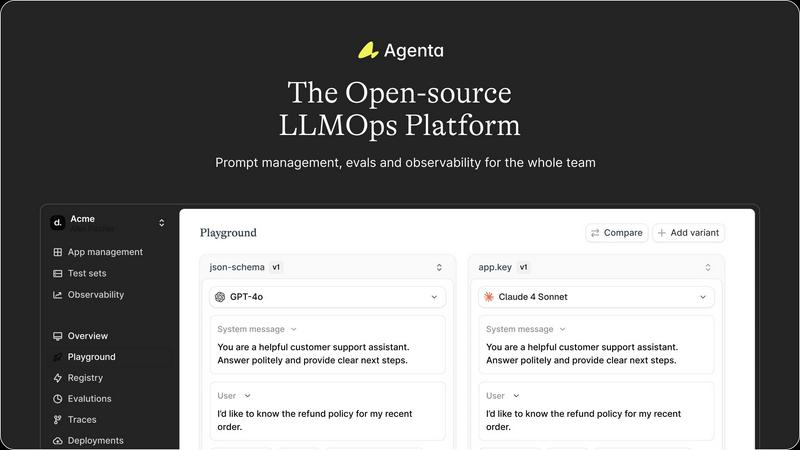
Agenta is an open-source LLMOps platform that centralizes prompt management and evaluation for reliable AI development.
Last updated: March 1, 2026

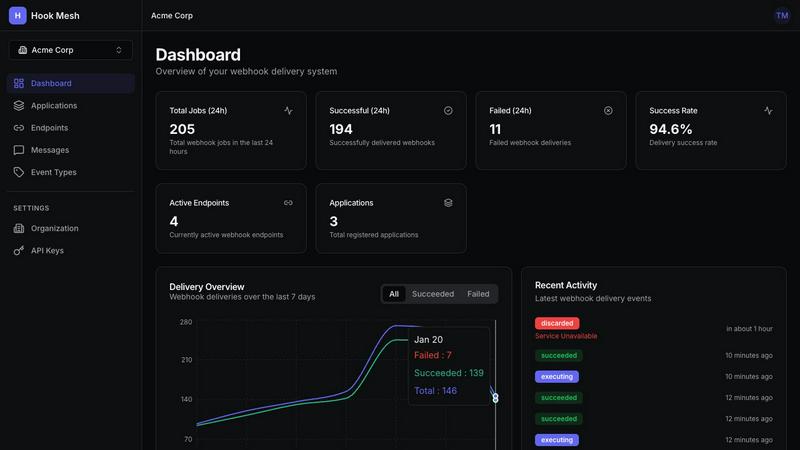
HookMesh simplifies webhook delivery with automatic retries and a self-service portal, ensuring reliability and peace.
Last updated: February 26, 2026
Visual Comparison
Agenta
HookMesh
Feature Comparison
Agenta
Centralized Prompt Management
Agenta's centralized prompt management feature allows teams to keep all prompts, evaluations, and traces in one unified platform, eliminating the chaos of scattered tools. This ensures that everyone involved has access to the latest versions of prompts and can collaborate effectively without losing critical information.
Automated Evaluation Processes
With Agenta, teams can create systematic evaluation processes that automate the testing and validation of every change made to prompts and models. This feature minimizes guesswork and allows for more reliable assessments of model performance through integrated evaluators that can be customized as needed.
Comprehensive Observability Tools
Agenta provides robust observability tools that allow teams to trace every request and pinpoint exact failure points in their AI systems. This feature facilitates effective debugging and helps gather vital user feedback, which can be annotated and transformed into actionable test cases with a single click.
Unified Collaboration Interface
The platform includes a user-friendly interface that empowers domain experts, product managers, and developers to work together within a single workflow. This feature simplifies the process of experimenting, comparing, versioning, and debugging prompts, making it easier for all team members to contribute without needing deep technical expertise.
About HookMesh
Reliable Delivery
HookMesh ensures that webhook delivery is never compromised. The platform employs automatic retries, utilizing exponential backoff strategies combined with jitter, allowing it to retry failed webhooks for up to 48 hours. This feature guarantees that webhook events reach their intended destinations without loss.
Circuit Breaker
The circuit breaker feature is designed to automatically disable failing endpoints, preventing them from disrupting the entire webhook delivery process. Once the endpoint recovers, it is re-enabled automatically, ensuring that issues are managed efficiently without manual intervention.
Customer Portal
HookMesh provides an embeddable user interface that enhances customer experience. This self-service portal allows customers to manage their endpoints, view detailed delivery logs, and replay failed webhook events with just one click, promoting greater transparency and operational efficiency.
Developer Experience
Designed with developers in mind, HookMesh offers a full REST API and official SDKs for JavaScript, Python, and Go. This comprehensive access allows for seamless integration into existing applications, enabling developers to send webhook events with minimal setup and maximum efficiency.
Use Cases
Agenta
Collaborative Development of LLM Applications
Agenta is ideal for teams looking to collaboratively develop LLM applications. By providing a centralized platform, it allows developers and subject matter experts to work together on prompt engineering and model evaluation, fostering innovation and efficiency.
Streamlined Debugging and Performance Monitoring
AI teams can leverage Agenta to streamline their debugging processes. The observability tools allow them to identify and address issues quickly, while the automated evaluation processes ensure continuous performance monitoring, helping to maintain high-quality standards in production.
Agile Iteration and Experimentation
Agenta supports agile methodologies by enabling rapid iteration of prompts and models. Teams can experiment with various approaches, track their results, and validate changes effectively, ensuring that their LLM applications remain competitive and responsive to user needs.
Integration with Existing Workflows
Agenta's ability to integrate seamlessly with popular frameworks and models like LangChain, LlamaIndex, and OpenAI makes it a versatile choice for teams. This feature enables organizations to leverage their existing technology stack while adopting best practices in LLMOps.
HookMesh
E-commerce Order Notifications
In an e-commerce setting, HookMesh can be utilized to send real-time order notifications to various external services. By ensuring reliable delivery, businesses can keep customers informed about their order status, enhancing the overall shopping experience.
Payment Processing
Payment processors can leverage HookMesh to deliver transaction updates to merchants effectively. The automatic retry and circuit breaker features ensure that critical payment notifications are consistently delivered, even in cases of temporary endpoint failures.
SaaS Integration
For SaaS products that need to communicate with other services, HookMesh simplifies the process of sending webhook events. This integration allows for seamless data flow between applications, enabling features like user account updates, data synchronization, and more.
Event-Driven Architecture
Companies adopting an event-driven architecture can use HookMesh to manage event notifications between microservices. By ensuring that all events are reliably delivered, organizations can maintain operational continuity and responsiveness in their systems.
Overview
About Agenta
Agenta is an innovative open-source LLMOps platform that revolutionizes the way large language model (LLM) applications are developed and deployed. Designed to create a collaborative environment, Agenta enables developers and subject matter experts to work together seamlessly, experimenting with prompts, evaluating model performance, and debugging production issues efficiently. The platform addresses critical challenges faced by AI teams, such as unpredictable LLM behavior, fragmented prompt management, siloed communication, and an absence of structured validation processes. By centralizing the LLM development workflow, Agenta enhances team collaboration, improves workflow efficiency, and accelerates rapid iterations, ultimately leading to the creation of high-quality LLM applications. It serves as a single source of truth, ensuring that all team members—from product managers to developers and domain experts—can engage in a coherent and transparent process.
About HookMesh
HookMesh is a cutting-edge solution designed to streamline and enhance the delivery of webhooks for modern Software as a Service (SaaS) products. It tackles the myriad complexities associated with building webhooks internally, such as implementing retry logic, managing circuit breakers, and diagnosing delivery issues. By adopting HookMesh, businesses can concentrate on their core offerings rather than being encumbered by the intricate technicalities of webhook management. This robust platform boasts a battle-tested infrastructure that guarantees reliable delivery through features like automatic retries, exponential backoff, and idempotency keys. HookMesh is tailored for developers and product teams who aim to deliver a seamless customer experience while ensuring consistent and reliable webhook event delivery. With a self-service portal that empowers users, HookMesh facilitates straightforward endpoint management and visibility. Users can also effortlessly replay failed webhooks with a single click, making it the preferred choice for organizations seeking a dependable webhook strategy that promotes peace of mind.
Frequently Asked Questions
Agenta FAQ
What is LLMOps, and how does Agenta fit into it?
LLMOps refers to the set of practices and tools designed to improve the development and deployment of large language models. Agenta fits into this framework by providing a centralized platform that streamlines collaboration, prompt management, evaluation, and observability.
Can Agenta integrate with existing tools and frameworks?
Yes, Agenta is designed to integrate seamlessly with a variety of existing tools and frameworks, including LangChain, LlamaIndex, OpenAI, and others. This flexibility allows teams to incorporate Agenta into their current workflows without significant disruption.
How does Agenta enhance team collaboration?
Agenta enhances team collaboration by providing a unified interface where product managers, developers, and domain experts can work together on prompt engineering and model evaluation. This reduces silos and improves communication across the team.
Is Agenta suitable for organizations of all sizes?
Absolutely. Agenta is designed to be scalable and adaptable, making it suitable for organizations of all sizes, from startups to large enterprises. Its open-source nature allows teams to customize the platform to fit their specific needs and workflows.
HookMesh FAQ
What are webhooks and how do they work?
Webhooks are automated messages sent from apps when something happens. They send data in real-time to another application, allowing for instant updates. Webhooks work via HTTP requests to a specified URL when triggered by an event in the source application.
How does HookMesh ensure webhook reliability?
HookMesh guarantees webhook reliability through a combination of automatic retries, exponential backoff, and circuit breaker mechanisms. These features work together to ensure that webhook events are delivered successfully, even in the face of temporary failures.
Can I manage my webhook endpoints with HookMesh?
Yes, HookMesh provides a self-service portal that allows users to manage their webhook endpoints easily. This includes adding new endpoints, viewing delivery logs, and replaying failed webhooks with just a click.
What programming languages does HookMesh support?
HookMesh offers official SDKs for JavaScript, Python, and Go, enabling developers to integrate webhook functionalities into their applications quickly. The REST API also supports sending webhook events from any programming language that can make HTTP requests.
Alternatives
Agenta Alternatives
Agenta is an open-source LLMOps platform that centralizes prompt management, evaluation, and debugging for large language model applications. It is designed to enhance collaboration among developers and subject matter experts by providing a unified environment for experimentation and model performance evaluation. Users commonly seek alternatives to Agenta due to a variety of factors, including pricing, specific feature sets, or unique platform requirements that may not be fully addressed by Agenta. When considering alternatives, it is essential to evaluate the platform's ability to streamline workflows, enhance collaboration, and provide robust evaluation tools, ensuring that it meets the specific needs of your team and project. --- [{"question": "What is Agenta?", "answer": "Agenta is an open-source LLMOps platform that centralizes prompt management, evaluation, and debugging for large language model applications."},{"question": "Who is Agenta for?", "answer": "Agenta is designed for developers and subject matter experts working on large language model applications who need a collaborative environment for prompt experimentation and evaluation."},{"question": "Is Agenta free?", "answer": "Yes, Agenta is an open-source platform, which means it is available for free to users."},{"question": "What are the main features of Agenta?", "answer": "Agenta features centralized prompt management, a unified playground for experimentation, and an automated evaluation system to enhance the reliability of model modifications."}]
HookMesh Alternatives
HookMesh is a cutting-edge solution that falls within the category of webhook delivery services, designed to optimize and streamline the webhook management process for SaaS products. It alleviates the technical burdens associated with in-house webhook implementations, such as error handling and retry mechanisms, allowing businesses to focus on their core offerings. Users often seek alternatives to HookMesh for various reasons, including pricing considerations, feature sets that may better align with their specific needs, or the desire for a platform that integrates more seamlessly with their existing tech stack. When evaluating alternatives to HookMesh, it is essential to consider several factors. Users should assess the reliability of delivery mechanisms, the usability of customer portals, and the overall developer experience. Additionally, understanding the pricing models, support options, and customizability of the alternatives can significantly impact the decision-making process. A thorough comparison of these attributes will help ensure that the chosen solution meets both current and future webhook management needs.