
ClearMind AI vs Polym
Side-by-side comparison to help you choose the right product.

ClearMind AI
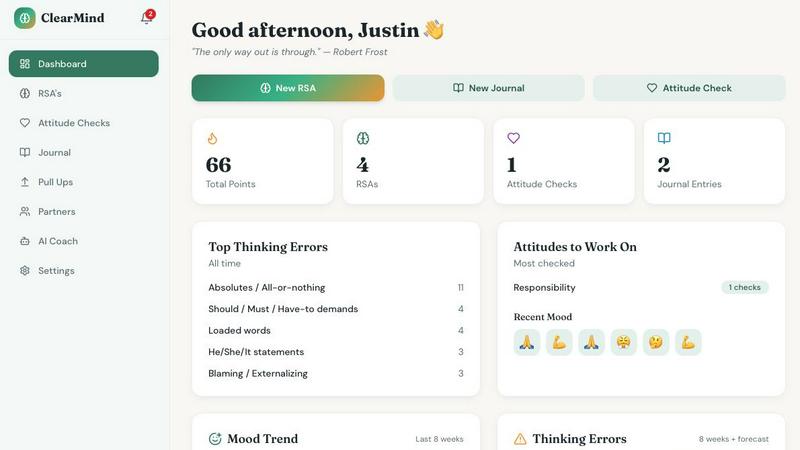
ClearMind AI is a free voice-first journaling app that uses CBT principles and AI analysis to help users identify and reframe unhealthy thinking.
Last updated: March 11, 2026

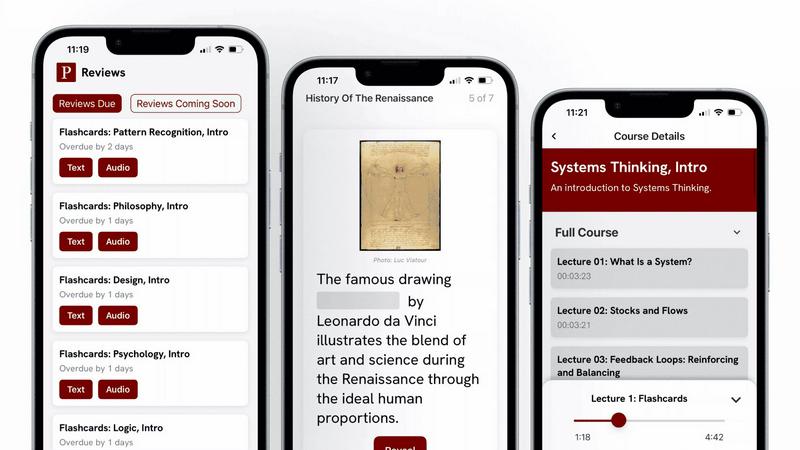
Polym is an audio app that uses active learning techniques to enhance long-term knowledge retention and recall.
Last updated: March 1, 2026
Visual Comparison
ClearMind AI
Polym
Feature Comparison
ClearMind AI
RSA Wizard
The RSA Wizard is the central feature, guiding users through a structured Rational Self-Analysis process. Users can record or type a description of an emotionally charged situation. The AI then analyzes the input to identify specific cognitive distortions, such as catastrophizing or black-and-white thinking, and helps reframe these thoughts with clear, objective reasoning. This step-by-step wizard transforms abstract emotional reactions into concrete, manageable thought patterns for review and revision.
Daily Journal with Emotion Detection
This feature provides a voice-dictation journal for daily entries, enhanced with AI-powered emotion detection. As users speak or type about their day, the system identifies underlying emotional tones and tracks them over time. This allows for the visualization of mood patterns and correlations between events, thoughts, and feelings, offering data-driven insights into emotional triggers and trends that might otherwise go unnoticed.
Progress Dashboard & AI Growth Coach
The Progress Dashboard offers a holistic view of a user's development through streaks, trend graphs, and personalized recommendations. Complementing this is the AI Growth Coach, a conversational agent that has access to the user's RSA history, journal entries, and mood data. This coach provides tailored guidance, answers questions, and suggests exercises based on the user's unique thinking patterns and historical progress.
Accountability Partners & Social Features
ClearMind AI incorporates a social framework to foster motivation and support. Users can invite friends to be Accountability Partners, share anonymized progress, and stay committed to their practice. The system includes "Pull Ups" for gentle accountability nudges and "Kudos" to celebrate milestones and wins, creating a supportive community environment for shared cognitive growth.
About Polym
Medium-Form Audio Courses
Polym provides in-depth, medium-form audio courses focused on the conceptual understanding of foundational subjects. These courses are carefully curated to cover material that is not only professionally relevant across various fields but also enriching for general knowledge. The content is specifically engineered for the audio format, with a focus on abstract concepts and principles from technical and mathematical fields that are suitable for auditory learning, thereby overcoming a common hurdle in educational media.
Active Learning via Retrieval Practice
The app moves beyond passive consumption by embedding retrieval practice—a core active learning technique—into the user experience. This is operationalized through interactive audio flashcards and prompted recall exercises within courses. By actively requiring the user to retrieve information from memory, this feature strengthens neural pathways, significantly enhancing long-term retention and recall compared to re-reading or re-listening alone.
Spaced Repetition Scheduling
To combat the natural curve of forgetting, Polym incorporates a spaced repetition algorithm. This system intelligently schedules review sessions for key concepts and terms at strategically increasing intervals. By prompting users to revisit material just as they are about to forget it, the app maximizes memory consolidation, ensuring that learned information transitions from short-term to durable long-term knowledge.
Interleaved Practice Sessions
Polym employs the interleaving learning strategy by mixing related topics or questions from different courses during study and review sessions. Instead of blocking study on a single subject, this approach challenges the brain to discriminate between concepts and apply knowledge in varied contexts. This feature enhances deeper learning, improves problem-solving flexibility, and strengthens the connections between interrelated subjects.
Use Cases
ClearMind AI
Managing Work-Related Stress and Anxiety
Professionals facing high-pressure deadlines, critical feedback, or interpersonal conflicts at work can use the RSA Wizard to deconstruct stressful events. By analyzing the automatic thoughts triggered by a difficult meeting or a missed target, the tool helps reframe perceptions, reduce anxiety, and develop more rational, solution-oriented responses, leading to improved performance and reduced burnout.
Improving Personal Relationship Dynamics
Individuals seeking to enhance communication and reduce conflict in personal relationships can utilize the journal and RSA features. After a disagreement, a user can process their emotional reaction, identify any irrational beliefs (e.g., "they never listen"), and reframe them. Over time, this practice cultivates empathy, objectivity, and healthier communication patterns, strengthening relational bonds.
Building Consistent Self-Reflection Habits
For anyone looking to develop a structured mindfulness or self-improvement routine, ClearMind AI serves as a guided daily practice. The combination of voice-first journaling and the structured RSA process lowers the barrier to entry for consistent reflection, helping users build the habit of examining their thoughts and emotions systematically rather than ruminating on them passively.
Supporting Complementary Personal Development
Individuals already engaged in coaching, therapy, or other personal development work can use ClearMind AI as a between-session tool. It provides a structured way to document insights, practice cognitive restructuring techniques learned in therapy, and track emotional patterns to discuss with a licensed professional, thereby augmenting and reinforcing their primary growth journey.
Polym
Professional Skill Reinforcement
Professionals in data science, finance, engineering, or management can use Polym to reinforce and retain core concepts in statistics, probability, logic, and economics. The audio format allows for learning during commutes or downtime, while the active recall and spaced repetition features ensure that these critical professional foundations remain sharp and readily accessible for application in work projects and decision-making.
Academic Study Aid for Students
University and graduate students can integrate Polym as a supplementary study tool for courses in computer science, philosophy, or history. The medium-form courses provide conceptual overviews, while the abbreviated versions and term-focused sessions are ideal for efficient exam review. The scientifically-backed methods help move information from crammed facts to deeply understood, long-term knowledge.
Lifelong Learning for Aspiring Polymaths
Individuals with broad intellectual curiosity who aim to build a wide base of foundational knowledge across disciplines will find Polym uniquely suited to their goals. The curated selection of subjects and the app's focus on conceptual understanding allow users to systematically explore fields like AI, philosophy, and scientific research, transforming scattered interest into structured, retained expertise.
Preparation for Certifications and Interviews
Job seekers or professionals preparing for technical certifications can utilize Polym to master key terminology and abstract concepts required for tests and interviews. The "Review Key Terms" feature and audio flashcards offer a highly efficient method for drilling definitions and principles, while interleaving helps in understanding how different concepts relate, a common interview question theme.
Overview
About ClearMind AI
ClearMind AI is a comprehensive digital self-improvement platform designed to enhance mental clarity and emotional resilience through structured cognitive reframing. At its core, the application leverages principles from Cognitive Behavioral Therapy (CBT) and Rational Self-Analysis (RSA) to help users systematically identify, challenge, and replace distorted or irrational thought patterns. It is engineered for individuals seeking to improve their decision-making, emotional regulation, and interpersonal relationships through proactive mental habit formation, rather than passive journaling or generic motivational advice. The platform distinguishes itself with a voice-first interface, allowing for natural expression, and is powered by artificial intelligence that analyzes user input to provide personalized insights and reframing exercises. Its primary value proposition is offering a 100% free, accessible toolkit that demystifies therapeutic techniques, enabling users to build healthier thinking patterns, track progress over time, and develop greater objectivity in responding to life's challenges. It is explicitly positioned as a skill-building and self-reflection aid, not a replacement for professional therapy.
About Polym
Polym is a specialized audio learning application engineered to optimize the long-term retention and recall of foundational knowledge across a diverse range of academic and professional disciplines. Unlike passive listening platforms, Polym is explicitly designed around evidence-based cognitive science principles, integrating active learning techniques directly into its audio format. The app offers structured, medium-form courses on essential subjects such as Statistics, Probability, Logic, Economics, Computer Science, Artificial Intelligence, Philosophy, and History. Each course is supplemented with abbreviated versions and audio flashcards, creating a multi-layered learning system. The core value proposition lies in its systematic application of proven learning strategies—namely retrieval practice, spaced repetition, and interleaving—to transform casual listening into an effective memorization and comprehension tool. It caters to a broad audience of lifelong learners, including students seeking to solidify academic fundamentals, professionals aiming to cross-skill or deepen domain expertise, and intellectually curious individuals or aspiring polymaths who desire a flexible, engaging way to build and retain critical knowledge. By delivering technically tailored audio content that emphasizes abstract concepts, Polym enables users to efficiently learn and, more importantly, remember complex information through scientifically-backed methods, making education both portable and permanent.
Frequently Asked Questions
ClearMind AI FAQ
What is Rational Self-Analysis (RSA)?
Rational Self-Analysis is a structured cognitive technique modeled after therapeutic practices like Cognitive Behavioral Therapy. It is a process where an individual systematically examines a distressing situation, records their automatic thoughts and emotions, identifies cognitive distortions within those thoughts, and then challenges and replaces them with more balanced, evidence-based rational responses. ClearMind AI's RSA Wizard digitizes and guides this entire process.
Is this app a replacement for therapy?
No, ClearMind AI is explicitly not a replacement for therapy, diagnosis, or medical advice. It is designed as a self-help tool for skill-building, self-reflection, and cognitive habit formation. For clinical mental health conditions, diagnosis, or treatment, it is essential to consult a licensed mental health professional. The app includes clear disclaimers advising users to seek professional help for serious concerns.
How does voice input work?
The app utilizes voice-first technology, allowing users to verbally describe their experiences, thoughts, and feelings. This audio input is transcribed and analyzed by the AI in real-time. The system detects emotional tone and linguistic cues to identify thinking patterns and emotional states, making the entry process more natural, accessible, and efficient than traditional text-based journaling.
Is my data private?
Based on the provided context, ClearMind AI emphasizes being a free tool without a "catch," which typically includes a commitment to user privacy. While specific privacy policy details are not listed here, such platforms generally employ data encryption and anonymization. Users should review the app's official privacy policy for detailed information on data collection, storage, usage, and sharing practices.
Polym FAQ
What research supports the learning strategies used in Polym?
The methodologies underpinning Polym—retrieval practice, spaced repetition, and interleaving—are extensively validated by cognitive science research. These techniques are known collectively as desirable difficulties, as they make learning more challenging in the short term but far more effective for long-term retention. A comprehensive starting point for this research can be found in academic reviews, such as the article available through the National Institutes of Health (PMCID: PMC9781761), which synthesizes evidence on effective learning strategies.
What subjects are currently covered by Polym courses?
Polym offers a growing library focused on foundational knowledge. Confirmed subjects include Logic, Logical Fallacies, Cognitive Biases, Statistics, Probability, Scientific Research Methods, Algorithms, Economics, Philosophy, and History. The selection is designed to be relevant across professional fields and for general intellectual enrichment, with an emphasis on concepts that are suitable for and benefit from the audio learning format.
Who is the primary target audience for the Polym app?
Polym is designed for a wide audience united by a desire to learn and remember effectively. This includes students, professionals seeking cross-disciplinary knowledge, and lifelong learners or aspiring polymaths. Essentially, it is for anyone who wants to improve their retention and recall of key subjects that are applicable both in professional contexts and in enriching everyday life and personal decision-making.
Is Polym available for both iOS and Android devices?
Yes, Polym is officially launched and fully available for download on both major mobile platforms. You can install the app directly from the Apple App Store for iOS devices and from the Google Play Store for Android devices, allowing for flexible, on-the-go learning regardless of your preferred mobile operating system.
Alternatives
ClearMind AI Alternatives
ClearMind AI is a personal development application designed to improve decision-making and emotional regulation. It operates within the cognitive and behavioral self-help category, utilizing a structured process akin to Rational Self-Analysis to help users identify and reframe distorted thinking patterns. This approach is grounded in principles similar to those found in cognitive behavioral therapy, moving beyond simple journaling to offer a systematic method for mental clarity. Users often explore alternatives to such tools for a variety of practical reasons. These can include seeking different pricing models or subscription tiers, desiring specific features not offered, or needing compatibility with a preferred operating system or device. Individual preferences for interface design, coaching styles, or the depth of psychological methodology also drive the search for other options. When evaluating alternatives, it is crucial to consider the core methodology and its evidence base. Look for tools that provide a structured framework for cognitive restructuring, not just passive content or generic affirmations. Security and data privacy are paramount, as these applications handle sensitive personal reflections. Ultimately, the best choice aligns with your specific goals for personal growth, learning style, and budget.
Polym Alternatives
Polym is an audio-based learning application focused on enhancing long-term retention of foundational knowledge in subjects like statistics, economics, computer science, and philosophy. It operates within the education technology and self-study software category, leveraging active learning techniques such as retrieval practice and spaced repetition. Users may seek alternatives to Polym for various reasons, including budget constraints, a preference for different content formats like video or text, the need for specific platform availability, or a desire for a broader or more niche subject library. The search often stems from finding the optimal tool that aligns with an individual's unique learning style and practical requirements. When evaluating alternatives, key considerations should include the core learning methodologies employed, such as active recall and spaced repetition systems. The depth and breadth of the content library, the flexibility of the learning format, pricing transparency, and the overall user experience are also critical factors. The ideal platform effectively balances scientific pedagogy with engaging, accessible delivery.