
Coursebricks vs Stable Commerce
Side-by-side comparison to help you choose the right product.

Coursebricks
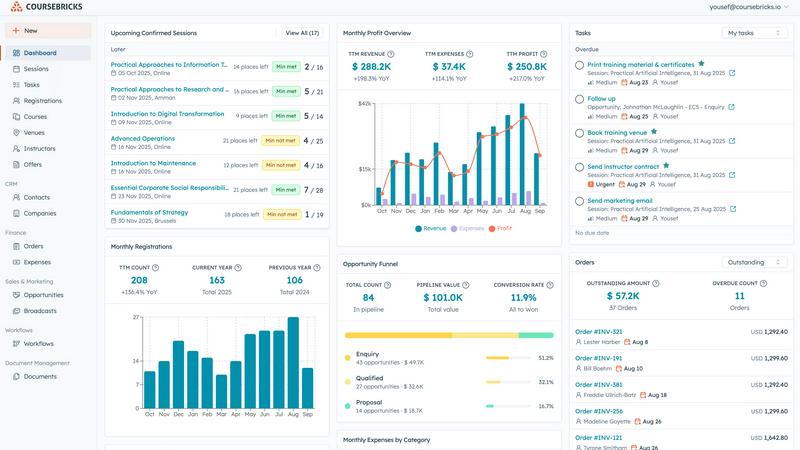
Coursebricks is the all-in-one platform for managing training courses, registrations, payments, and marketing.
Last updated: March 1, 2026

Stable Commerce
Stable Commerce is an AI-first e-commerce engine that autonomously builds and optimizes fully operational online stores.
Last updated: March 4, 2026
Visual Comparison
Coursebricks
Stable Commerce
Feature Comparison
Coursebricks
Unified Course Scheduling
This feature provides a single, centralized calendar and dashboard for managing an entire training schedule. Administrators can assign instructors, book physical or virtual venues, and attach training materials to each course instance from one unified interface. The system intelligently tracks resource availability, helps prevent scheduling conflicts, and ensures all team members are synchronized without the need to juggle multiple spreadsheets or disparate software tools, thereby optimizing resource utilization and operational planning.
Integrated Website & Checkout
Coursebricks allows organizations to seamlessly display and sell their courses through a fully integrated, professional storefront on their own website. This eliminates dependency on third-party marketplaces. The platform provides customizable course pages and a secure checkout process that can accept immediate credit card payments via Stripe or facilitate invoice-based bookings. All customer and order information captured during registration is automatically populated into the built-in CRM, creating a seamless flow from marketing to sales to customer management.
Advanced Email Marketing & Broadcasts
This suite of tools is designed to increase course enrollment and engagement through targeted, data-driven communication. Users can create and send personalized email campaigns and promotions by leveraging advanced filtering based on customer data, past course attendance, or lead status. This capability enables highly segmented broadcasts to the most relevant audience, helping to boost fill rates, generate qualified leads, and drive revenue growth through automated, yet personalized, marketing workflows.
Comprehensive Workflow Automation
Coursebricks automates the entire student journey and key administrative processes to save time and ensure consistency. Users can create custom automation rules to trigger actions such as sending enrollment confirmations, sharing pre-course materials, dispatching payment reminders, distributing post-training surveys, and automatically generating and emailing certificates upon completion. Each automated step is fully tracked, providing complete visibility into communication logs and task completion status.
About Stable Commerce
Prompt-to-Store Generator
This foundational feature allows users to generate a complete, live online store by simply describing their business idea in a natural language prompt. The AI agent interprets the prompt, automatically designs the storefront, configures the necessary backend systems, and applies basic branding and structure, delivering a functional store in under two minutes. This eliminates the traditional hurdles of theme selection, plugin installation, and manual page building, making store launch an instantaneous process rather than a multi-day technical project.
Autonomous Commerce Agent
Acting as the central intelligence of the platform, the Autonomous Agent continuously manages and orchestrates the entire e-commerce operation. It performs the roles of multiple specialists by automatically connecting storefronts, marketplaces, customer relationship management systems, analytics dashboards, and fulfillment logistics into a cohesive workflow. The agent also analyzes real-time data to track sales and customer behavior, and proactively optimizes store performance for better conversion rates and efficiency, all without requiring manual intervention or supervision.
Integrated E-Commerce Stack
Stable Commerce provides a fully integrated, all-in-one platform that consolidates every critical component needed to run an online business. This includes robust inventory management across unlimited locations, seamless order processing, integrated fulfillment APIs, and customer service tools. The platform also comes with enterprise-grade security protocols, SSL certification, and fraud protection built-in, ensuring that data safety and technical reliability are foundational, not add-ons.
Multi-Source Product Import
The platform simplifies product catalog population by offering direct import capabilities from a wide array of sources. Users can effortlessly import products from spreadsheets (Excel, CSV) or directly from major online marketplaces such as eBay, Etsy, and Amazon. This feature streamlines the initial setup and ongoing inventory expansion, allowing merchants to quickly list items without manual data entry, which is especially valuable for dropshipping or multi-channel retailers.
Use Cases
Coursebricks
For Independent Training Providers & Coaching Businesses
Solo entrepreneurs and small training companies utilize Coursebricks to establish a professional, automated business operation without a large administrative team. They leverage the platform to build a branded website, schedule sessions, handle registrations and payments autonomously, and automate client communications and certification. This allows them to focus on content delivery and business growth while the system manages the operational backend efficiently and cost-effectively.
For Corporate Learning & Development Departments
Internal L&D teams within organizations use Coursebricks to manage employee training programs, from mandatory compliance courses to professional development workshops. The system streamlines the enrollment process, manages internal invoicing or chargebacks, assigns instructors, tracks attendance and completion, and automatically issues certificates. The reporting features provide crucial data on training ROI, employee skill development, and program effectiveness to stakeholders.
For Multi-Instructor Training Academies & Institutions
Larger training organizations with multiple instructors and a diverse course catalog benefit from Coursebricks' centralized resource management. The platform allows administrators to coordinate schedules across several instructors, manage bookings for various physical venues or webinar links, and handle a high volume of registrants. Role-based access control ensures instructors only see relevant information, while leadership gains a unified view of all operations, finances, and performance metrics.
For Organizations Scaling Online & Hybrid Learning
Companies transitioning to or expanding their virtual and hybrid training offerings find Coursebricks essential for managing the complexity of blended learning formats. The platform seamlessly handles schedules for both classroom and live webinar sessions within the same system. It automates the distribution of digital materials and Zoom links for online participants, provides a unified registration portal for all course types, and delivers consistent automated communication regardless of delivery method.
Stable Commerce
First-Time Entrepreneur Launch
An individual with a product idea but no technical expertise or capital to hire developers can use Stable Commerce to enter the market rapidly. By inputting a simple prompt about their niche—for example, "an online store selling eco-friendly yoga mats and accessories"—they receive a fully-built, secure, and mobile-ready store. This allows them to bypass the learning curve associated with traditional platforms like Shopify or WooCommerce, where managing plugins and themes is often a barrier to launch.
Scaling an Existing E-commerce Business
Established store owners burdened by high operational costs from multiple plugin subscriptions, developer fees, and a team managing disparate tools can migrate to Stable Commerce for consolidation. The autonomous agent unifies their tech stack, automates optimization tasks, and provides managed analytics, enabling the business to scale its operations without linearly increasing its overhead or technical complexity, potentially saving significant annual costs.
Agencies Managing Multiple Client Stores
Marketing or e-commerce agencies can leverage the Stable Commerce platform, particularly the Pro or Agency tiers, to deploy and manage stores for their clients with unprecedented efficiency. The prompt-based generation and centralized agent management allow for rapid prototyping and consistent, hands-off operation of multiple stores, turning service delivery into a scalable, repeatable process rather than a custom development project for each client.
Merchants Expanding to New Sales Channels
A retailer looking to expand beyond their primary website into additional marketplaces or sales channels can use Stable Commerce's orchestration capabilities. The platform can help manage a unified inventory and order flow across these new storefronts, with the autonomous agent handling the integrations and synchronization, thus reducing the manual effort and risk of error associated with multi-channel management.
Overview
About Coursebricks
Coursebricks is a comprehensive, all-in-one training management software platform engineered to consolidate and streamline the entire lifecycle of organizing, delivering, and scaling professional training programs. It serves as a centralized operational hub, integrating critical functionalities such as course scheduling, student registrations, payment processing, customer relationship management (CRM), email marketing, and detailed reporting. This solution is meticulously designed for training providers, corporate learning and development departments, coaching businesses, and educational institutions that seek to eliminate administrative complexity, reduce operational costs, and enhance both the learner and administrator experience. Its core value proposition lies in granting organizations complete control and ownership over their training business. Unlike marketplace platforms, Coursebricks enables users to publish and sell courses directly through their own branded websites while retaining 100% of their revenue, as the platform does not impose transaction fees. By automating repetitive tasks like confirmations, reminders, and certificate issuance, it significantly reduces manual workload. The platform's flexibility to manage both in-person classroom sessions and live virtual webinars, coupled with powerful integrations and actionable business insights, positions Coursebricks as an indispensable ecosystem for any entity aiming to professionalize and grow its training operations efficiently.
About Stable Commerce
Stable Commerce is an AI-native infrastructure platform engineered to fundamentally transform the operational and financial dynamics of running an online store. It functions as an autonomous e-commerce operations (eComOps) framework, moving beyond traditional store builders by deploying an intelligent AI agent to orchestrate the entire digital commerce stack. The platform's core value proposition is the radical simplification and automation of complex, fragmented processes—from store creation and system integration to ongoing optimization—thereby eliminating the need for multiple plugins, extensive developer resources, and large operational teams. It is designed for a broad spectrum of users, from budding entrepreneurs seeking a frictionless entry into e-commerce to seasoned professionals and agencies aiming to scale operations efficiently without proportional increases in overhead or technical debt. By leveraging a prompt-based interface, Stable Commerce can generate a fully operational, secure, and mobile-responsive online store in under two minutes, integrating essential components like payment gateways, analytics, and fulfillment APIs autonomously. This approach positions Stable Commerce not merely as a tool, but as a comprehensive, AI-first engine that handles the orchestration, analysis, and continuous optimization of e-commerce, allowing business owners to focus solely on strategy, inventory, and customer growth.
Frequently Asked Questions
Coursebricks FAQ
What is a training management system?
A training management system (TMS) is a specialized software platform designed to automate and streamline the administrative, operational, and financial processes involved in running a training business or department. Unlike a Learning Management System (LMS), which focuses primarily on delivering and tracking online learning content, a TMS like Coursebricks handles the broader business operations, including course scheduling, instructor and venue management, registrations, payments, invoicing, CRM, email marketing, and reporting, all within a single integrated system.
Do I need technical knowledge to use Coursebricks?
No, Coursebricks is built to be user-friendly and does not require advanced technical knowledge. The platform features an intuitive interface for managing day-to-day operations. For website integration, it offers simple copy-and-paste embed codes or a dedicated WordPress plugin to sync course data automatically, eliminating the need for manual coding or double data entry. The setup and configuration are designed to be guided and straightforward.
Can I showcase my courses directly on my own website?
Yes, absolutely. A core functionality of Coursebricks is enabling you to publish and sell your courses directly through your existing branded website. You can embed course listings, details, and a secure checkout process seamlessly into your site's pages. This gives you complete control over the customer experience and brand identity, while Coursebricks powers the backend functionality, including the shopping cart, payment gateway, and registration management.
Is my data secure?
Coursebricks employs robust security measures to protect customer data. This includes industry-standard encryption for data in transit and at rest, secure cloud infrastructure, and regular security audits. The platform is designed to be compliant with major data protection regulations. For specific details on data handling, security protocols, and compliance certifications, you should refer to the platform's detailed Privacy Policy, Data Processing Agreement (DPA), and Sub-processors documentation.
Stable Commerce FAQ
How does the "prompt-to-store" feature actually work?
You provide a natural language description of the store you want to create (e.g., "a boutique selling vintage watches"). Stable Commerce's AI agent parses this prompt to understand your niche, then automatically generates a corresponding store structure, selects an appropriate design layout, pre-configures essential pages (Home, Product, About, Contact), and integrates core systems like a shopping cart and basic payment settings. The result is a live, minimally-viable store ready for you to add your specific products and branding details.
What is meant by an "autonomous agent" and what does it do?
The autonomous agent is an AI-powered system that acts as your automated operations manager. Once your store is live, it continuously works in the background to perform tasks that typically require human effort or multiple software tools. This includes connecting third-party services (like email marketing or analytics), monitoring store performance metrics, suggesting and implementing optimizations for better sales, and ensuring all parts of your e-commerce stack work together seamlessly without you needing to manually configure each integration.
Can I use my own custom domain name with Stable Commerce?
Yes, custom domain integration is a feature included in the Basic plan and above. The Free plan provides a stablecommerce subdomain (e.g., yourstore.stablecommerce.com). On paid plans, you can connect your own purchased domain (e.g., www.yourbrand.com) to your store, which is essential for building brand authority and customer trust. The process typically involves updating your domain's DNS settings as guided by the platform.
How does the pricing and "success fee" model work?
Stable Commerce employs a hybrid pricing model. There is a monthly platform access fee (Free, $29, $79) that grants you a set number of stores, prompts, and features. Additionally, there is a "success fee," which is a small percentage charged on your sales revenue. This fee decreases as you move to higher plans (3% on Free, 2% on Basic, 0.5% on Pro). This aligns the platform's incentives with your growth—you pay more only when you sell more.
Alternatives
Coursebricks Alternatives
Coursebricks is a comprehensive training management software solution, categorized within the productivity and management sector. It serves as an all-in-one platform for organizations to handle course scheduling, payments, customer relationship management, and logistical operations. This integrated approach is designed to streamline administrative burdens for training providers and corporate departments. Users may explore alternatives to Coursebricks for various reasons. Common considerations include specific budget constraints and pricing models, the need for different feature sets or integrations, or a requirement for a platform better suited to a particular scale or type of training delivery. The search often stems from a desire to find the optimal balance between functionality, cost, and ease of use for a unique organizational context. When evaluating alternatives, it is crucial to assess core capabilities against your primary needs. Key factors to compare include the depth of scheduling and automation tools, the flexibility of payment processing and checkout integration, the robustness of built-in CRM and marketing features, and the overall scalability of the platform. The goal is to identify a system that not only manages logistics but also actively supports business growth and enhances the learner experience.
Stable Commerce Alternatives
Stable Commerce is an AI-native eCommerce and automation platform designed to simplify the creation and management of online stores. It belongs to the category of modern, AI-driven eCommerce solutions that prioritize rapid setup and automated optimization, aiming to reduce the technical barriers for store owners. Users often explore alternatives to any platform for a variety of reasons. Common motivations include seeking different pricing models or tiers, requiring specific features or integrations not offered, needing a platform that scales differently with business growth, or simply preferring a different user interface and workflow. The diverse needs of online merchants mean no single solution is perfect for everyone. When evaluating an alternative, key considerations should include the total cost of ownership, the depth and flexibility of core eCommerce features, the quality of customer support, and the platform's roadmap for future development. It is also crucial to assess how well a potential alternative aligns with your specific business model, technical skill level, and long-term growth ambitions.