
Deeploy vs iGPT
Side-by-side comparison to help you choose the right product.

Deeploy
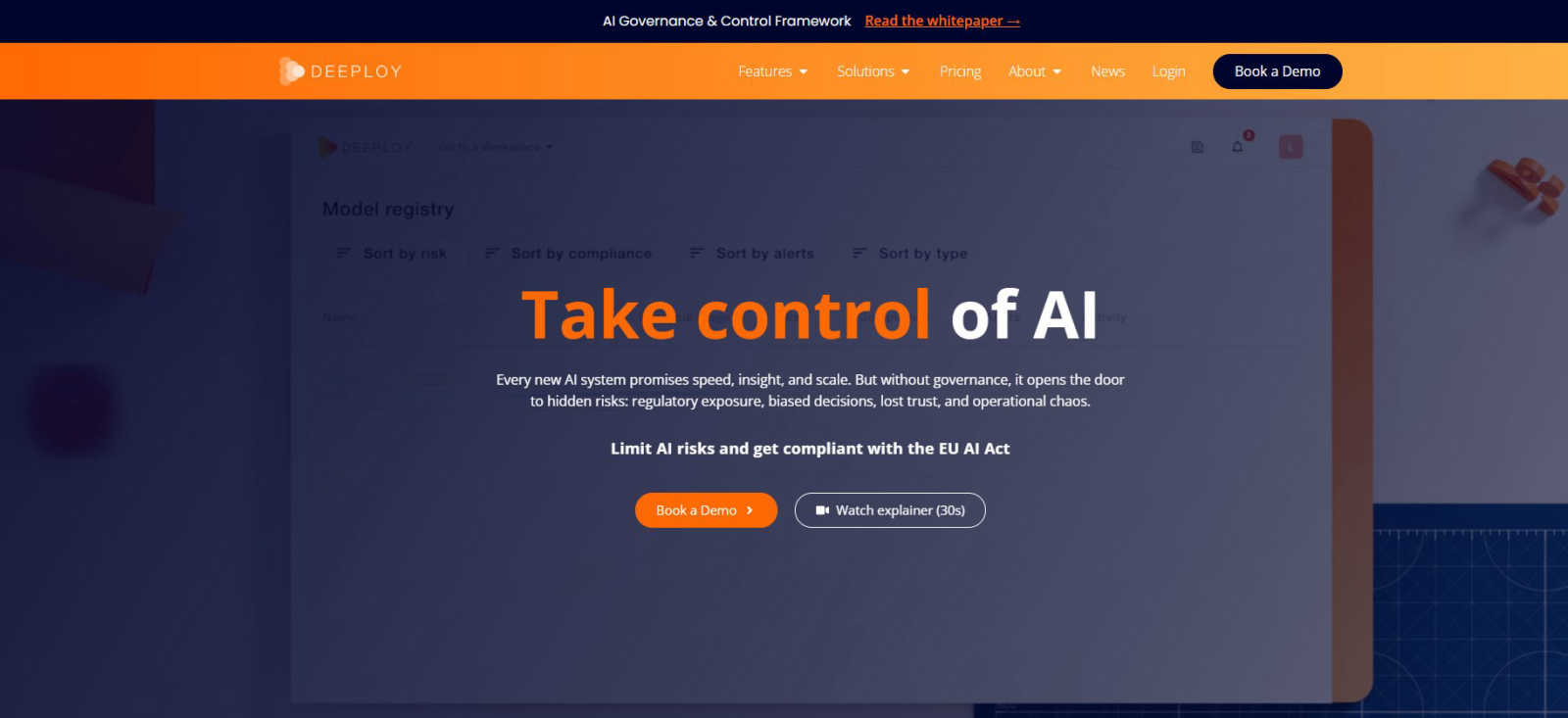
Deeploy provides comprehensive AI governance for compliance, risk management, and real-time oversight.
Last updated: March 1, 2026

iGPT is an enterprise API that transforms email data into context-aware, actionable insights for AI agents and.
Last updated: February 28, 2026
Visual Comparison
Deeploy
iGPT
Feature Comparison
Deeploy
AI Discovery and Onboarding
This feature provides complete visibility across an organization's entire AI ecosystem. It allows teams to discover, document, and onboard every AI system—whether built in-house, sourced from vendors, or embedded in other software—into a centralized registry. By connecting to existing MLOps and GenAI platforms, it eliminates blind spots without requiring costly migrations. This creates a single source of truth for all AI assets, which is the foundational step for effective governance, risk assessment, and compliance reporting.
Control Frameworks
Deeploy simplifies regulatory navigation with pre-built and customizable control frameworks. Organizations can adopt industry-standard frameworks like ISO 42001 or the NIST AI RMF, or build their own tailored policies. The platform guides users through risk classification processes, establishing clear accountability with defined approval workflows. This structured approach demystifies complex regulations, turning abstract requirements into manageable, step-by-step processes that ensure consistent application of governance rules across all AI initiatives.
Control Implementation
This feature translates governance policies into actionable, engineer-friendly requirements. Instead of presenting vague guidelines, Deeploy provides clear technical and procedural controls for each AI system based on its risk profile. It dramatically accelerates compliance—by up to 90% according to the provider—through the use of templates and automated evidence collection. It even employs AI-powered assessments to handle repetitive compliance tasks, ensuring that governance is practically implemented and followed by engineering teams.
Real-Time Monitoring and Explainability
Deeploy offers continuous, production-level monitoring to proactively prevent AI incidents. It tracks model performance, data drift, and output anomalies, sending instant alerts when issues are detected. Crucially, it includes built-in explainability features that help users understand why a model made a specific prediction. For LLMs, it adds tracing and guardrails to protect outputs. This continuous oversight allows teams to identify and rectify errors before they impact end-users or create compliance breaches.
iGPT
Unified Intelligence Endpoint
iGPT consolidates the entire complexity of email intelligence into a single, natural language API call. This unified endpoint seamlessly handles retrieval, context shaping, and reasoning in one integrated pipeline, eliminating the need for developers to manage separate systems for parsing, vector stores, or complex prompt chains. Users simply send a query, and the API returns a structured, contextual answer with citations, dramatically reducing development time and maintenance overhead for building email-aware applications.
Advanced Context Engineering Framework (CEF)
The platform employs a sophisticated Context Engineering Framework that automatically optimizes how information is retrieved and presented to large language models. It performs hybrid retrieval combining semantic, keyword, and filter-based searches, which are then intelligently scored and reranked. The framework also automatically reconstructs full email threads across time and participants, shapes the optimal context window for the LLM, and ensures every piece of information in the response is traceable back to its source email or attachment.
Enterprise-Grade Security & Compliance
iGPT is built with a foundational commitment to data security and privacy. It operates on a zero-data training and zero-data retention policy, ensuring customer data is never used to train models or stored post-processing. It supports OAuth-only authentication with strict Role-Based Access Control (RBAC) and provides comprehensive audit trails. This architecture guarantees that sensitive email communications remain under the company's control, making it suitable for highly regulated industries like finance, legal, and healthcare.
Real-Time Ingestion & Attachment Processing
The system continuously and instantly indexes new email messages and attachments as they arrive, ensuring that the intelligence provided is always based on the most current data. Its powerful attachment processing engine deeply extracts text, data, and structural information from a wide array of file formats, including documents, PDFs, and spreadsheets. This allows iGPT to understand and reason over the complete content of an email thread, not just the body text, unlocking insights buried in complex documents.
Use Cases
Deeploy
Regulatory Compliance and Audit Readiness
Organizations subject to regulations like the EU AI Act use Deeploy to systematically achieve and demonstrate compliance. The platform automates evidence collection, maintains detailed audit trails, and provides documentation for every AI system. This use case is critical for enterprises in heavily regulated industries such as finance, healthcare, and public services, enabling them to scale AI with confidence while having all necessary proof for regulatory audits readily available.
Centralized AI Inventory and Risk Management
Companies with scattered AI deployments across multiple teams and vendors utilize Deeploy to create a unified inventory. This central registry allows leadership and risk officers to gain a holistic view of their AI exposure, classify systems by risk level, and apply appropriate governance controls consistently. It transforms AI from an unmanaged collection of tools into a strategically overseen portfolio, enabling informed decision-making and proactive risk mitigation.
Accelerating Safe Model Deployment
Data science and MLOps teams employ Deeploy to streamline the path from development to production. By integrating governance checks and monitoring capabilities directly into the deployment pipeline, the platform reduces deployment time from weeks to hours while ensuring new models meet all organizational standards. The built-in explainability features also facilitate smoother handovers and provide transparency for both technical and non-technical stakeholders.
Ensuring Ethical AI and Human Oversight
In sensitive applications like mental healthcare or customer-facing services, Deeploy facilitates responsible AI implementation. It enforces ethical guidelines through customizable control frameworks and enables essential human-in-the-loop processes. The real-time explainability and feedback mechanisms allow human experts to review, understand, and correct AI decisions, building trust and ensuring systems operate within defined ethical boundaries.
iGPT
Intelligent Email Assistants & Copilots
Developers can build sophisticated AI agents that draft, prioritize, summarize, and act on email with full historical and contextual understanding. These assistants can manage inboxes, flag urgent items, suggest replies based on past correspondence, and automate routine communication tasks, significantly boosting productivity for individuals and teams who rely heavily on email for daily operations.
Automated Workflow & Project Management
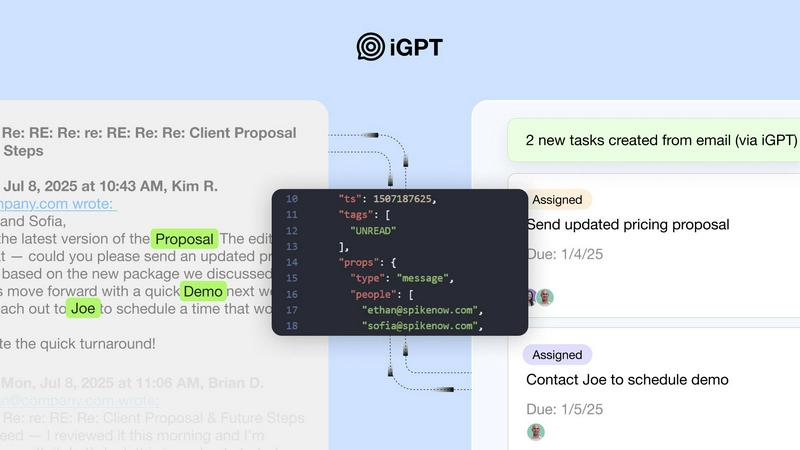
iGPT can automatically transform email threads into structured tasks, deadlines, approvals, and calendar events. By analyzing conversation threads and attachments, it can identify action items, assign owners, track project momentum, and flag stalled discussions or missed deadlines, seamlessly bridging communication data with project management tools and CRMs.
Customer Support & Relationship Management
Support copilots powered by iGPT can rebuild the complete customer story by analyzing long, complex email chains, tone shifts, and all related attachments. This provides support agents with immediate, full-context understanding of a customer's issue history. For sales teams, CRM agents can extract deal decisions, ownership changes, and key discussion points directly from email threads to keep CRM records accurate and actionable.
Compliance Auditing & Legal Discovery
In regulated environments, iGPT serves as a powerful tool for compliance and legal e-discovery. It can trace feedback, approvals, contractual terms, and decision-making rationale directly back to the original email conversations and attached documents. This creates a verifiable and searchable audit trail, simplifying compliance reporting, internal audits, and legal discovery processes.
Overview
About Deeploy
Deeploy is a comprehensive AI governance and operational platform designed to provide organizations with the critical infrastructure needed to manage, monitor, and scale artificial intelligence systems responsibly. In an era of rapid AI proliferation, organizations often struggle with fragmented AI tools, models, and vendors, leading to significant operational, compliance, and reputational risks. Deeploy directly addresses this challenge by centralizing oversight of an entire AI landscape into a single, unified system. Its core value proposition is enabling businesses to harness the transformative power of AI while maintaining complete control, ensuring accountability, and adhering to evolving regulatory standards like the EU AI Act. The platform is built for enterprises running AI at scale, including data science teams, ML engineers, compliance officers, and risk management executives. By integrating governance directly into the AI lifecycle, Deeploy transforms governance from a bureaucratic hurdle into an enabling framework that accelerates safe deployment, provides real-time explainability, and builds essential trust in AI operations across all teams and use cases.
About iGPT
iGPT is an advanced email intelligence API engineered specifically for enterprises and agentic workflows, fundamentally transforming how organizations access and utilize their email communications. It addresses a critical gap in the AI landscape, where email—the primary medium for real business work—often remains a siloed and unstructured data source that breaks conventional AI tools. By leveraging state-of-the-art AI capabilities, iGPT provides a secure and efficient gateway to distill meaningful, context-aware insights from vast amounts of complex email data, including lengthy conversations and embedded attachments like PDFs, documents, and spreadsheets. Its core value proposition is a unified, single API call that replaces the entire complex pipeline of parsing, chunking, indexing, and prompt tuning required by traditional RAG (Retrieval-Augmented Generation) systems. This makes it an indispensable tool for developers building intelligent agents and for industries where compliance, data integrity, and operational efficiency are paramount. With features like real-time ingestion, hybrid retrieval, and full citation of sources, iGPT enables enhanced decision-making, sophisticated workflow automation, and robust audit trails, all while maintaining enterprise-grade security with zero data training and retention policies.
Frequently Asked Questions
Deeploy FAQ
What is AI governance and why is it important?
AI governance refers to the framework of policies, processes, and tools used to ensure AI systems are developed and deployed responsibly, ethically, and in compliance with regulations. It is critically important because ungoverned AI can lead to significant risks including biased outcomes, security vulnerabilities, regulatory fines, and loss of public trust. Deeploy provides the infrastructure to operationalize governance, turning high-level principles into enforceable, day-to-day practices that mitigate risk while enabling innovation.
How does Deeploy handle different types of AI models?
Deeploy is designed as a platform-agnostic solution capable of governing diverse AI systems. It can connect to and manage traditional machine learning models from MLOps platforms, generative AI models from various vendors, and AI embedded within third-party software. The system applies relevant controls and monitoring based on each model's specific risk classification and use case, providing a consistent governance layer across an organization's entire heterogeneous AI landscape.
Can Deeploy help with compliance with the EU AI Act?
Yes, Deeploy is explicitly built to help organizations comply with the EU AI Act and other global regulations. It provides workflows to classify AI systems according to the Act's risk categories (unacceptable, high, limited, minimal), implements corresponding required controls for high-risk systems, and automates the documentation and evidence collection needed to demonstrate compliance. The control frameworks can be tailored to map directly to the Act's specific requirements.
How does the real-time monitoring feature work?
Deeploy's real-time monitoring continuously tracks key performance indicators of deployed AI models. It monitors for concept drift, data drift, performance degradation, and output anomalies. When a metric deviates beyond a predefined threshold, the system triggers instant alerts to relevant teams. For generative AI, it includes tracing to log the chain of reasoning and can apply guardrails to filter or flag inappropriate outputs, allowing issues to be addressed proactively before affecting users.
iGPT FAQ
How does iGPT handle data privacy and security?
iGPT is architected with enterprise-grade security as a core principle. It operates on a strict zero-data training and zero-data retention model, meaning your data is never used to train AI models, improve services, or stored after processing. All inferences are handled in memory. Access is controlled via OAuth and Role-Based Access Control (RBAC), and every API request generates a full audit trail, ensuring data sovereignty and compliance with stringent regulatory standards.
What makes iGPT different from building my own RAG system for emails?
Building a custom RAG system for emails requires significant engineering effort: parsing complex MIME data, chunking text, managing vector databases, tuning retrieval algorithms, reconstructing threads, and continuously optimizing prompts. iGPT abstracts all this complexity into a single API call. It handles real-time ingestion, hybrid retrieval, context optimization, and citation automatically, allowing developers to focus on building their application logic rather than maintaining a fragile data pipeline.
What types of email sources and attachments does iGPT support?
iGPT can connect to and deeply index data from major enterprise email providers and protocols. Its advanced attachment processing engine supports a wide range of file formats, including but not limited to PDFs, Microsoft Office documents (Word, Excel, PowerPoint), plain text files, and spreadsheets. It extracts not just raw text but also understands data structure and context within these files in relation to the email thread.
Can I control the quality and speed of the responses?
Yes, iGPT offers configurable quality tiers through its Context Engineering Framework (CEF). Users can select different CEF levels (e.g., cef-1-normal) in their API request to balance response latency, cost, and depth of analysis. This allows for optimization based on the use case, whether it requires sub-second retrieval for simple queries or deeper, more comprehensive reasoning for complex analytical tasks.
Alternatives
Deeploy Alternatives
Deeploy is a specialized AI governance platform within the business intelligence and enterprise software category. It provides organizations with the tools to oversee, monitor, and ensure compliance for their AI systems, addressing critical needs around risk management and regulatory adherence like the EU AI Act. Users may explore alternatives to Deeploy for various reasons. Common considerations include specific budgetary constraints, the need for different feature integrations, or a requirement for a platform that aligns with a particular technical stack or existing workflow. The search often stems from a need to find the optimal balance between comprehensive governance capabilities and operational fit. When evaluating alternatives, key factors to assess include the depth of AI model lifecycle coverage, the flexibility of compliance frameworks offered, the strength of audit and explainability features, and the overall ease of integration with an organization's current MLOps and data science ecosystems. The goal is to identify a solution that provides robust oversight without creating unnecessary complexity.
iGPT Alternatives
iGPT is an advanced email intelligence API that falls within the Business Intelligence category. It transforms organizational email data into context-aware, actionable insights through a secure gateway, enhancing decision-making and workflow automation for enterprises. Users may explore alternatives for various reasons, including specific budget constraints, the need for different feature sets like enhanced analytics or broader data source integration, or platform compatibility requirements such as a preference for on-premise deployment over a cloud API. The search for a different solution often stems from unique organizational needs not fully addressed by a single provider. When evaluating alternatives, key considerations should include the depth of AI and natural language processing capabilities, the robustness of security and compliance frameworks, the ease and flexibility of integration, and the overall scalability of the solution to handle an enterprise's email volume and complexity.