
Fusedash vs iGPT
Side-by-side comparison to help you choose the right product.

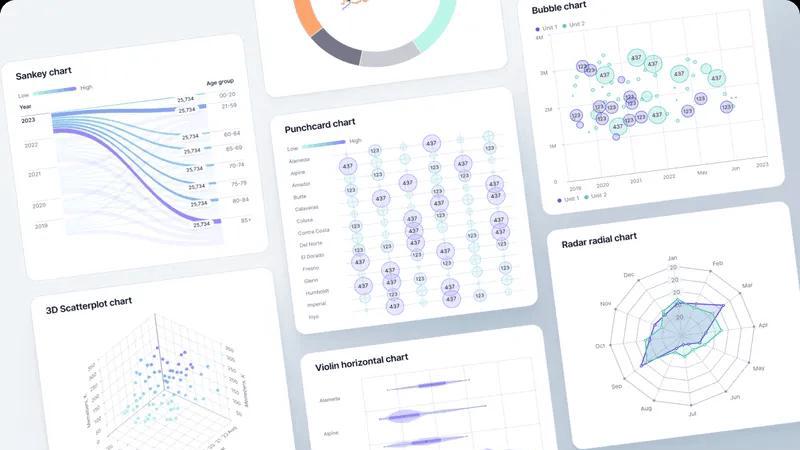
Fusedash transforms raw data into intuitive dashboards and interactive visuals for quick, informed decision-making.
Last updated: March 4, 2026

iGPT is an enterprise API that transforms email data into context-aware, actionable insights for AI agents and.
Last updated: February 28, 2026
Visual Comparison
Fusedash
iGPT
Feature Comparison
Fusedash
Flexible Views
Fusedash offers the ability to create various dashboard views tailored to different audiences. Stakeholders can access the insights that matter most without the need for extensive back-and-forth communication. Customization options like layouts, filters, and time ranges ensure that each team receives relevant data in their preferred format.
AI Chart Generator
The AI Chart Generator enables users to create compelling charts from CSV files or APIs in mere minutes. This feature simplifies the process of selecting the appropriate chart type, applying comparisons, and refining labels to effectively communicate the data story, making it easy to integrate these visuals into dashboards or use them independently for reporting.
Dashboard Software
Fusedash combines the functionality of dashboards and reporting into a single workspace. This integration allows teams to monitor KPIs while also providing the necessary context through narrative reporting. By incorporating storytelling elements, users can clarify what changed, the implications of those changes, and future actions, reducing the risk of conflicting reports.
AI Chat
The Smart Chat feature offers users the ability to ask questions in plain language, facilitating quicker navigation through the data. By providing suggested metrics, charts, and breakdowns, Smart Chat allows users to transform insights into shareable dashboard views, making data exploration more intuitive and efficient.
About iGPT
Unified Intelligence Endpoint
iGPT consolidates the entire complexity of email intelligence into a single, natural language API call. This unified endpoint seamlessly handles retrieval, context shaping, and reasoning in one integrated pipeline, eliminating the need for developers to manage separate systems for parsing, vector stores, or complex prompt chains. Users simply send a query, and the API returns a structured, contextual answer with citations, dramatically reducing development time and maintenance overhead for building email-aware applications.
Advanced Context Engineering Framework (CEF)
The platform employs a sophisticated Context Engineering Framework that automatically optimizes how information is retrieved and presented to large language models. It performs hybrid retrieval combining semantic, keyword, and filter-based searches, which are then intelligently scored and reranked. The framework also automatically reconstructs full email threads across time and participants, shapes the optimal context window for the LLM, and ensures every piece of information in the response is traceable back to its source email or attachment.
Enterprise-Grade Security & Compliance
iGPT is built with a foundational commitment to data security and privacy. It operates on a zero-data training and zero-data retention policy, ensuring customer data is never used to train models or stored post-processing. It supports OAuth-only authentication with strict Role-Based Access Control (RBAC) and provides comprehensive audit trails. This architecture guarantees that sensitive email communications remain under the company's control, making it suitable for highly regulated industries like finance, legal, and healthcare.
Real-Time Ingestion & Attachment Processing
The system continuously and instantly indexes new email messages and attachments as they arrive, ensuring that the intelligence provided is always based on the most current data. Its powerful attachment processing engine deeply extracts text, data, and structural information from a wide array of file formats, including documents, PDFs, and spreadsheets. This allows iGPT to understand and reason over the complete content of an email thread, not just the body text, unlocking insights buried in complex documents.
Use Cases
Fusedash
Marketing Performance Monitoring
Fusedash is invaluable for marketing teams looking to track campaign performance in real-time. By utilizing customizable dashboards, marketers can visualize key metrics, understand audience engagement, and promptly adjust strategies based on actionable insights.
Sales Analytics
Sales teams can leverage Fusedash to monitor sales performance, identify trends, and pinpoint areas for improvement. With interactive charts and real-time data, sales professionals can make informed decisions that enhance revenue generation and customer satisfaction.
Operational Efficiency Tracking
Operations teams can utilize Fusedash to analyze workflow efficiency and resource allocation. By creating detailed maps and dashboards, they can visualize operational bottlenecks and implement changes that improve productivity and reduce costs.
Financial Reporting
Finance departments can benefit from Fusedash by consolidating financial data into comprehensive reports. The ability to create consistent KPIs and metrics ensures that all stakeholders are aligned on financial performance, enabling more strategic decision-making.
iGPT
Intelligent Email Assistants & Copilots
Developers can build sophisticated AI agents that draft, prioritize, summarize, and act on email with full historical and contextual understanding. These assistants can manage inboxes, flag urgent items, suggest replies based on past correspondence, and automate routine communication tasks, significantly boosting productivity for individuals and teams who rely heavily on email for daily operations.
Automated Workflow & Project Management
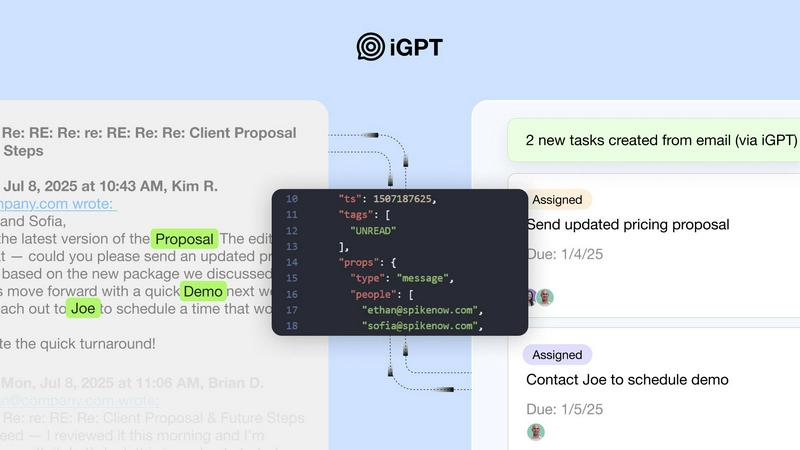
iGPT can automatically transform email threads into structured tasks, deadlines, approvals, and calendar events. By analyzing conversation threads and attachments, it can identify action items, assign owners, track project momentum, and flag stalled discussions or missed deadlines, seamlessly bridging communication data with project management tools and CRMs.
Customer Support & Relationship Management
Support copilots powered by iGPT can rebuild the complete customer story by analyzing long, complex email chains, tone shifts, and all related attachments. This provides support agents with immediate, full-context understanding of a customer's issue history. For sales teams, CRM agents can extract deal decisions, ownership changes, and key discussion points directly from email threads to keep CRM records accurate and actionable.
Compliance Auditing & Legal Discovery
In regulated environments, iGPT serves as a powerful tool for compliance and legal e-discovery. It can trace feedback, approvals, contractual terms, and decision-making rationale directly back to the original email conversations and attached documents. This creates a verifiable and searchable audit trail, simplifying compliance reporting, internal audits, and legal discovery processes.
Overview
About Fusedash
Fusedash is an advanced AI-powered data visualization platform that streamlines the process of transforming connected data into actionable insights. Designed for teams across various sectors, it serves as a unified workspace where users can create decision-ready dashboards, interactive charts, detailed maps, and narrative reports without the hassle of duplicating efforts across multiple tools. The core value proposition of Fusedash lies in its commitment to consistency and efficiency; users can define key metrics and KPIs once, ensuring that every view and report reflects the same trusted numbers. This feature is particularly advantageous for organizations seeking to eliminate manual reporting cycles and conflicting data narratives. Fusedash empowers users to monitor real-time data while also enabling them to drill down into specific segments, regions, or time periods to understand the underlying reasons behind data trends. With integrated AI functionalities like natural language data chat and smart visualization assistance, Fusedash simplifies data exploration and reporting, turning raw data into a shared source of truth that fosters alignment and drives decisive action.
About iGPT
iGPT is an advanced email intelligence API engineered specifically for enterprises and agentic workflows, fundamentally transforming how organizations access and utilize their email communications. It addresses a critical gap in the AI landscape, where email—the primary medium for real business work—often remains a siloed and unstructured data source that breaks conventional AI tools. By leveraging state-of-the-art AI capabilities, iGPT provides a secure and efficient gateway to distill meaningful, context-aware insights from vast amounts of complex email data, including lengthy conversations and embedded attachments like PDFs, documents, and spreadsheets. Its core value proposition is a unified, single API call that replaces the entire complex pipeline of parsing, chunking, indexing, and prompt tuning required by traditional RAG (Retrieval-Augmented Generation) systems. This makes it an indispensable tool for developers building intelligent agents and for industries where compliance, data integrity, and operational efficiency are paramount. With features like real-time ingestion, hybrid retrieval, and full citation of sources, iGPT enables enhanced decision-making, sophisticated workflow automation, and robust audit trails, all while maintaining enterprise-grade security with zero data training and retention policies.
Frequently Asked Questions
Fusedash FAQ
What types of data can Fusedash integrate?
Fusedash can integrate a wide range of data sources, including CSV files, APIs, and public datasets. This flexibility allows users to combine various data types into a single cohesive platform for analysis and reporting.
How does Fusedash ensure data consistency?
Fusedash allows users to define key metrics and KPIs once, which can then be reused across all dashboards and reports. This ensures that everyone in the organization is referencing the same trusted numbers, promoting transparency and alignment.
Is Fusedash suitable for non-technical users?
Yes, Fusedash is designed to be user-friendly, with features like the AI Chart Generator and Smart Chat that simplify data visualization and exploration. This makes it accessible for users without extensive technical expertise.
Can I customize the dashboards in Fusedash?
Absolutely. Fusedash offers extensive customization options for dashboards, including layouts, filters, and time ranges, allowing users to tailor their views to meet the specific needs of different teams and stakeholders.
iGPT FAQ
How does iGPT handle data privacy and security?
iGPT is architected with enterprise-grade security as a core principle. It operates on a strict zero-data training and zero-data retention model, meaning your data is never used to train AI models, improve services, or stored after processing. All inferences are handled in memory. Access is controlled via OAuth and Role-Based Access Control (RBAC), and every API request generates a full audit trail, ensuring data sovereignty and compliance with stringent regulatory standards.
What makes iGPT different from building my own RAG system for emails?
Building a custom RAG system for emails requires significant engineering effort: parsing complex MIME data, chunking text, managing vector databases, tuning retrieval algorithms, reconstructing threads, and continuously optimizing prompts. iGPT abstracts all this complexity into a single API call. It handles real-time ingestion, hybrid retrieval, context optimization, and citation automatically, allowing developers to focus on building their application logic rather than maintaining a fragile data pipeline.
What types of email sources and attachments does iGPT support?
iGPT can connect to and deeply index data from major enterprise email providers and protocols. Its advanced attachment processing engine supports a wide range of file formats, including but not limited to PDFs, Microsoft Office documents (Word, Excel, PowerPoint), plain text files, and spreadsheets. It extracts not just raw text but also understands data structure and context within these files in relation to the email thread.
Can I control the quality and speed of the responses?
Yes, iGPT offers configurable quality tiers through its Context Engineering Framework (CEF). Users can select different CEF levels (e.g., cef-1-normal) in their API request to balance response latency, cost, and depth of analysis. This allows for optimization based on the use case, whether it requires sub-second retrieval for simple queries or deeper, more comprehensive reasoning for complex analytical tasks.
Alternatives
Fusedash Alternatives
Fusedash is an AI-powered data visualization platform that belongs to the analytics and business intelligence category. It enables teams to convert raw data into clear dashboards and charts, promoting immediate action on insights. Users often seek alternatives to Fusedash due to various reasons, including pricing concerns, specific feature requirements, or the need for compatibility with existing platforms. Additionally, organizations may look for tools that better fit their unique workflows or user experience preferences. When choosing an alternative to Fusedash, it is essential to consider several factors. Look for platforms that offer similar capabilities in data visualization and dashboard creation, ensuring they can effectively transform raw data into actionable insights. Evaluate the user interface for ease of use, the flexibility of features, and the platform's ability to integrate with other tools your team already utilizes.
iGPT Alternatives
iGPT is an advanced email intelligence API that falls within the Business Intelligence category. It transforms organizational email data into context-aware, actionable insights through a secure gateway, enhancing decision-making and workflow automation for enterprises. Users may explore alternatives for various reasons, including specific budget constraints, the need for different feature sets like enhanced analytics or broader data source integration, or platform compatibility requirements such as a preference for on-premise deployment over a cloud API. The search for a different solution often stems from unique organizational needs not fully addressed by a single provider. When evaluating alternatives, key considerations should include the depth of AI and natural language processing capabilities, the robustness of security and compliance frameworks, the ease and flexibility of integration, and the overall scalability of the solution to handle an enterprise's email volume and complexity.