
Nani vs Prompt Builder
Side-by-side comparison to help you choose the right product.

Nani streamlines AI image generation by organizing prompts and images into reusable sets for effortless creativity.
Last updated: February 26, 2026

Prompt Builder
Prompt Builder is a unified platform to generate, optimize, test, and manage AI prompts for models like ChatGPT and Gemini.
Last updated: April 13, 2026
Visual Comparison
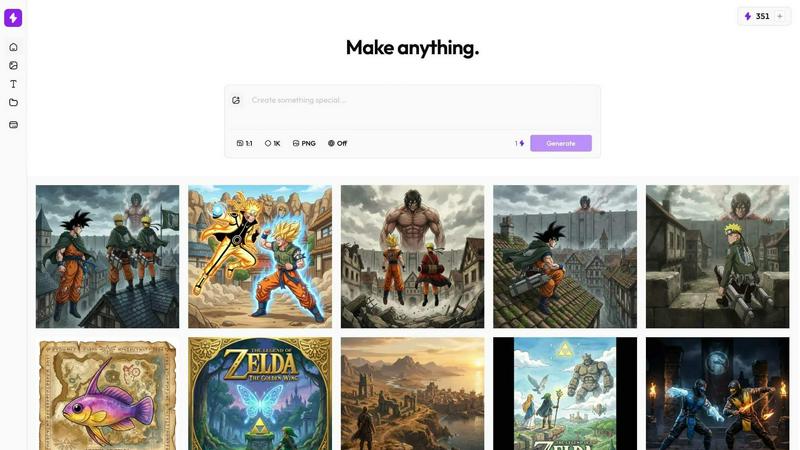
Nani
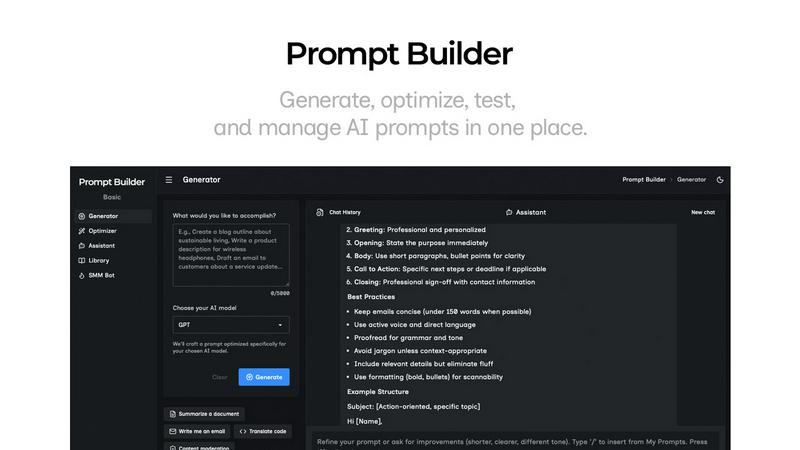
Prompt Builder
Feature Comparison
Nani
User-Friendly Interface
Nani boasts a simple and intuitive interface designed to facilitate a seamless creative experience. Users can jump straight into image generation without facing a steep learning curve, allowing them to create stunning visuals in mere seconds by simply typing a prompt and hitting generate.
Reusable Prompt Sets
One of Nani's standout features is its ability to group images and save prompts as reusable sets. This functionality enables users to maintain consistent characters and styles across multiple generations, streamlining workflows and enhancing productivity for ongoing projects.
Organized Library Management
Nani allows users to create folders, filter favorites, and bulk-select images, empowering them to keep their libraries organized. This level of organization is crucial for users with large volumes of images, ensuring that they can quickly find and access their creative assets as their projects scale.
Seamless Workflow Integration
The tool supports a seamless workflow by enabling users to drag and drop images as references. Additionally, users can share their creations through public links, allowing others to easily recreate their work in their own accounts, thus fostering collaboration and sharing within creative communities.
About Prompt Builder
Prompt Generator
The Prompt Generator is the foundational feature that transforms a simple idea into a robust, model-specific prompt. Users describe their intended task in natural language and select their target AI model (e.g., GPT-4, Claude 3, Gemini Pro). The system then crafts a detailed prompt draft tailored to the selected model's nuances and optimal prompting structures. This includes appropriate formatting, context setting, and constraint phrasing, providing a solid, professional-grade starting point that can be further refined in the integrated chat workspace, significantly reducing initial setup time.
Prompt Assistant & Chat Workspace
This integrated feature allows for seamless testing and iteration of prompts without ever leaving the Prompt Builder environment. The Prompt Assistant provides a chat-first interface where users can run their generated or optimized prompts. It includes a model selector to test outputs across different assistants like Grok, Gemini, or DeepSeek. Users can engage in follow-up conversations, make adjustments, and see results in real-time. All chat histories are preserved, enabling fast iterations and preventing the loss of successful prompt versions across disparate tools.
Prompt Optimizer
The Optimizer tool is designed to enhance existing prompts. Users can paste any prompt—whether from an external source or selected from their personal Library—and the Optimizer will analyze and rewrite it for improved clarity, specificity, and effectiveness. It provides structured improvements across key dimensions such as instruction clarity, added constraints, defined output formats, and inclusion of examples. Each optimization is saved in a history log, and optimized prompts can be instantly sent to the Prompt Assistant for testing with a single click.
Prompt Library & Community Templates
This feature offers a dual-purpose repository for prompt management and discovery. The "My Prompts" section allows users to save, pin, organize, and tag their best prompt versions for easy reuse across projects and teams. Simultaneously, the "Community Prompts" section provides a curated library of reusable prompts and templates shared by other users, searchable and filterable by category and model. This fosters knowledge sharing and provides immediate, proven starting points for common tasks, from creative writing to data analysis.
Use Cases
Nani
Graphic Design Projects
Graphic designers can utilize Nani to quickly generate images needed for branding, advertising, or social media campaigns. The ability to save prompt sets means they can maintain a consistent visual identity across all materials with minimal effort.
Illustration for Books and Comics
Illustrators working on books or comics can benefit from Nani’s reusable prompt sets, allowing them to create character designs and settings consistently throughout their narratives. This efficiency helps in meeting tight deadlines while ensuring artistic coherence.
Marketing and Advertising
Content creators in marketing and advertising can leverage Nani to produce eye-catching visuals that align with their campaign themes. The tool’s quick image generation capabilities support rapid iterations, enabling teams to respond to market trends effectively.
Educational Content Creation
Educators and instructional designers can use Nani to generate visuals for educational materials. By utilizing organized folders and prompt sets, they can easily curate resources for different subjects, making the teaching materials visually engaging and easier to navigate.
Prompt Builder
Content Creation and Marketing
Marketing professionals and content creators can use Prompt Builder to rapidly generate and refine copy for blogs, social media posts, ad copy, and email campaigns. The SMM Bot feature specifically streamlines creating platform-ready content for X, LinkedIn, and Instagram by generating tailored posts with appropriate tones, hashtags, and calls-to-action. This ensures brand-consistent, engaging content is produced efficiently for multiple channels from a single brief.
Technical Development and Coding
Developers and engineers can leverage the platform to create precise prompts for code generation, debugging, documentation, and system design explanations. By generating prompts tuned for models like Claude or GPT-4, which are strong in reasoning, they can get more accurate, syntactically correct code snippets and detailed technical explanations, saving hours of manual coding and research time.
Research and Data Analysis
Academics, analysts, and students can utilize Prompt Builder to craft detailed prompts for summarizing complex research papers, extracting insights from datasets, generating literature reviews, or formulating hypotheses. The ability to optimize prompts for clarity and structure ensures the AI provides comprehensive, well-formatted, and relevant outputs, making the research process more systematic and productive.
Business Process Automation
Business professionals and operations teams can build a library of standardized prompts to automate routine tasks such as drafting reports, generating meeting agendas and minutes, creating standard operating procedures, or formatting data. This ensures consistency in output quality, reduces repetitive work, and allows team members to reuse and share effective prompt templates, scaling best practices across the organization.
Overview
About Nani
Nani is a groundbreaking workflow tool specifically crafted to enhance the experience of AI image generation, catering primarily to artists, designers, and content creators who engage in regular and repetitive image creation tasks. Unlike traditional AI image tools that are tailored for sporadic, one-off creations, Nani offers a streamlined solution that minimizes the hassle of rewriting prompts and navigating through disorganized image feeds. Powered by Google's advanced Nano Banana Pro (Gemini), Nani provides a robust platform where creativity is prioritized over administrative burdens. Its user-friendly interface encourages quick image generation, while innovative features such as reusable prompt sets and organized folder systems ensure that users can maintain consistency and efficiency in their creative workflows. With Nani, users can focus on bringing their ideas to life without getting bogged down by the intricacies of the image generation process.
About Prompt Builder
Prompt Builder is a sophisticated, all-in-one prompt engineering workspace designed to streamline the entire lifecycle of creating and deploying effective AI prompts. It serves as a centralized platform for writing, testing, optimizing, and managing prompts across a vast array of leading large language models (LLMs). The core value proposition lies in eliminating the inefficiencies of manual prompt crafting. Instead of spending hours rewriting and adapting instructions for different AI systems, users describe their task in plain English, select a target model, and Prompt Builder generates a professionally structured, model-optimized draft in seconds. This draft can then be interactively refined within a built-in chat interface, saved into a personal or community library, and executed directly within the platform. It is an indispensable tool for AI practitioners, content creators, developers, marketers, and any professional seeking to maximize the quality, consistency, and reusability of their AI interactions without being locked into a single model's ecosystem.
Frequently Asked Questions
Nani FAQ
What is Nani and how does it work?
Nani is an AI image generation workflow tool that simplifies the process of creating images. Users input prompts to generate visuals quickly, and features like reusable prompt sets help streamline the workflow and maintain consistency.
Can I use Nani for free?
Yes, Nani offers 5 free credits for new users to get started. No credit card is required to begin utilizing the platform, allowing users to explore its capabilities without financial commitment.
How does the billing work for Nani?
Nani operates on a credit-based billing system, allowing users to pay only for the images they generate. The cost is approximately 30 cents per generation for images at 1K or 2K resolution, ensuring transparency and flexibility.
Are there any limitations to the free credits?
While users can start creating with 5 free credits, additional credits may be required for ongoing projects. However, Nani’s credits never expire, and users have the option to purchase more credits as needed without any subscription commitments.
Prompt Builder FAQ
What AI models does Prompt Builder support?
Prompt Builder supports a wide and growing range of leading large language models. This includes OpenAI's GPT series, Anthropic's Claude, Google's Gemini, Meta's Llama, Mistral AI's models, DeepSeek, xAI's Grok, Perplexity, and Cohere. The platform is designed to be model-agnostic, allowing you to generate prompts tailored for each specific model's strengths and expected input formats.
How does the free plan work?
The free plan offers users a generous starting point to explore the platform's core capabilities. It includes 25 assistant requests per month, allowing you to test and run prompts within the built-in Prompt Assistant using various models. This plan provides access to the Prompt Generator, Optimizer, and Library features, requiring no credit card to sign up, so you can evaluate the tool's effectiveness for your workflow at no cost.
Can I use prompts created in Prompt Builder outside of the platform?
Absolutely. Prompts created, optimized, and saved within your Prompt Builder Library are yours to use. You can easily copy any prompt and paste it directly into the native interface of your chosen AI model, such as the ChatGPT website, Claude.ai, or Google Gemini. The platform is designed to enhance prompt creation for use anywhere, while also providing the convenience of an integrated testing environment.
How does the Prompt Optimizer improve my existing prompts?
The Prompt Optimizer acts as an AI-powered editor for your prompts. It analyzes the provided text and applies structured enhancements focused on key areas: improving overall clarity and instruction specificity, adding necessary constraints to narrow the output, defining a clear format for the response (e.g., JSON, markdown, bullet points), and suggesting or incorporating examples to guide the model. This process transforms vague or generic prompts into precise, high-yield instructions.
Alternatives
Nani Alternatives
Nani is a workflow tool designed to simplify the process of AI image generation, placing it within the broader category of AI assistants. By organizing prompts and images into reusable sets, Nani caters specifically to artists, designers, and content creators who engage in repetitive tasks, allowing them to focus more on creativity rather than administrative burdens. Users often seek alternatives to Nani due to various factors such as pricing, feature sets, and compatibility with their specific platform needs. Finding the right alternative requires careful consideration of features that enhance efficiency, usability, and the overall creative process. When evaluating alternatives, it is essential to prioritize tools that provide intuitive interfaces, robust features for image and prompt management, and seamless integration with existing workflows. Look for options that offer flexibility in customizing prompts and image sets, as well as those that allow for easy iteration and refinement of past work. Ultimately, the best alternative should align with your unique creative needs and enhance your productivity in AI image generation.
Prompt Builder Alternatives
Prompt Builder is a comprehensive AI prompt engineering workspace designed to streamline the process of creating, optimizing, and managing prompts for large language models. It falls into the category of AI assistants and productivity tools, specifically built for developers, content creators, and professionals who regularly interact with models like GPT, Claude, and Gemini. The platform allows users to transform a simple idea into a refined, executable prompt through an intuitive drafting, testing, and versioning system. Users may seek alternatives to Prompt Builder for various reasons, including budget constraints, specific feature requirements not covered by the platform, or a need for deeper integration within a particular ecosystem or workflow. Some may prioritize open-source solutions, while others might look for a tool with a different user interface or collaboration capabilities. The search often stems from a desire to find the optimal balance of cost, functionality, and ease of use for their unique projects. When evaluating alternatives, key considerations should include the range of supported AI models, the sophistication of prompt testing and optimization tools, and the ability to organize and reuse prompt libraries. Security and data privacy policies are critical for handling sensitive prompts, while collaboration features can be vital for team use. Ultimately, the best choice depends on aligning the tool's core strengths with the user's primary objective: efficiently producing high-quality, reliable outputs from AI models.