
Polym vs SchoolGPT
Side-by-side comparison to help you choose the right product.

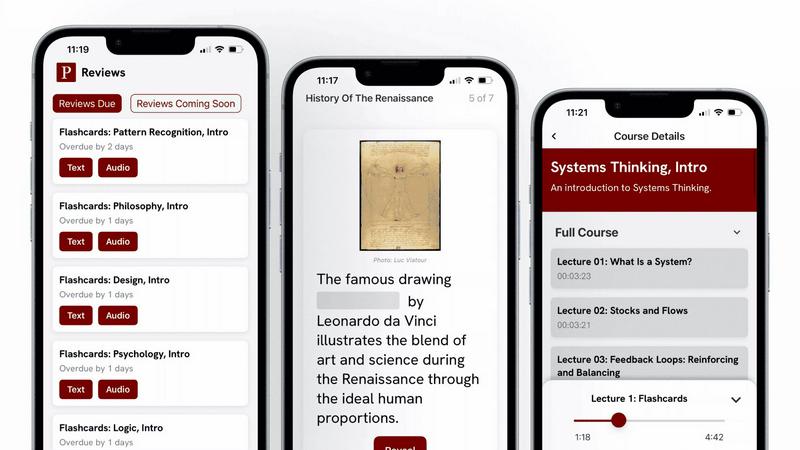
Polym is an audio app that uses active learning techniques to enhance long-term knowledge retention and recall.
Last updated: March 1, 2026

SchoolGPT
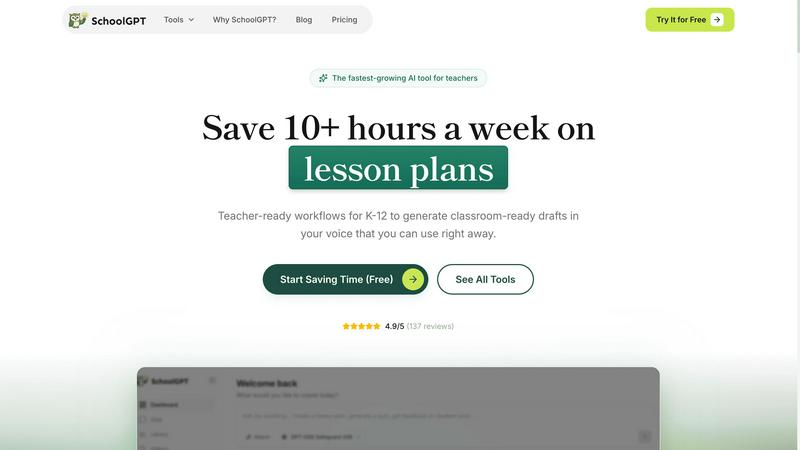
SchoolGPT is an AI teaching assistant that saves educators over 10 hours weekly on lesson planning and grading tasks.
Last updated: February 28, 2026
Visual Comparison
Polym
SchoolGPT
Feature Comparison
Polym
Medium-Form Audio Courses
Polym provides in-depth, medium-form audio courses focused on the conceptual understanding of foundational subjects. These courses are carefully curated to cover material that is not only professionally relevant across various fields but also enriching for general knowledge. The content is specifically engineered for the audio format, with a focus on abstract concepts and principles from technical and mathematical fields that are suitable for auditory learning, thereby overcoming a common hurdle in educational media.
Active Learning via Retrieval Practice
The app moves beyond passive consumption by embedding retrieval practice—a core active learning technique—into the user experience. This is operationalized through interactive audio flashcards and prompted recall exercises within courses. By actively requiring the user to retrieve information from memory, this feature strengthens neural pathways, significantly enhancing long-term retention and recall compared to re-reading or re-listening alone.
Spaced Repetition Scheduling
To combat the natural curve of forgetting, Polym incorporates a spaced repetition algorithm. This system intelligently schedules review sessions for key concepts and terms at strategically increasing intervals. By prompting users to revisit material just as they are about to forget it, the app maximizes memory consolidation, ensuring that learned information transitions from short-term to durable long-term knowledge.
Interleaved Practice Sessions
Polym employs the interleaving learning strategy by mixing related topics or questions from different courses during study and review sessions. Instead of blocking study on a single subject, this approach challenges the brain to discriminate between concepts and apply knowledge in varied contexts. This feature enhances deeper learning, improves problem-solving flexibility, and strengthens the connections between interrelated subjects.
SchoolGPT
Instant Lesson Plan Generation
SchoolGPT enables educators to quickly generate lesson plans based on specific standards, topics, or objectives. This feature allows teachers to focus on instruction rather than spending hours on planning, ensuring that lessons are not only comprehensive but also tailored to meet curriculum requirements.
Writing Feedback Tool
This feature allows teachers to provide instant and constructive feedback on student writing. Educators can base the feedback on custom criteria or rubrics, facilitating personalized learning experiences and helping students improve their writing skills effectively.
Customizable Rubric Generator
With the rubric generator, teachers can easily create customized rubrics for any assignment. This tool streamlines the assessment process and ensures that evaluations are consistent, fair, and aligned with educational standards, ultimately enhancing the grading experience.
Text Leveler
The text leveler feature adapts any text to fit a student's reading level or skills. This adaptability promotes inclusivity in the classroom by ensuring that all students can engage with the material, regardless of their reading proficiency.
Use Cases
Polym
Professional Skill Reinforcement
Professionals in data science, finance, engineering, or management can use Polym to reinforce and retain core concepts in statistics, probability, logic, and economics. The audio format allows for learning during commutes or downtime, while the active recall and spaced repetition features ensure that these critical professional foundations remain sharp and readily accessible for application in work projects and decision-making.
Academic Study Aid for Students
University and graduate students can integrate Polym as a supplementary study tool for courses in computer science, philosophy, or history. The medium-form courses provide conceptual overviews, while the abbreviated versions and term-focused sessions are ideal for efficient exam review. The scientifically-backed methods help move information from crammed facts to deeply understood, long-term knowledge.
Lifelong Learning for Aspiring Polymaths
Individuals with broad intellectual curiosity who aim to build a wide base of foundational knowledge across disciplines will find Polym uniquely suited to their goals. The curated selection of subjects and the app's focus on conceptual understanding allow users to systematically explore fields like AI, philosophy, and scientific research, transforming scattered interest into structured, retained expertise.
Preparation for Certifications and Interviews
Job seekers or professionals preparing for technical certifications can utilize Polym to master key terminology and abstract concepts required for tests and interviews. The "Review Key Terms" feature and audio flashcards offer a highly efficient method for drilling definitions and principles, while interleaving helps in understanding how different concepts relate, a common interview question theme.
SchoolGPT
Efficient Grading
Teachers can utilize SchoolGPT to generate personalized feedback on student assignments quickly. This efficiency reduces grading time significantly while ensuring that students receive valuable insights into their work, ultimately promoting their academic growth.
Lesson Development
Educators can leverage SchoolGPT to create detailed lesson plans tailored to specific learning objectives. By using pre-designed templates, teachers can ensure that their lessons are engaging and aligned with state standards, allowing them to spend more time on teaching and less on planning.
Assessment Creation
SchoolGPT makes it easy for educators to design multiple-choice quizzes and tests aligned with curriculum goals. This feature simplifies the assessment process, enabling teachers to focus on evaluating student learning rather than creating assessments from scratch.
Parent Communication
The platform offers tools for generating professional emails and family communications, enabling teachers to maintain effective communication with parents. This feature fosters a collaborative educational environment and keeps families informed about student progress and classroom activities.
Overview
About Polym
Polym is a specialized audio learning application engineered to optimize the long-term retention and recall of foundational knowledge across a diverse range of academic and professional disciplines. Unlike passive listening platforms, Polym is explicitly designed around evidence-based cognitive science principles, integrating active learning techniques directly into its audio format. The app offers structured, medium-form courses on essential subjects such as Statistics, Probability, Logic, Economics, Computer Science, Artificial Intelligence, Philosophy, and History. Each course is supplemented with abbreviated versions and audio flashcards, creating a multi-layered learning system. The core value proposition lies in its systematic application of proven learning strategies—namely retrieval practice, spaced repetition, and interleaving—to transform casual listening into an effective memorization and comprehension tool. It caters to a broad audience of lifelong learners, including students seeking to solidify academic fundamentals, professionals aiming to cross-skill or deepen domain expertise, and intellectually curious individuals or aspiring polymaths who desire a flexible, engaging way to build and retain critical knowledge. By delivering technically tailored audio content that emphasizes abstract concepts, Polym enables users to efficiently learn and, more importantly, remember complex information through scientifically-backed methods, making education both portable and permanent.
About SchoolGPT
SchoolGPT is an innovative AI teaching assistant meticulously designed for K-12 educators, offering a comprehensive platform that caters to various educational needs. This all-in-one solution provides instant access to a multitude of AI models, including ChatGPT, Claude, Gemini, and others, enabling educators to efficiently tackle a range of classroom tasks. With over 60 ready-to-use templates crafted by experienced teachers, SchoolGPT empowers users to create lesson plans, offer writing feedback, design multiple-choice quizzes, generate rubrics, and much more in a matter of seconds. Every output aligns with state standards and incorporates built-in differentiation to meet diverse student needs. Unlike generic AI tools that often require extensive prompt engineering, SchoolGPT generates classroom-ready drafts that reflect the teacher's unique voice, facilitating immediate application in educational settings. By streamlining administrative tasks, SchoolGPT has already assisted over 10,000 educators in reclaiming valuable time for teaching and personal use, ultimately enhancing the educational experience for both teachers and students.
Frequently Asked Questions
Polym FAQ
What research supports the learning strategies used in Polym?
The methodologies underpinning Polym—retrieval practice, spaced repetition, and interleaving—are extensively validated by cognitive science research. These techniques are known collectively as desirable difficulties, as they make learning more challenging in the short term but far more effective for long-term retention. A comprehensive starting point for this research can be found in academic reviews, such as the article available through the National Institutes of Health (PMCID: PMC9781761), which synthesizes evidence on effective learning strategies.
What subjects are currently covered by Polym courses?
Polym offers a growing library focused on foundational knowledge. Confirmed subjects include Logic, Logical Fallacies, Cognitive Biases, Statistics, Probability, Scientific Research Methods, Algorithms, Economics, Philosophy, and History. The selection is designed to be relevant across professional fields and for general intellectual enrichment, with an emphasis on concepts that are suitable for and benefit from the audio learning format.
Who is the primary target audience for the Polym app?
Polym is designed for a wide audience united by a desire to learn and remember effectively. This includes students, professionals seeking cross-disciplinary knowledge, and lifelong learners or aspiring polymaths. Essentially, it is for anyone who wants to improve their retention and recall of key subjects that are applicable both in professional contexts and in enriching everyday life and personal decision-making.
Is Polym available for both iOS and Android devices?
Yes, Polym is officially launched and fully available for download on both major mobile platforms. You can install the app directly from the Apple App Store for iOS devices and from the Google Play Store for Android devices, allowing for flexible, on-the-go learning regardless of your preferred mobile operating system.
SchoolGPT FAQ
Is SchoolGPT really free to start?
Yes, SchoolGPT offers a free tier that allows users to generate up to 10 AI outputs per month. This option is perfect for educators looking to explore the platform without any financial commitment.
Why not just use ChatGPT?
While ChatGPT is a powerful tool, SchoolGPT is specifically designed for the classroom. It provides ready-to-use templates, aligns with state standards, and eliminates the need for complex prompts, making it more effective for educators.
Is my data and student information safe?
SchoolGPT is fully compliant with FERPA and COPPA regulations, ensuring that all user data and student information are kept private and secure. Educators can use the platform with confidence, knowing that their data is protected.
How much time will I actually save?
Teachers using SchoolGPT report saving over 10 hours each week on lesson planning, grading, and administrative tasks. By automating these processes, educators can reclaim valuable time for teaching and personal activities.
Alternatives
Polym Alternatives
Polym is an audio-based learning application focused on enhancing long-term retention of foundational knowledge in subjects like statistics, economics, computer science, and philosophy. It operates within the education technology and self-study software category, leveraging active learning techniques such as retrieval practice and spaced repetition. Users may seek alternatives to Polym for various reasons, including budget constraints, a preference for different content formats like video or text, the need for specific platform availability, or a desire for a broader or more niche subject library. The search often stems from finding the optimal tool that aligns with an individual's unique learning style and practical requirements. When evaluating alternatives, key considerations should include the core learning methodologies employed, such as active recall and spaced repetition systems. The depth and breadth of the content library, the flexibility of the learning format, pricing transparency, and the overall user experience are also critical factors. The ideal platform effectively balances scientific pedagogy with engaging, accessible delivery.
SchoolGPT Alternatives
SchoolGPT is an innovative AI teaching assistant designed specifically for K-12 educators, streamlining lesson planning and grading tasks. By providing a comprehensive suite of tools, including lesson plan generators, writing feedback systems, and assessment creators, SchoolGPT empowers teachers to enhance their educational delivery while reclaiming valuable time. Users often seek alternatives to SchoolGPT for various reasons, including pricing concerns, the desire for specific features, or the need for compatibility with different platforms. When selecting an alternative, it's essential to consider factors like user experience, the range of available tools, integration capabilities, and the overall support offered to educators. Ensuring that the chosen solution aligns with individual teaching styles and curriculum requirements is key to maximizing its effectiveness.