
DeepRails
DeepRails provides real-time AI guardrails to detect and fix LLM hallucinations before they reach users.
Visit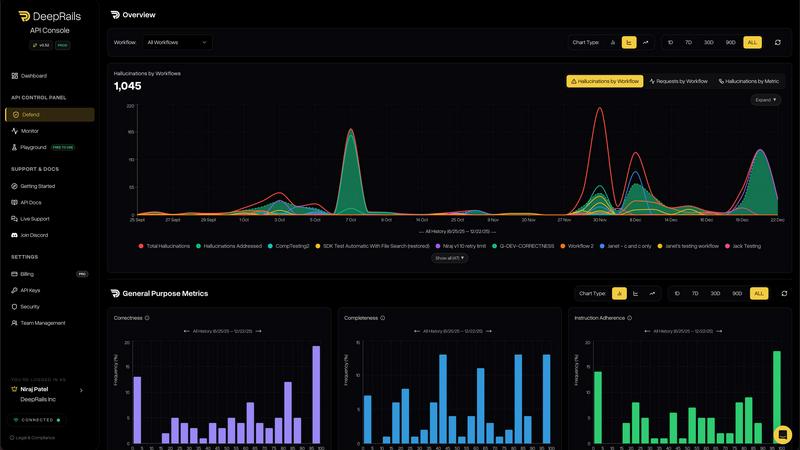
About DeepRails
DeepRails is an advanced, production-grade AI reliability and guardrails platform engineered specifically for development teams building with large language models (LLMs). Its core mission is to directly address the most significant barrier to enterprise AI adoption: the propensity of LLMs to produce hallucinations, factual inaccuracies, and inconsistent reasoning. Unlike basic monitoring tools that merely flag potential issues, DeepRails is architected to both hyper-accurately identify these critical failures and substantively fix them in real-time before erroneous outputs reach end-users. The platform provides comprehensive, model-agnostic evaluation of AI outputs across key dimensions such as factual correctness, grounding in source material, logical consistency, and safety, enabling teams to distinguish true errors from acceptable model variance with industry-leading precision. Built by AI engineers for AI engineers, it integrates seamlessly with leading LLM providers and modern development pipelines. DeepRails combines its flagship Defend API for real-time correction, automated remediation workflows, customizable evaluation metrics, and human-in-the-loop feedback systems to create a continuous improvement cycle for model behavior. This ensures that AI applications deployed in sensitive domains like legal, finance, healthcare, and education are reliable, trustworthy, and safe.
Features of DeepRails
Ultra-Accurate Hallucination Detection
DeepRails provides an expansive library of guardrail metrics that go beyond simple classification to deliver granular, score-based evaluations (0-100) for pinpoint accuracy. Its proprietary detection algorithms for dimensions like Correctness, Context Adherence, and Completeness are benchmarked as significantly more accurate than alternatives like AWS Bedrock, with claims of 45% higher accuracy for factual correctness. This allows developers to precisely detect whether hallucinations exist in AI outputs, distinguishing critical errors from benign variances with high confidence.
Real-Time Correction with Defend API
The platform's core capability is the Defend API, which acts as a real-time correction engine or "kill-switch" for AI hallucinations. It operates inline in the application workflow, automatically scoring model outputs against configured guardrails. When a failure is detected, it can trigger automated improvement actions like "FixIt" or "ReGen" to correct the output or generate a new, compliant response before it is delivered to the customer, ensuring only vetted content reaches end-users.
Comprehensive Analytics and Audit Console
Every interaction processed through DeepRails is logged in real-time to a centralized console. This provides beautiful, actionable metrics on AI performance, hallucination rates, and guardrail scores. Teams can drill into any individual run for a full audit trace, including the original prompt, the raw LLM output, the evaluation results, and the step-by-step "improvement chain" showing any automated corrections applied, enabling complete transparency and debugging.
Customizable Guardrail Metrics and Workflows
While offering a robust set of pre-built metrics for Quality, Safety, and Advanced evaluation, DeepRails is designed for customization. Development teams can tailor guardrail thresholds and create custom metrics aligned with specific business objectives, domain-specific jargon, or unique compliance requirements. This flexibility ensures the platform can be adapted to govern AI behavior precisely for any use case, from legal citation verification to brand tone compliance.
Use Cases of DeepRails
Legal and Compliance Applications
In the legal domain, where accuracy is non-negotiable, DeepRails is critical for verifying AI-generated content. It can automatically evaluate whether legal citations (e.g., "Henderson v. Texas (2018)") are factual, ensure all parts of a complex legal query are answered completely, and enforce strict adherence to provided context in Retrieval-Augmented Generation (RAG) systems. This prevents the severe risks associated with AI "making up" case law or providing incorrect legal advice.
Financial Services and Advisory
For fintech companies and financial institutions deploying AI chatbots or analytical tools, DeepRails ensures all financial advice, data summaries, and numerical claims are factually correct and grounded in verified source materials. Its correctness and completeness guardrails mitigate the risk of hallucinations that could lead to poor investment decisions, regulatory non-compliance, or loss of customer trust.
Healthcare and Life Sciences Support
In healthcare applications, such as symptom checkers or drug interaction tools, DeepRails provides a vital safety layer. It can rigorously verify the factual accuracy of medical information, detect potential safety violations, and ensure patient privacy by identifying and filtering out unintended PII leakage in AI-generated responses, making AI assistants safer for patient-facing interactions.
Educational Content and Tutoring Systems
For AI-powered educational platforms and tutoring systems, DeepRails guarantees the reliability of instructional content. It assesses whether explanations are factually sound, complete, and adhere to pedagogical guidelines. This ensures students receive accurate information, and the AI tutor fully addresses multi-part questions, maintaining educational integrity and effectiveness.
Frequently Asked Questions
What makes DeepRails different from other AI evaluation tools?
DeepRails distinguishes itself through its dual focus on both ultra-accurate detection and real-time, automated correction. While many tools only monitor and flag issues, DeepRails' Defend API actively intercepts and fixes problematic outputs in milliseconds. Furthermore, its detection metrics are benchmarked as significantly more accurate than major cloud providers, and its platform is built as a model-agnostic, developer-centric suite with full audit capabilities, not just a scoring service.
How does the real-time correction ("FixIt") actually work?
When the Defend API scores an LLM output and finds it violates a configured guardrail (e.g., a low correctness score), it can trigger predefined improvement actions. "FixIt" might involve sending the flawed output back through a remediation pipeline with additional instructions or context to correct the specific error. "ReGen" may prompt a new call to the LLM to generate a compliant response from scratch. The entire process happens automatically before the response is sent to the user.
Can DeepRails integrate with my existing LLM and application stack?
Yes, DeepRails is designed as a model-agnostic platform that integrates seamlessly with leading LLM providers (like OpenAI, Anthropic, etc.) and modern development pipelines. It offers SDKs and a straightforward API that can be inserted as a middleware layer between your application logic and your LLM calls, requiring minimal changes to existing architecture to begin enforcing guardrails.
Is DeepRails suitable for evaluating complex AI agents and workflows?
Absolutely. Beyond evaluating single LLM responses, DeepRails offers advanced metrics like "Agentic Performance" (coming soon) designed to evaluate how effectively an AI autonomously plans, decides, and executes complex multi-step tasks. This makes it suitable for monitoring and governing sophisticated autonomous AI systems and multi-agent workflows, ensuring reliability across entire chains of reasoning and action.