
Image to 3D AI
Effortlessly convert any 2D image into a detailed 3D model for free using advanced AI technology at IMGto3D.ai.
Visit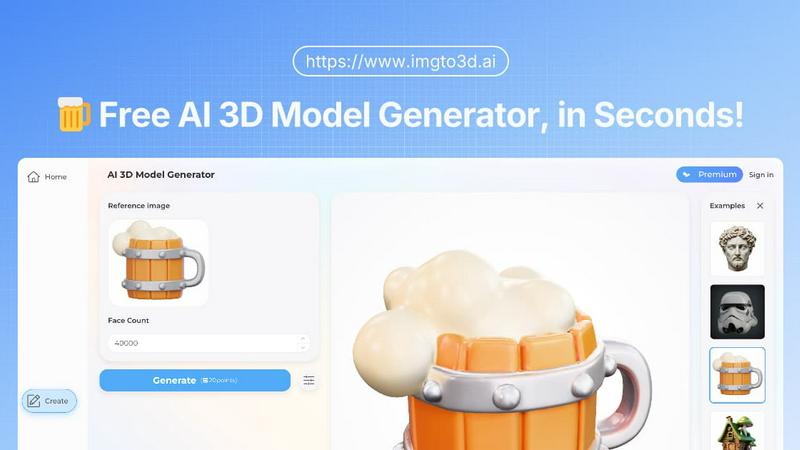
About Image to 3D AI
Image to 3D AI, developed by ImgTo3D.ai, is an innovative web-based platform that harnesses the power of deep learning to transform two-dimensional images into intricate three-dimensional models. This tool is designed to eliminate the traditional complexities associated with 3D modeling, providing a quick and efficient solution for various users. Whether you are a digital artist, game developer, educator, or 3D printing enthusiast, Image to 3D AI caters to your needs by converting photographs, digital artwork, or sketches into detailed 3D assets within seconds. The platform's advanced algorithms intelligently deduce depth, shape, and geometry, significantly reducing the time and expertise usually required for 3D modeling, which typically involves complex software and manual labor. The main value proposition lies in its speed, accessibility, and user-friendly interface, enabling a broader audience to engage in 3D asset generation without the steep learning curve. By offering a robust free tier that requires no sign-up or credit card, it democratizes access to advanced 3D modeling technology, while the Pro tier provides enhanced features for professional workflows.
Features of Image to 3D AI
AI-Powered Textured Image-to-3D Conversion
This core feature allows users to transform any static 2D image into a richly textured 3D model almost instantaneously. Utilizing advanced AI algorithms, users can achieve high-quality results with minimal effort, making it ideal for rapid prototyping and creative projects.
Multi-Format Export
Image to 3D AI supports exporting models in various formats, including OBJ, GLB, and STL. This versatility ensures compatibility with a wide range of applications, from gaming and augmented reality to 3D printing, enhancing workflow flexibility and usability.
Adjustable Polygon Density
Users can control the polygon density during the conversion process, allowing for a balance between model detail and performance. This feature is particularly beneficial for developers aiming to optimize assets for resource-constrained environments while retaining essential visual fidelity.
No Sign-Up or Credit Card Required
Image to 3D AI offers a permanently free tier that allows users to generate 3D models without any sign-up or financial commitment. This lowers barriers to entry and encourages experimentation, making it accessible to a diverse user base.
Use Cases of Image to 3D AI
Game Development
Game developers can utilize Image to 3D AI to rapidly create characters, environments, and props, significantly shortening the development cycle. The ability to generate models quickly allows for iterative design and prototyping, enabling teams to focus on gameplay and mechanics rather than technical modeling.
3D Printing
The platform is ideal for 3D printing enthusiasts who want to design custom objects. Users can convert their ideas into printable models effortlessly, with export formats optimized for various 3D printers, facilitating the transition from digital design to physical product.
XR/VR Experiences
For creators in the augmented and virtual reality space, Image to 3D AI provides a means to populate virtual worlds quickly with high-quality 3D assets. This capability is particularly crucial for maintaining performance in immersive environments, allowing for seamless user experiences.
Creative Portfolios
Artists and designers can leverage the tool to build impressive portfolios by rapidly converting concepts into 3D models. This capability enables them to showcase their ideas and skills without being bogged down by the technicalities of traditional modeling workflows.
Frequently Asked Questions
How does Image to 3D AI work?
Image to 3D AI uses advanced deep learning algorithms to analyze a 2D image and infer depth, shape, and geometry to create a 3D model. Users upload an image, and the AI generates the model in seconds.
What types of images can I use?
You can upload various types of images, including photographs, digital artworks, and hand-drawn sketches. For optimal results, clear and well-lit images of single objects are recommended.
Is there any cost associated with using Image to 3D AI?
Image to 3D AI offers a free tier that allows users to generate models without any financial commitment. A Pro tier is also available for those who require enhanced capabilities and additional features.
What file formats can I export my 3D models in?
Users can export their 3D models in multiple formats, including OBJ, GLB, and STL, making it suitable for various applications, including gaming, AR/VR, and 3D printing.
Similar to Image to 3D AI

Automatically get personalized actions from your YT, podcast, and email subscriptions.


AI Chat, Chat AI, AI Detector & AI Checker. Chat with AI, detect AI writing, humanize text and create content powered by Chat GPT 5.5.

SOC 2 and ISO 27001 turned into a clear to-do list. AI prepares the first drafts, you approve every call, and the founders actually answer.


Distro is an AI Distribution Operator that helps B2B teams publish content, find buyer conversations, engage prospects, and turn social intent into pi