
Activepieces vs Agent to Agent Testing Platform
Side-by-side comparison to help you choose the right product.

Activepieces
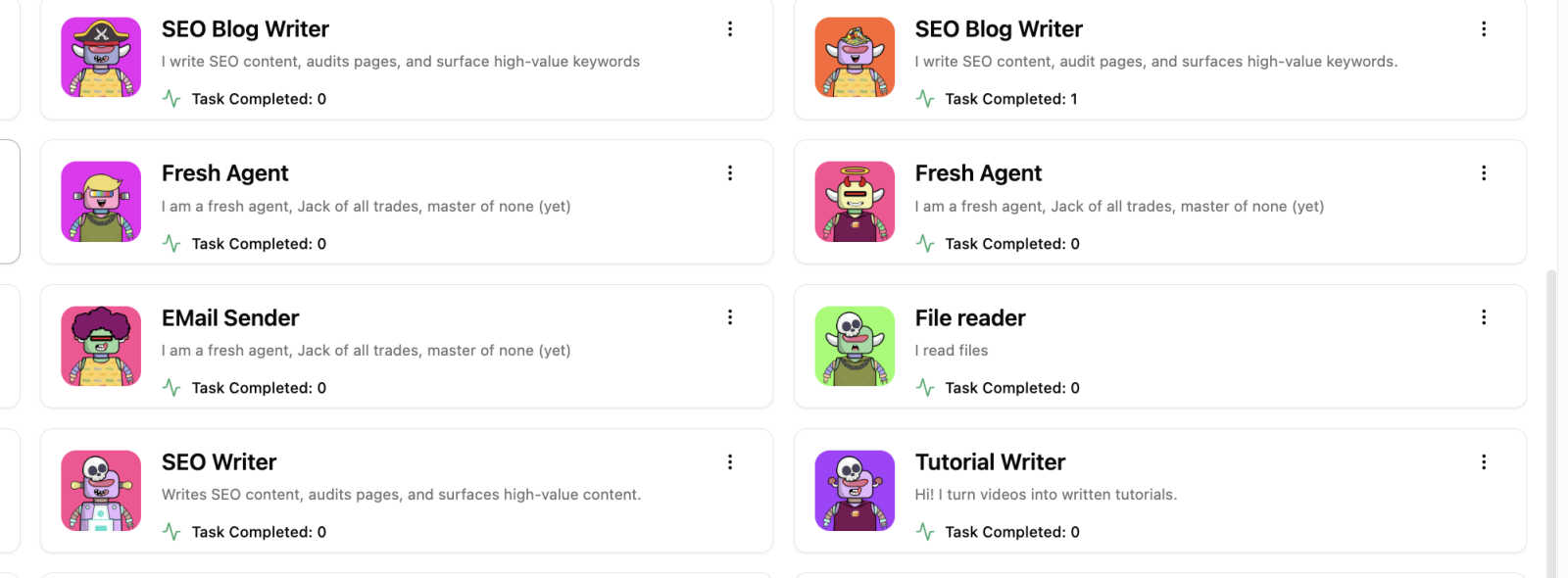
Activepieces is an open-source platform for building no-code AI agents and smart automations.
Last updated: March 1, 2026

Agent to Agent Testing Platform
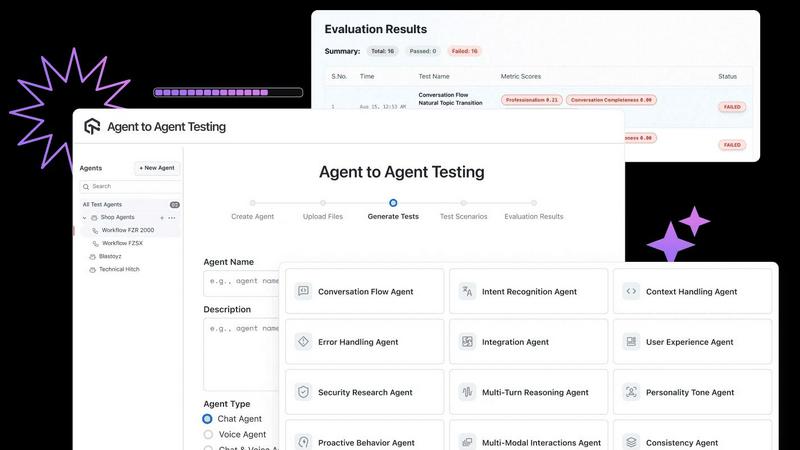
Validate AI agent performance across chat, voice, and phone interactions while detecting compliance and security risks.
Last updated: February 26, 2026
Visual Comparison
Activepieces
Agent to Agent Testing Platform
Feature Comparison
Activepieces
No-Code AI Agent Builder
The platform provides a visual, drag-and-drop builder that allows anyone to create and orchestrate intelligent AI agents. Users can define specific instructions, triggers, and tools for each agent, enabling them to perform complex tasks like data analysis, content generation, and decision-making. This eliminates the barrier of programming expertise, putting the power to build autonomous systems directly in the hands of business teams and process owners.
Extensive Integration Library
Activepieces boasts a vast ecosystem of over 638 pre-built integrations, connecting to essential tools across categories such as communication (Slack, Gmail), CRM (HubSpot), databases, productivity (Notion), and AI models (OpenAI). This extensive library ensures that automations can span virtually every application in a company's tech stack, creating end-to-end workflows that eliminate manual data transfer and siloed operations.
Enterprise Control & Governance
Designed for organizational adoption, Activepieces includes robust IT governance tools without sacrificing usability. Features include Single Sign-On (SSO) with SAML 2.0, SCIM provisioning for user management, advanced Role-Based Access Control (RBAC) to define permissions for admins, builders, and viewers, and comprehensive audit logs. This provides security and oversight while allowing teams to build and innovate independently.
Flexible Deployment Options
The platform offers unmatched deployment flexibility to meet diverse security and infrastructure needs. Users can opt for the fully-managed cloud service with SOC 2 Type II compliance and data region options, or choose self-hosting via Docker or Helm charts for complete data sovereignty within their own network. This ensures compliance with strict regulatory requirements and gives enterprises full control over their automation environment.
Agent to Agent Testing Platform
Automated Scenario Generation
This feature allows users to create diverse test cases for AI agents automatically, simulating various interactions such as chat, voice, hybrid, or phone calls. This capability ensures comprehensive coverage across different communication scenarios.
True Multi-Modal Understanding
By enabling the input of multiple formats, including text, images, audio, and video, this feature allows users to set detailed requirements that reflect real-world conditions. It helps gauge the expected output of AI agents in a more holistic manner.
Autonomous Test Scenario Generation
Access to a library of hundreds of pre-defined scenarios empowers users to efficiently evaluate AI agents. Custom scenarios can also be developed, catering to specific testing needs such as assessing personality tone or intent recognition.
Regression Testing with Risk Scoring
This feature conducts end-to-end regression testing, highlighting potential areas of concern through risk scoring. It allows organizations to prioritize critical issues, optimizing their testing efforts and ensuring a robust AI agent performance.
Use Cases
Activepieces
Automated Customer Support
Businesses can deploy AI support agents to automatically triage incoming support tickets, categorize them by priority and topic, and provide instant, accurate responses using connected knowledge bases. For complex issues, the workflow can seamlessly escalate to a human agent with all relevant context, significantly reducing response times, improving customer satisfaction, and freeing up support staff for high-value interactions.
Intelligent Sales & Lead Management
Sales teams can implement automations to score and qualify leads in real-time as they enter the CRM. AI agents can analyze lead data, assign priority scores, and automatically initiate personalized email sequences or schedule follow-up tasks in the sales team's calendar. This ensures no lead falls through the cracks, improves conversion rates, and allows sales representatives to focus their efforts on the most promising opportunities.
Marketing Campaign Orchestration
Marketing departments can build workflows that trigger personalized email or message campaigns based on specific user behaviors, such as website visits or content downloads. AI agents can dynamically segment audiences, generate personalized content, and schedule communications across multiple channels, ensuring timely and relevant engagement that nurtures leads through the marketing funnel efficiently.
Internal Process Automation
Organizations can streamline internal operations by automating repetitive tasks like data entry, report generation, and approval processes. For example, an automation can compile data from various sources into a daily executive report, route invoice approvals through the correct hierarchy, and sync project updates across tools like Jira and Notion, saving countless hours and minimizing human error.
Agent to Agent Testing Platform
Quality Assurance for Chatbots
Enterprises can employ the platform to rigorously test chatbots across various scenarios, ensuring they respond accurately and effectively to user inquiries while maintaining a friendly tone and adherence to data privacy policies.
Voice Assistant Testing
The platform is ideal for validating the performance of voice assistants, simulating real-world interactions to assess their understanding of user intent, tone, and their ability to handle complex queries seamlessly.
Phone Caller Agent Evaluation
Organizations can utilize the Agent to Agent Testing Platform to evaluate phone caller agents, ensuring they deliver a professional and empathetic interaction experience while adhering to compliance and escalation protocols.
Multi-Persona Testing
By leveraging diverse personas, businesses can simulate different user behaviors and needs during testing. This ensures that AI agents are equipped to handle a wide range of customer interactions effectively and efficiently.
Overview
About Activepieces
Activepieces is an open-source, no-code automation platform engineered to build, orchestrate, and deploy sophisticated AI agents and workflows. It serves as a comprehensive ecosystem that democratizes automation, enabling users from non-technical business professionals to seasoned developers to construct autonomous systems capable of handling complex, repetitive tasks across their entire software stack. The platform's core value proposition lies in its unparalleled ability to seamlessly connect over 638 disparate applications—including Gmail, Slack, Notion, HubSpot, and databases—into cohesive, intelligent processes without requiring any coding knowledge. Users can design sophisticated agentic teams where specialized AI agents collaborate on tasks like lead qualification, personalized communication, and data processing. Built with enterprise-grade reliability, Activepieces offers critical features such as workflow versioning, automatic retry mechanisms, and SOC 2 Type II compliance. It provides ultimate deployment flexibility, available as a fully-managed cloud service or for self-hosting via Docker, and includes capabilities for embedding its workflow builder into other applications. This combination makes Activepieces a powerful, secure, and scalable foundation for organizations aiming to accelerate operations, reduce human error, and implement AI-powered automation at scale across departments like customer support, sales, marketing, and internal operations.
About Agent to Agent Testing Platform
Agent to Agent Testing Platform is an innovative, AI-native quality assurance framework tailored to assess the performance of AI agents in real-world scenarios. As AI agents become increasingly autonomous and complex, traditional quality assurance methods designed for static software systems are proving inadequate. This platform offers a comprehensive solution that evaluates multi-turn conversations across various interfaces, including chat, voice, and phone interactions. It is aimed at enterprises that require rigorous validation processes before deploying AI agents in production. The platform excels in identifying long-tail failures, edge cases, and interaction patterns that manual testing often overlooks, ensuring that AI agents operate reliably and effectively. By leveraging a suite of over 17 specialized AI agents, it empowers businesses to simulate thousands of interactions, providing insights into critical metrics such as bias, toxicity, and hallucinations. Ultimately, the Agent to Agent Testing Platform is essential for organizations seeking to enhance the quality of their AI systems while maintaining user trust and satisfaction.
Frequently Asked Questions
Activepieces FAQ
What is an AI Agent in Activepieces?
In Activepieces, an AI Agent is an autonomous workflow component powered by AI models like OpenAI. It is more than a simple automation; it can understand instructions, make decisions, process natural language, and perform complex tasks such as summarizing content, extracting data from documents, or writing personalized responses. Users can build teams of these specialized agents that work together within a single workflow.
How does Activepieces ensure security and compliance?
Activepieces is built with enterprise-grade security. Its cloud offering is SOC 2 Type II compliant and adheres to GDPR principles, with data residency options in the EU and US. For the highest security requirements, the self-hosted option keeps all data within your private network. Additionally, platform features like SSO, SCIM, RBAC, and audit logs provide granular control and visibility over user access and actions.
Can I use Activepieces without any coding experience?
Absolutely. Activepieces is fundamentally a no-code platform. Its core interface is a visual, drag-and-drop workflow builder where you connect triggers (events that start a workflow) and actions (steps the workflow takes) using pre-built pieces for apps and logic. This design empowers business users, operations teams, and citizen developers to build powerful automations without writing a single line of code.
What is the difference between the Cloud and Self-Hosted plans?
The Cloud plan is a fully-managed service where Activepieces hosts and maintains the platform for you, offering quick setup, automatic updates, and high availability with no infrastructure management. The Self-Hosted plan involves deploying and managing the Activepieces software on your own servers or cloud infrastructure (via Docker or Helm), providing full data control, the ability to meet specific compliance needs, and no external data transfer.
Agent to Agent Testing Platform FAQ
What types of AI agents can be tested using the platform?
The Agent to Agent Testing Platform supports various types of AI agents, including chatbots, voice assistants, and phone caller agents. This versatility allows for comprehensive testing across numerous interaction types.
How does the platform ensure comprehensive test coverage?
The platform employs automated scenario generation and a library of predefined test cases to create diverse testing scenarios. This approach ensures that AI agents are evaluated under multiple conditions, covering a wide range of potential user interactions.
Can I create custom test scenarios?
Yes, users have the capability to create custom test scenarios tailored to their specific needs. This feature allows for focused testing on particular aspects of AI behavior such as personality tone or intent recognition.
How does risk scoring work in regression testing?
Risk scoring provides insights into potential vulnerabilities in the AI agent's performance following updates or changes. The system highlights areas of concern, allowing teams to prioritize issues and optimize their QA efforts effectively.
Alternatives
Activepieces Alternatives
Activepieces is an open-source, no-code platform for building and orchestrating intelligent AI agents and automations. It belongs to the categories of AI assistants and development tools, enabling users to create autonomous systems that connect hundreds of apps into cohesive, intelligent workflows without coding. Users may explore alternatives for various reasons. These include budget constraints and specific pricing model needs, a requirement for different feature sets or specialized integrations, or a preference for a different deployment model, such as fully cloud-based versus self-hosted solutions. The need for a platform with a different user experience or learning curve also drives evaluation of other options. When selecting an alternative, key considerations should include the platform's core capabilities in AI and automation, the breadth and depth of its application integrations, its deployment and hosting flexibility, and its overall value relative to cost. Security features, scalability, and the quality of support are also critical factors for business use.
Agent to Agent Testing Platform Alternatives
The Agent to Agent Testing Platform is an innovative AI-native quality assurance framework specially designed to validate the behavior of AI agents across various communication channels, including chat, voice, phone, and multimodal systems. This platform is particularly crucial as it addresses the complexities of autonomous AI systems, which increasingly operate in unpredictable ways that traditional QA processes cannot adequately assess. Users often seek alternatives due to factors such as pricing, specific feature requirements, or the need for compatibility with existing platforms, reflecting a desire for tailored solutions that better align with their operational demands. When evaluating alternatives to the Agent to Agent Testing Platform, it is essential to consider several critical aspects. Look for platforms that offer comprehensive testing capabilities across multiple interaction types, scalability for synthetic user interactions, and robust validation mechanisms for compliance and security. Additionally, prioritize solutions that can accommodate the unique needs of your organization, such as integration with existing systems and access to advanced analytics for ongoing performance monitoring.