
Agent to Agent Testing Platform vs PoYo API
Side-by-side comparison to help you choose the right product.

Agent to Agent Testing Platform
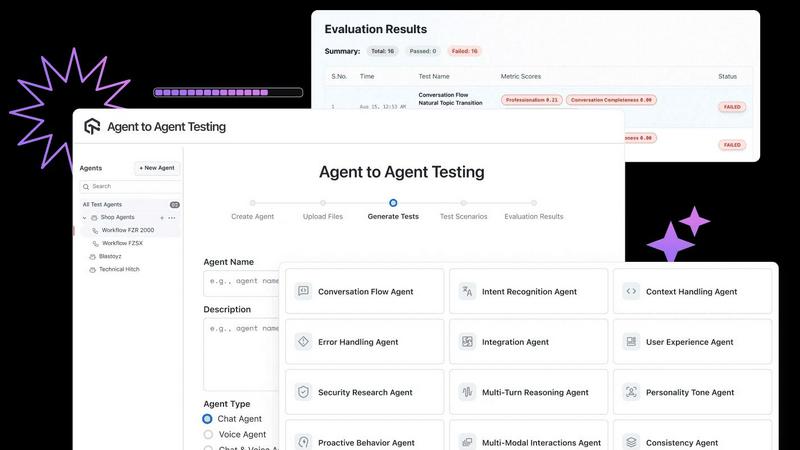
Validate AI agent performance across chat, voice, and phone interactions while detecting compliance and security risks.
Last updated: February 26, 2026

PoYo API
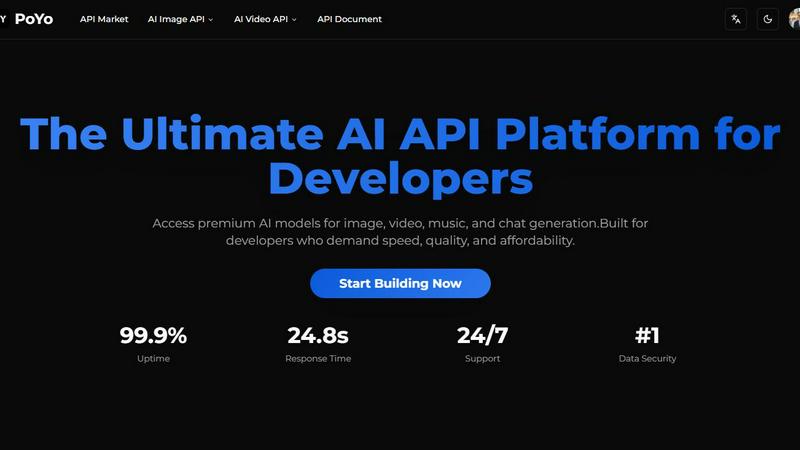
PoYo API provides unified developer access to premium AI models for image, video, music, and chat generation.
Last updated: February 28, 2026
Visual Comparison
Agent to Agent Testing Platform
PoYo API
Feature Comparison
Agent to Agent Testing Platform
Automated Scenario Generation
This feature allows users to create diverse test cases for AI agents automatically, simulating various interactions such as chat, voice, hybrid, or phone calls. This capability ensures comprehensive coverage across different communication scenarios.
True Multi-Modal Understanding
By enabling the input of multiple formats, including text, images, audio, and video, this feature allows users to set detailed requirements that reflect real-world conditions. It helps gauge the expected output of AI agents in a more holistic manner.
Autonomous Test Scenario Generation
Access to a library of hundreds of pre-defined scenarios empowers users to efficiently evaluate AI agents. Custom scenarios can also be developed, catering to specific testing needs such as assessing personality tone or intent recognition.
Regression Testing with Risk Scoring
This feature conducts end-to-end regression testing, highlighting potential areas of concern through risk scoring. It allows organizations to prioritize critical issues, optimizing their testing efforts and ensuring a robust AI agent performance.
PoYo API
Unified Multi-Model API Access
PoYo API provides a single, consolidated endpoint for accessing a curated library of over 500 leading AI models spanning image, video, music, and chat generation. This eliminates the need for developers to manage multiple API keys, SDKs, and billing accounts across different providers. The platform's standardized interface simplifies integration, reduces code complexity, and accelerates development cycles, allowing teams to focus on building application logic rather than managing vendor-specific integrations.
Flexible Credit-Based Pricing Model
The platform operates on a transparent, pay-as-you-go credit system, fundamentally diverging from restrictive subscription plans. Users purchase credits that never expire and are consumed based on the specific model and task complexity used. This model offers unparalleled financial flexibility, enabling developers to scale usage up or down based on real demand without being locked into fixed monthly fees or over-provisioning for unused capacity, ensuring optimal cost-efficiency.
Enterprise-Grade Security & Reliability
PoYo API is built with a zero-knowledge architecture, ensuring API keys and user credentials are stored with industry-standard encryption. The platform guarantees 99.9% operational uptime through robust monitoring systems and provides full audit logging for compliance. This commitment to security and reliability makes it suitable for handling sensitive data and mission-critical production workloads where data integrity and service availability are paramount.
Comprehensive Developer Tools & Support
Developers benefit from a suite of tools designed to streamline the development process, including a free playground for testing all models without a credit card, simple two-endpoint async API design, and webhook support for real-time task callbacks. This is complemented by 24/7 dedicated technical support and a dashboard with manual retry capabilities for failed tasks, providing developers with full control and assistance throughout the integration and deployment lifecycle.
Use Cases
Agent to Agent Testing Platform
Quality Assurance for Chatbots
Enterprises can employ the platform to rigorously test chatbots across various scenarios, ensuring they respond accurately and effectively to user inquiries while maintaining a friendly tone and adherence to data privacy policies.
Voice Assistant Testing
The platform is ideal for validating the performance of voice assistants, simulating real-world interactions to assess their understanding of user intent, tone, and their ability to handle complex queries seamlessly.
Phone Caller Agent Evaluation
Organizations can utilize the Agent to Agent Testing Platform to evaluate phone caller agents, ensuring they deliver a professional and empathetic interaction experience while adhering to compliance and escalation protocols.
Multi-Persona Testing
By leveraging diverse personas, businesses can simulate different user behaviors and needs during testing. This ensures that AI agents are equipped to handle a wide range of customer interactions effectively and efficiently.
PoYo API
Content Creation & Marketing Automation
Marketing teams and content platforms can leverage PoYo API to automate the generation of high-quality visual and audio content at scale. This includes creating promotional images, social media videos, advertising jingles, and product demo scripts using models like Nano Banana Pro, Sora-2, and Suno AI. The API's concurrency and speed enable the rapid production of personalized content for campaigns, significantly reducing manual effort and time-to-market.
AI-Powered Application Development
Software development companies and indie developers can integrate state-of-the-art AI capabilities directly into their applications. This allows for building features such as in-app image editors, video generation tools, AI music composers, or intelligent chatbots powered by models like GPT-5 and Claude Sonnet, all through a single API integration, enhancing product value and user engagement without managing underlying AI infrastructure.
Research & Prototyping
Researchers, data scientists, and product teams can use the platform's free playground and flexible credits to rapidly prototype and test various AI models for specific use cases. They can compare outputs from different image, video, or music generation models to determine the best fit for their project's quality, style, and cost requirements before committing to full-scale integration and development.
Media & Entertainment Production
Studios and independent creators can utilize the advanced video and music APIs for storyboarding, generating visual effects, creating background scores, or even producing short-form content. Access to models like Veo3.1 and the complete Suno suite (for lyrics-to-song, vocal removal, etc.) provides professional-grade tools that can augment traditional production pipelines with AI-driven creativity.
Overview
About Agent to Agent Testing Platform
Agent to Agent Testing Platform is an innovative, AI-native quality assurance framework tailored to assess the performance of AI agents in real-world scenarios. As AI agents become increasingly autonomous and complex, traditional quality assurance methods designed for static software systems are proving inadequate. This platform offers a comprehensive solution that evaluates multi-turn conversations across various interfaces, including chat, voice, and phone interactions. It is aimed at enterprises that require rigorous validation processes before deploying AI agents in production. The platform excels in identifying long-tail failures, edge cases, and interaction patterns that manual testing often overlooks, ensuring that AI agents operate reliably and effectively. By leveraging a suite of over 17 specialized AI agents, it empowers businesses to simulate thousands of interactions, providing insights into critical metrics such as bias, toxicity, and hallucinations. Ultimately, the Agent to Agent Testing Platform is essential for organizations seeking to enhance the quality of their AI systems while maintaining user trust and satisfaction.
About PoYo API
PoYo API is a sophisticated, centralized platform engineered to provide developers with streamlined, high-performance access to a vast and diverse ecosystem of over 500 premium artificial intelligence models. It functions as a singular, unified gateway for AI-powered generation across multiple modalities, including image, video, music, and conversational chat. Designed explicitly for developers, startups, and enterprises, PoYo API eliminates the traditional complexities of integrating disparate AI services by consolidating them under one intuitive interface and a single API key. Its core value proposition lies in delivering exceptional quality, remarkable speed with sub-50ms response times, and a transparent, cost-effective credit-based pricing model that charges only for actual usage without mandatory recurring subscriptions. By offering immediate access to cutting-edge models like Sora-2 for video, Nano Banana Pro for high-resolution imagery, and GPT-5 for chat, all backed by enterprise-grade security and 99.9% uptime, PoYo API empowers developers to build and scale next-generation AI applications with unprecedented efficiency and reliability.
Frequently Asked Questions
Agent to Agent Testing Platform FAQ
What types of AI agents can be tested using the platform?
The Agent to Agent Testing Platform supports various types of AI agents, including chatbots, voice assistants, and phone caller agents. This versatility allows for comprehensive testing across numerous interaction types.
How does the platform ensure comprehensive test coverage?
The platform employs automated scenario generation and a library of predefined test cases to create diverse testing scenarios. This approach ensures that AI agents are evaluated under multiple conditions, covering a wide range of potential user interactions.
Can I create custom test scenarios?
Yes, users have the capability to create custom test scenarios tailored to their specific needs. This feature allows for focused testing on particular aspects of AI behavior such as personality tone or intent recognition.
How does risk scoring work in regression testing?
Risk scoring provides insights into potential vulnerabilities in the AI agent's performance following updates or changes. The system highlights areas of concern, allowing teams to prioritize issues and optimize their QA efforts effectively.
PoYo API FAQ
What is the PoYo API credit system and how does it work?
PoYo API uses a prepaid credit system where you purchase credits that are then consumed based on the AI model and task you execute. Each model has a defined credit cost per task (e.g., per image generation, per second of video). Credits do not expire, and you only pay for successful generations, with no charges for failed tasks. This system replaces traditional monthly subscriptions, offering greater flexibility and cost control.
How does PoYo API ensure low latency and handle high-volume requests?
The platform is engineered for performance, boasting an average response time of under 50ms and built to handle massive parallel requests. It utilizes an asynchronous API design for long-running tasks (like video generation) with webhook callback support, ensuring your application isn't blocked waiting for a response. This architecture, combined with robust backend infrastructure, allows for high concurrency and ultra-low latency suitable for scalable production applications.
Is there a way to test the AI models before purchasing credits?
Yes, PoYo API provides completely free playground access on each model's dedicated page. You can experiment with various generation parameters, test prompts, and evaluate the output quality of any model in the library without needing to sign up for a paid plan or provide credit card details. This allows for thorough testing and debugging before integrating the API into your application.
What security measures are in place to protect my API keys and data?
PoYo API employs enterprise-grade security practices, including a zero-knowledge architecture. Your API keys are encrypted using industry-standard protocols. The platform ensures that your credentials and data are protected, with full audit logging available for security monitoring and compliance purposes. This makes it a secure choice for developers handling sensitive information or building applications for regulated industries.
Alternatives
Agent to Agent Testing Platform Alternatives
The Agent to Agent Testing Platform is an innovative AI-native quality assurance framework specially designed to validate the behavior of AI agents across various communication channels, including chat, voice, phone, and multimodal systems. This platform is particularly crucial as it addresses the complexities of autonomous AI systems, which increasingly operate in unpredictable ways that traditional QA processes cannot adequately assess. Users often seek alternatives due to factors such as pricing, specific feature requirements, or the need for compatibility with existing platforms, reflecting a desire for tailored solutions that better align with their operational demands. When evaluating alternatives to the Agent to Agent Testing Platform, it is essential to consider several critical aspects. Look for platforms that offer comprehensive testing capabilities across multiple interaction types, scalability for synthetic user interactions, and robust validation mechanisms for compliance and security. Additionally, prioritize solutions that can accommodate the unique needs of your organization, such as integration with existing systems and access to advanced analytics for ongoing performance monitoring.
PoYo API Alternatives
PoYo API is a centralized platform in the AI Assistants and generative AI category, providing developers with unified access to a vast library of over 500 premium models for image, video, music, and chat generation. It simplifies integration through a single API key and employs a flexible, consumption-based credit system. Developers may seek alternatives for various reasons, including specific budgetary constraints, the need for different pricing models like monthly subscriptions, or requirements for niche AI models not covered by a generalist platform. Others might prioritize direct relationships with model providers or have unique compliance and data residency needs that influence their platform choice. When evaluating alternatives, key considerations include the breadth and specialization of the available AI models, the overall cost structure and transparency, performance metrics like latency and uptime, and the robustness of security and support frameworks. The ideal platform aligns with both the technical demands of the application and the strategic goals of the development project.