
Agent to Agent Testing Platform vs Prompt Coder
Side-by-side comparison to help you choose the right product.

Agent to Agent Testing Platform
Validate AI agent performance across chat, voice, and phone interactions while detecting compliance and security risks.
Last updated: February 26, 2026
Prompt Coder
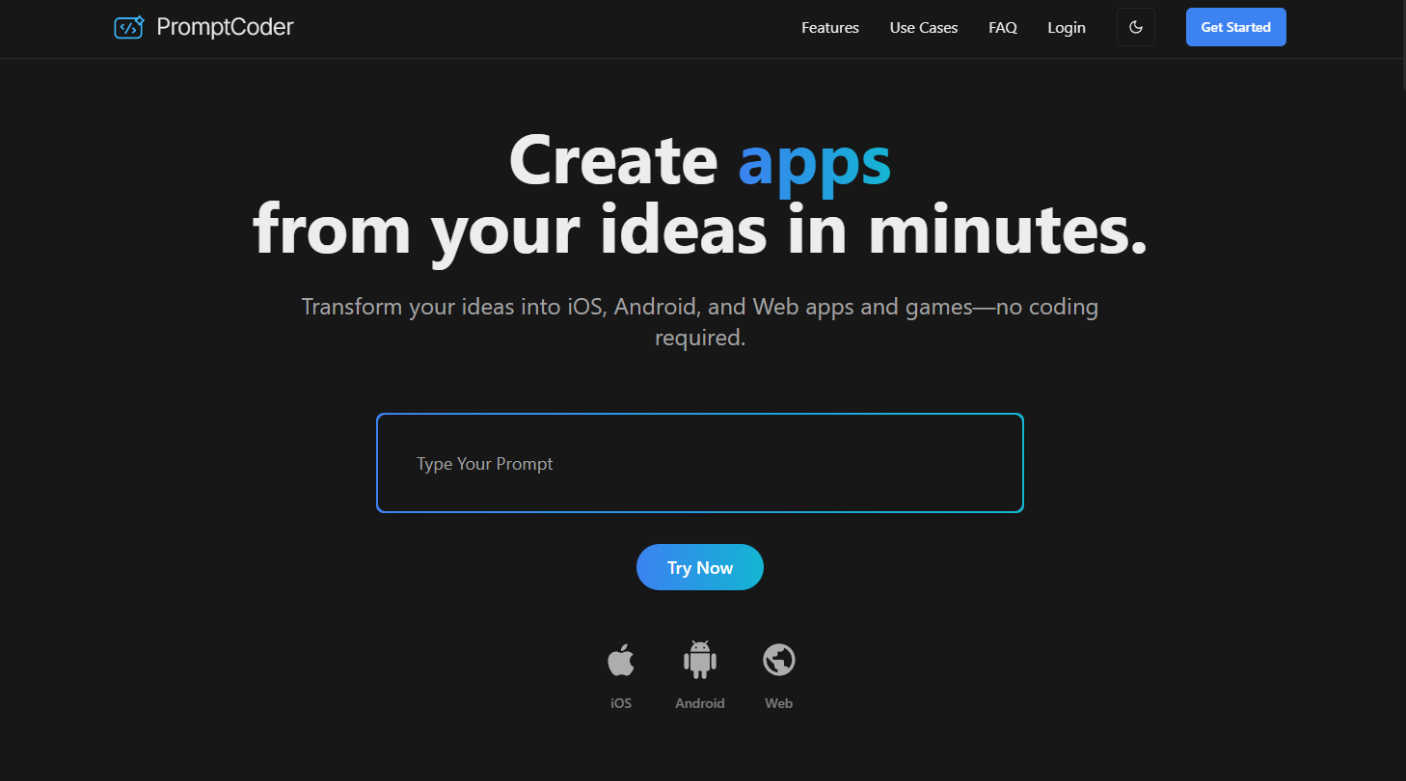
Prompt Coder uses AI to instantly transform your ideas into cross-platform apps and games.
Last updated: March 1, 2026
Visual Comparison
Agent to Agent Testing Platform
Prompt Coder
Feature Comparison
Agent to Agent Testing Platform
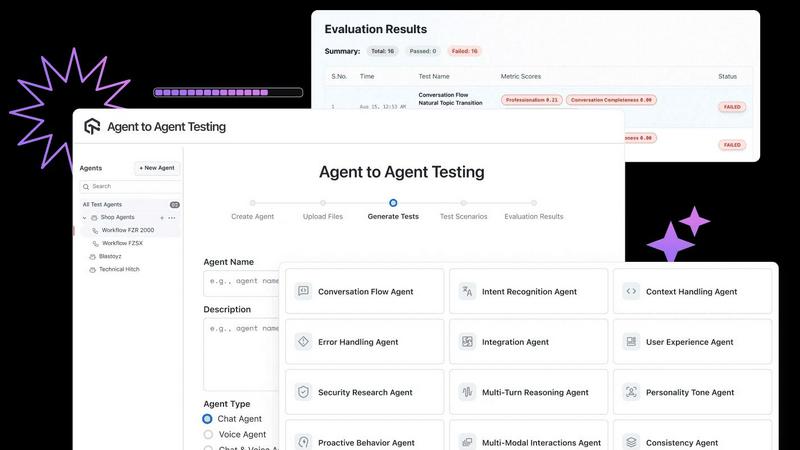
Automated Scenario Generation
This feature allows users to create diverse test cases for AI agents automatically, simulating various interactions such as chat, voice, hybrid, or phone calls. This capability ensures comprehensive coverage across different communication scenarios.
True Multi-Modal Understanding
By enabling the input of multiple formats, including text, images, audio, and video, this feature allows users to set detailed requirements that reflect real-world conditions. It helps gauge the expected output of AI agents in a more holistic manner.
Autonomous Test Scenario Generation
Access to a library of hundreds of pre-defined scenarios empowers users to efficiently evaluate AI agents. Custom scenarios can also be developed, catering to specific testing needs such as assessing personality tone or intent recognition.
Regression Testing with Risk Scoring
This feature conducts end-to-end regression testing, highlighting potential areas of concern through risk scoring. It allows organizations to prioritize critical issues, optimizing their testing efforts and ensuring a robust AI agent performance.
Prompt Coder
Natural Language to Code Conversion
This is the foundational technology of Prompt Coder, where sophisticated AI models interpret human-written prompts and descriptions to generate the underlying source code for applications. The system understands context, desired features, and user interface elements from plain English (or other supported languages), translating abstract ideas into structured programming syntax for multiple platforms. This feature handles the complexity of syntax, frameworks, and platform-specific requirements automatically.
Cross-Platform Deployment Engine
Prompt Coder's architecture is designed for inherent multi-platform support. When an application is generated, the AI ensures the core logic and assets are adapted to create native-compatible versions for iOS, Android, and responsive web applications simultaneously. This engine manages the nuances of each operating system, from UI/UX guidelines to API integrations, providing a true "write once, deploy everywhere" experience without sacrificing native performance or feel.
AI-Powered Iteration and Prototyping
The platform facilitates rapid prototyping and iterative design. Users can provide follow-up prompts to modify existing applications, such as "add a user login screen" or "change the primary color to blue," and the AI will intelligently update the codebase accordingly. This allows for real-time experimentation and refinement, turning the development process into a dynamic conversation between the creator and the AI, significantly accelerating the journey from prototype to polished product.
Integrated Publishing Suite
Beyond development, Prompt Coder provides tools and guidance for publishing completed applications to major platforms. This includes assistance with generating necessary assets (like icons and screenshots), configuring app store listings, and understanding submission guidelines for the Apple App Store and Google Play Store, as well as web hosting setup. This end-to-end support streamlines the path from a working build to a publicly available software product.
Use Cases
Agent to Agent Testing Platform
Quality Assurance for Chatbots
Enterprises can employ the platform to rigorously test chatbots across various scenarios, ensuring they respond accurately and effectively to user inquiries while maintaining a friendly tone and adherence to data privacy policies.
Voice Assistant Testing
The platform is ideal for validating the performance of voice assistants, simulating real-world interactions to assess their understanding of user intent, tone, and their ability to handle complex queries seamlessly.
Phone Caller Agent Evaluation
Organizations can utilize the Agent to Agent Testing Platform to evaluate phone caller agents, ensuring they deliver a professional and empathetic interaction experience while adhering to compliance and escalation protocols.
Multi-Persona Testing
By leveraging diverse personas, businesses can simulate different user behaviors and needs during testing. This ensures that AI agents are equipped to handle a wide range of customer interactions effectively and efficiently.
Prompt Coder
Entrepreneurial MVP Development
Startup founders and solo entrepreneurs can use Prompt Coder to rapidly build a Minimum Viable Product (MVP) for their business idea. By describing the core functionality—such as a marketplace, a booking system, or a content delivery app—they can generate a working prototype in minutes. This allows for quick market validation, user testing, and pitching to investors without the initial high cost and time investment of hiring a development team.
Educational Tool and Resource Creation
Educators and instructional designers can create custom interactive learning applications, quizzes, or simulation tools tailored to their specific curriculum. For instance, a teacher could prompt the AI to "create an app for practicing vocabulary with flashcards and a multiple-choice quiz," resulting in a personalized educational tool for their students without needing any programming knowledge.
Small Business Digital Solutions
Local business owners can develop custom applications to enhance their operations and customer engagement. Examples include creating a loyalty rewards app, a simple menu and ordering system for a restaurant, an appointment booking app for a service provider, or a portfolio showcase for a freelancer. This empowers small businesses to compete digitally with customized tools that would otherwise be cost-prohibitive.
Personal Project and Hobbyist Development
Individuals with creative ideas for games, utility apps, or personal productivity tools can bring their concepts to life. A hobbyist could describe a simple 2D game concept, a habit-tracking application, or a personal finance dashboard, and Prompt Coder will handle the complex coding. This opens up software creation as a form of personal expression and problem-solving for a non-technical audience.
Overview
About Agent to Agent Testing Platform
Agent to Agent Testing Platform is an innovative, AI-native quality assurance framework tailored to assess the performance of AI agents in real-world scenarios. As AI agents become increasingly autonomous and complex, traditional quality assurance methods designed for static software systems are proving inadequate. This platform offers a comprehensive solution that evaluates multi-turn conversations across various interfaces, including chat, voice, and phone interactions. It is aimed at enterprises that require rigorous validation processes before deploying AI agents in production. The platform excels in identifying long-tail failures, edge cases, and interaction patterns that manual testing often overlooks, ensuring that AI agents operate reliably and effectively. By leveraging a suite of over 17 specialized AI agents, it empowers businesses to simulate thousands of interactions, providing insights into critical metrics such as bias, toxicity, and hallucinations. Ultimately, the Agent to Agent Testing Platform is essential for organizations seeking to enhance the quality of their AI systems while maintaining user trust and satisfaction.
About Prompt Coder
Prompt Coder is an AI-powered software publisher and development platform that fundamentally democratizes the creation of digital applications. It serves as a transformative bridge between conceptual ideas and functional software by leveraging advanced natural language processing. Users can articulate their vision for an application or game in simple text descriptions, and the platform's AI engine interprets these prompts to generate complete, production-ready code. This process eliminates the traditional requirement for extensive programming expertise, enabling a broad spectrum of users including entrepreneurs, educators, content creators, and small business owners to build and publish their own software. The core value proposition lies in its ability to drastically reduce development time and technical barriers, allowing creators to focus purely on innovation and user experience. Prompt Coder specializes in delivering cross-platform compatibility, ensuring the applications it helps create are natively functional for iOS and Android mobile ecosystems as well as modern web browsers. By integrating artificial intelligence directly into the software development lifecycle, the platform ensures the output is not only functional but also adheres to contemporary standards of scalability, reliability, and user-centric design.
Frequently Asked Questions
Agent to Agent Testing Platform FAQ
What types of AI agents can be tested using the platform?
The Agent to Agent Testing Platform supports various types of AI agents, including chatbots, voice assistants, and phone caller agents. This versatility allows for comprehensive testing across numerous interaction types.
How does the platform ensure comprehensive test coverage?
The platform employs automated scenario generation and a library of predefined test cases to create diverse testing scenarios. This approach ensures that AI agents are evaluated under multiple conditions, covering a wide range of potential user interactions.
Can I create custom test scenarios?
Yes, users have the capability to create custom test scenarios tailored to their specific needs. This feature allows for focused testing on particular aspects of AI behavior such as personality tone or intent recognition.
How does risk scoring work in regression testing?
Risk scoring provides insights into potential vulnerabilities in the AI agent's performance following updates or changes. The system highlights areas of concern, allowing teams to prioritize issues and optimize their QA efforts effectively.
Prompt Coder FAQ
What is PromptCoder?
Prompt Coder is an AI-powered software publisher and development platform that transforms natural language descriptions into fully functional applications for iOS, Android, and the web. It acts as both a tool for users to create software without coding and as a publisher that leverages AI to build innovative applications. The platform's core mission is to democratize software development by removing technical barriers through artificial intelligence.
What types of applications do you publish?
As a publisher, Prompt Coder creates and releases a wide range of software solutions across categories, all powered by its underlying AI technology. This includes innovative mobile applications for productivity, education, utilities, and entertainment on both iOS and Android platforms, as well as modern web-based software solutions designed to work seamlessly across all browsers and devices.
How does AI power your software development?
The company utilizes artificial intelligence throughout its development lifecycle. AI algorithms are employed to automate code generation, optimize user interface and experience design, perform rigorous testing, and ensure the software is scalable and reliable. This AI-centric approach allows for faster development cycles, consistent code quality, and the ability to rapidly prototype and iterate on software concepts based on natural language input.
Which platforms do you support?
Prompt Coder provides comprehensive support for all major digital platforms. This includes native application development for Apple's iOS ecosystem and Google's Android platform, ensuring apps meet each system's specific design and performance standards. Additionally, the platform develops fully responsive web applications that are compatible with all modern desktop and mobile browsers, providing universal access.
Alternatives
Agent to Agent Testing Platform Alternatives
The Agent to Agent Testing Platform is an innovative AI-native quality assurance framework specially designed to validate the behavior of AI agents across various communication channels, including chat, voice, phone, and multimodal systems. This platform is particularly crucial as it addresses the complexities of autonomous AI systems, which increasingly operate in unpredictable ways that traditional QA processes cannot adequately assess. Users often seek alternatives due to factors such as pricing, specific feature requirements, or the need for compatibility with existing platforms, reflecting a desire for tailored solutions that better align with their operational demands. When evaluating alternatives to the Agent to Agent Testing Platform, it is essential to consider several critical aspects. Look for platforms that offer comprehensive testing capabilities across multiple interaction types, scalability for synthetic user interactions, and robust validation mechanisms for compliance and security. Additionally, prioritize solutions that can accommodate the unique needs of your organization, such as integration with existing systems and access to advanced analytics for ongoing performance monitoring.
Prompt Coder Alternatives
Prompt Coder is an AI-powered development assistant that allows users to generate functional applications and games for iOS, Android, and the web using simple text descriptions. It belongs to the category of AI assistants, specifically those designed to democratize software creation by translating natural language into code. This no-code approach enables rapid prototyping and cross-platform deployment, making it a powerful tool for non-technical creators. Users often explore alternatives to find a solution that better aligns with their specific requirements. Common reasons include seeking different pricing models, more granular control over the generated code, specialized features for particular types of applications, or integration with other development tools and workflows. The needs of a solo entrepreneur, a large enterprise team, and an educational institution can vary significantly, driving the search for a tailored platform. When evaluating alternatives, key considerations include the platform's core technology and output quality, the range of target platforms it supports, and the depth of customization and iteration it allows. It is also crucial to assess the learning curve, the availability of support and community resources, and the long-term viability of the projects created. The ideal choice balances ease of use with the flexibility to grow with your project's complexity.