
Agenta vs diffray
Side-by-side comparison to help you choose the right product.

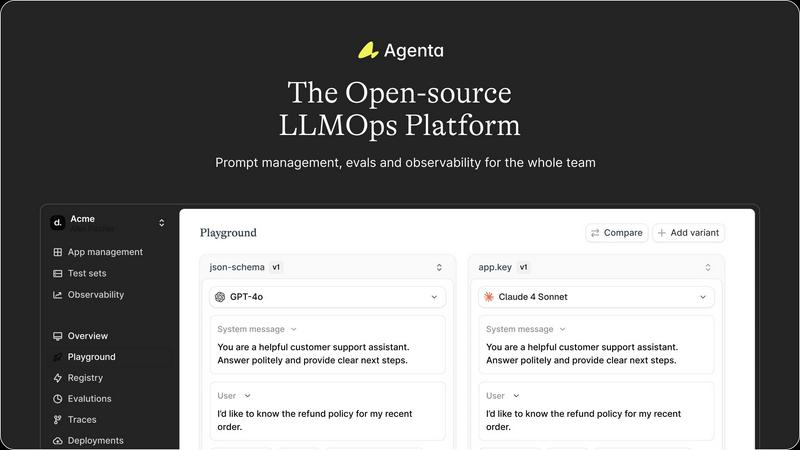
Agenta is an open-source LLMOps platform that centralizes prompt management and evaluation for reliable AI development.
Last updated: March 1, 2026

diffray
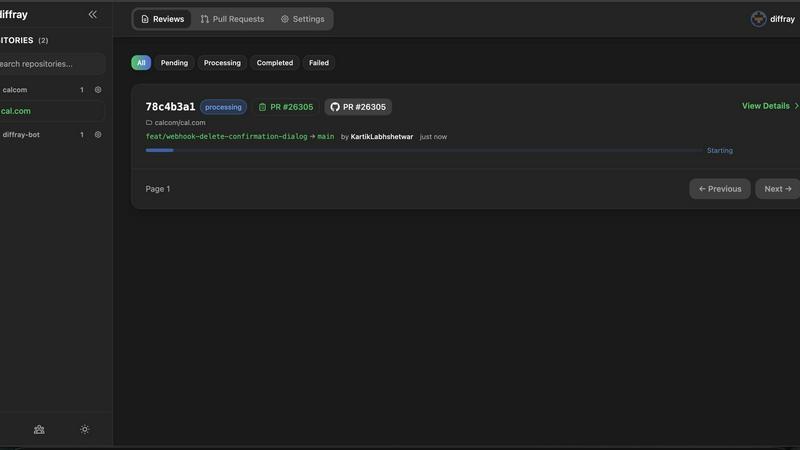
Diffray offers advanced multi-agent AI code reviews that significantly reduce false positives while identifying real.
Last updated: February 28, 2026
Visual Comparison
Agenta
diffray
Feature Comparison
Agenta
Centralized Prompt Management
Agenta's centralized prompt management feature allows teams to keep all prompts, evaluations, and traces in one unified platform, eliminating the chaos of scattered tools. This ensures that everyone involved has access to the latest versions of prompts and can collaborate effectively without losing critical information.
Automated Evaluation Processes
With Agenta, teams can create systematic evaluation processes that automate the testing and validation of every change made to prompts and models. This feature minimizes guesswork and allows for more reliable assessments of model performance through integrated evaluators that can be customized as needed.
Comprehensive Observability Tools
Agenta provides robust observability tools that allow teams to trace every request and pinpoint exact failure points in their AI systems. This feature facilitates effective debugging and helps gather vital user feedback, which can be annotated and transformed into actionable test cases with a single click.
Unified Collaboration Interface
The platform includes a user-friendly interface that empowers domain experts, product managers, and developers to work together within a single workflow. This feature simplifies the process of experimenting, comparing, versioning, and debugging prompts, making it easier for all team members to contribute without needing deep technical expertise.
About diffray
Multi-Agent Architecture
diffray's unique multi-agent architecture allows for a tailored code review experience. Each of the 30+ agents specializes in evaluating distinct aspects of code quality, ensuring that reviews are thorough, accurate, and relevant. This system minimizes irrelevant feedback, allowing developers to focus on critical issues that matter most.
Enhanced Issue Detection
By leveraging its specialized agents, diffray boasts a threefold increase in the detection of genuine coding issues compared to traditional tools. This enhanced issue detection not only improves code quality but also reduces the likelihood of deploying problematic code into production environments, thereby increasing overall software reliability.
Significant Time Savings
One of the standout features of diffray is its ability to streamline the code review process, drastically reducing the time spent on PR reviews. Teams report that the average review time has plummeted from 45 minutes to just 12 minutes weekly, allowing developers to allocate their time more efficiently to other critical tasks in the development lifecycle.
Targeted Feedback Mechanism
diffray provides focused feedback that is specific to the coding issues identified by its agents. This targeted feedback mechanism helps developers understand not only what the issues are but also why they matter and how to resolve them effectively, resulting in a more streamlined development process and higher quality code.
Use Cases
Agenta
Collaborative Development of LLM Applications
Agenta is ideal for teams looking to collaboratively develop LLM applications. By providing a centralized platform, it allows developers and subject matter experts to work together on prompt engineering and model evaluation, fostering innovation and efficiency.
Streamlined Debugging and Performance Monitoring
AI teams can leverage Agenta to streamline their debugging processes. The observability tools allow them to identify and address issues quickly, while the automated evaluation processes ensure continuous performance monitoring, helping to maintain high-quality standards in production.
Agile Iteration and Experimentation
Agenta supports agile methodologies by enabling rapid iteration of prompts and models. Teams can experiment with various approaches, track their results, and validate changes effectively, ensuring that their LLM applications remain competitive and responsive to user needs.
Integration with Existing Workflows
Agenta's ability to integrate seamlessly with popular frameworks and models like LangChain, LlamaIndex, and OpenAI makes it a versatile choice for teams. This feature enables organizations to leverage their existing technology stack while adopting best practices in LLMOps.
diffray
Agile Development Teams
Agile development teams benefit immensely from diffray's rapid code review capabilities. By reducing PR review times, teams can iterate faster, respond to changes promptly, and maintain a steady pace of delivery, which is vital in an agile environment.
Large Codebases
For organizations managing extensive codebases, diffray's multi-agent architecture ensures that reviews are manageable and focused. This is essential for large teams where the volume of code can lead to overwhelming PRs filled with noise, allowing developers to concentrate on critical issues without distraction.
Continuous Integration Pipelines
In continuous integration workflows, diffray can be integrated to evaluate code automatically as it is submitted. This allows teams to catch issues early in the development process, leading to smoother deployments and less technical debt over time.
Security-Focused Development
Given its emphasis on security, diffray is particularly useful for teams developing applications where security is paramount. The specialized agents focusing on security vulnerabilities help ensure that potential threats are identified and addressed before they can affect production systems.
Overview
About Agenta
Agenta is an innovative open-source LLMOps platform that revolutionizes the way large language model (LLM) applications are developed and deployed. Designed to create a collaborative environment, Agenta enables developers and subject matter experts to work together seamlessly, experimenting with prompts, evaluating model performance, and debugging production issues efficiently. The platform addresses critical challenges faced by AI teams, such as unpredictable LLM behavior, fragmented prompt management, siloed communication, and an absence of structured validation processes. By centralizing the LLM development workflow, Agenta enhances team collaboration, improves workflow efficiency, and accelerates rapid iterations, ultimately leading to the creation of high-quality LLM applications. It serves as a single source of truth, ensuring that all team members—from product managers to developers and domain experts—can engage in a coherent and transparent process.
About diffray
diffray is an advanced AI-powered code review tool that revolutionizes the code review process by utilizing a sophisticated multi-agent architecture. Unlike conventional AI tools that rely on a singular, generic model, diffray employs a network of over 30 specialized agents, each dedicated to evaluating specific facets of code quality. This includes critical areas such as security, performance, bugs, best practices, and search engine optimization (SEO). Such a targeted architecture greatly minimizes the noise typically found in pull requests (PRs), achieving an impressive 87 percent reduction in false positives while tripling the detection rate of actual issues. This makes diffray an invaluable asset for development teams striving to enhance their code quality and efficiency. By significantly cutting down the time required for PR reviews—from an average of 45 minutes to just 12 minutes per week—diffray enables teams to uphold high standards in their codebases without the usual clutter and distraction associated with traditional code review solutions.
Frequently Asked Questions
Agenta FAQ
What is LLMOps, and how does Agenta fit into it?
LLMOps refers to the set of practices and tools designed to improve the development and deployment of large language models. Agenta fits into this framework by providing a centralized platform that streamlines collaboration, prompt management, evaluation, and observability.
Can Agenta integrate with existing tools and frameworks?
Yes, Agenta is designed to integrate seamlessly with a variety of existing tools and frameworks, including LangChain, LlamaIndex, OpenAI, and others. This flexibility allows teams to incorporate Agenta into their current workflows without significant disruption.
How does Agenta enhance team collaboration?
Agenta enhances team collaboration by providing a unified interface where product managers, developers, and domain experts can work together on prompt engineering and model evaluation. This reduces silos and improves communication across the team.
Is Agenta suitable for organizations of all sizes?
Absolutely. Agenta is designed to be scalable and adaptable, making it suitable for organizations of all sizes, from startups to large enterprises. Its open-source nature allows teams to customize the platform to fit their specific needs and workflows.
diffray FAQ
How does diffray reduce false positives?
diffray employs a multi-agent architecture with over 30 specialized agents that focus on various aspects of code quality, resulting in an 87 percent reduction in false positives. This targeted approach ensures that feedback is more relevant and actionable.
Can diffray integrate with my existing tools?
Yes, diffray is designed to integrate seamlessly with popular development tools and platforms, making it easy to incorporate into your existing workflows without significant disruption.
What kind of support does diffray offer for users?
diffray provides comprehensive user support, including documentation, tutorials, and customer service to help users maximize the benefits of the tool and address any issues that may arise during its use.
Is diffray suitable for small teams and startups?
Absolutely. diffray is beneficial for teams of all sizes, including small teams and startups, as it enhances code quality and efficiency, enabling even the smallest teams to maintain high standards in their codebases without excessive overhead.
Alternatives
Agenta Alternatives
Agenta is an open-source LLMOps platform that centralizes prompt management, evaluation, and debugging for large language model applications. It is designed to enhance collaboration among developers and subject matter experts by providing a unified environment for experimentation and model performance evaluation. Users commonly seek alternatives to Agenta due to a variety of factors, including pricing, specific feature sets, or unique platform requirements that may not be fully addressed by Agenta. When considering alternatives, it is essential to evaluate the platform's ability to streamline workflows, enhance collaboration, and provide robust evaluation tools, ensuring that it meets the specific needs of your team and project. --- [{"question": "What is Agenta?", "answer": "Agenta is an open-source LLMOps platform that centralizes prompt management, evaluation, and debugging for large language model applications."},{"question": "Who is Agenta for?", "answer": "Agenta is designed for developers and subject matter experts working on large language model applications who need a collaborative environment for prompt experimentation and evaluation."},{"question": "Is Agenta free?", "answer": "Yes, Agenta is an open-source platform, which means it is available for free to users."},{"question": "What are the main features of Agenta?", "answer": "Agenta features centralized prompt management, a unified playground for experimentation, and an automated evaluation system to enhance the reliability of model modifications."}]
diffray Alternatives
Diffray is an innovative AI-powered code review tool that falls into the development category, specifically designed to enhance the code review process through a multi-agent architecture. This tool stands out by utilizing over 30 specialized agents, each focusing on distinct aspects of code quality, which dramatically reduces false positives and improves the identification of real issues within code. Users often seek alternatives to diffray for a variety of reasons, including budget constraints, specific feature requirements, or compatibility with different platforms and workflows. When choosing an alternative, it is crucial to consider factors such as the effectiveness of the code analysis, the relevance of the feedback provided, integration capabilities with existing tools, and overall user experience. Finding a solution that aligns with the specific needs of a development team can lead to improved code quality and more efficient review processes.