
Agent to Agent Testing Platform vs AI Detector
Side-by-side comparison to help you choose the right product.

Agent to Agent Testing Platform
Validate AI agent performance across chat, voice, and phone interactions while detecting compliance and security risks.
Last updated: February 26, 2026
AI Detector
AI Detector verifies content authenticity by identifying AI-generated text from leading models like ChatGPT and GPT-4.
Last updated: March 1, 2026
Visual Comparison
Agent to Agent Testing Platform
AI Detector
Feature Comparison
Agent to Agent Testing Platform
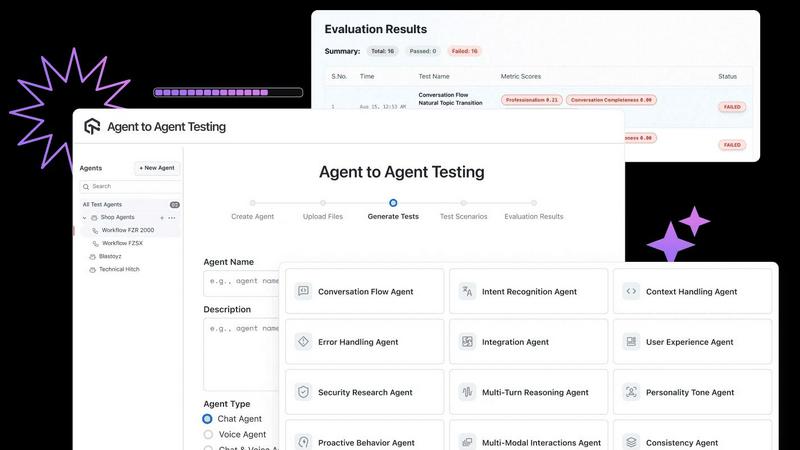
Automated Scenario Generation
This feature allows users to create diverse test cases for AI agents automatically, simulating various interactions such as chat, voice, hybrid, or phone calls. This capability ensures comprehensive coverage across different communication scenarios.
True Multi-Modal Understanding
By enabling the input of multiple formats, including text, images, audio, and video, this feature allows users to set detailed requirements that reflect real-world conditions. It helps gauge the expected output of AI agents in a more holistic manner.
Autonomous Test Scenario Generation
Access to a library of hundreds of pre-defined scenarios empowers users to efficiently evaluate AI agents. Custom scenarios can also be developed, catering to specific testing needs such as assessing personality tone or intent recognition.
Regression Testing with Risk Scoring
This feature conducts end-to-end regression testing, highlighting potential areas of concern through risk scoring. It allows organizations to prioritize critical issues, optimizing their testing efforts and ensuring a robust AI agent performance.
AI Detector
Advanced AI Detection Engine
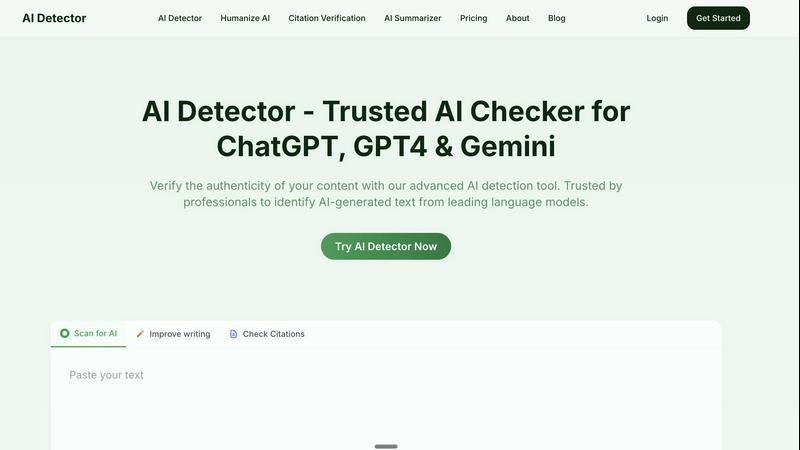
At the heart of AI Detector is a state-of-the-art detection algorithm specifically trained to recognize the unique linguistic patterns and statistical fingerprints of text produced by major AI models. It goes beyond a simple binary result, providing a detailed sentence-level analysis. Each sentence within a submitted text is individually assessed and highlighted if AI-generated, accompanied by a visual gauge showing the overall percentage of AI content. This granular approach allows users to pinpoint exactly which sections may require revision or further scrutiny, offering transparency and actionable insights rather than just a final score.
Comprehensive Writing & Integrity Suite
AI Detector transcends the role of a mere detector by incorporating a full spectrum of writing and verification tools. This integrated suite includes a robust plagiarism checker to cross-reference content against vast databases, a citation verification tool to ensure reference accuracy, an advanced grammar and style corrector, and a sophisticated paraphrasing tool. This multifaceted capability makes it a one-stop solution for content refinement and integrity assurance, enabling users to not only identify AI-generated text but also improve the overall quality, originality, and credibility of their writing in a single, efficient workflow.
Privacy-First & Secure Analysis
In an era of significant data privacy concerns, AI Detector is built on a foundational commitment to user security. The platform operates under a strict policy where all submitted content is processed in real-time for analysis and is never stored on its servers, logged, or shared with any third parties. This ensures that sensitive documents—such as unpublished research, proprietary business reports, or confidential academic essays—can be checked with absolute trust. Users can verify the authenticity of their work without the fear of their intellectual property being compromised or their data being used for secondary purposes.
Multilingual Support & Detailed Analytics
Catering to a global user base, AI Detector supports the detection of AI-generated content across multiple languages with high reliability. This makes it an invaluable tool for international institutions, multinational corporations, and non-native English speakers. Furthermore, the tool provides comprehensive analytics reports that extend beyond simple highlights. These reports include confidence scores for the detection verdict and detailed AI probability metrics, giving users a deep, quantitative understanding of the analysis. This level of detail supports more informed decision-making, whether for grading assignments, editing content, or auditing documents.
Use Cases
Agent to Agent Testing Platform
Quality Assurance for Chatbots
Enterprises can employ the platform to rigorously test chatbots across various scenarios, ensuring they respond accurately and effectively to user inquiries while maintaining a friendly tone and adherence to data privacy policies.
Voice Assistant Testing
The platform is ideal for validating the performance of voice assistants, simulating real-world interactions to assess their understanding of user intent, tone, and their ability to handle complex queries seamlessly.
Phone Caller Agent Evaluation
Organizations can utilize the Agent to Agent Testing Platform to evaluate phone caller agents, ensuring they deliver a professional and empathetic interaction experience while adhering to compliance and escalation protocols.
Multi-Persona Testing
By leveraging diverse personas, businesses can simulate different user behaviors and needs during testing. This ensures that AI agents are equipped to handle a wide range of customer interactions effectively and efficiently.
AI Detector
Academic Integrity for Educators and Students
Educational institutions worldwide utilize AI Detector to uphold academic honesty. Professors and teachers can efficiently screen student submissions—including essays, research papers, and homework—to ensure work is original and complies with institutional policies. Conversely, students can proactively use the tool to self-check their drafts before submission, ensuring their own writing is not inadvertently flagged and that any properly cited external sources or ethically used paraphrasing tools do not create false positives, thereby safeguarding their academic standing.
Content Authenticity for Marketing and Publishing
Content creators, digital marketers, bloggers, and journalists rely on AI Detector to verify the originality of their work before publication. Search engine algorithms and discerning audiences increasingly penalize or distrust content that is identifiably AI-generated. By using the detector, professionals can ensure their blog posts, articles, marketing copy, and social media content maintain a genuine, human voice. This helps build trust with their audience, improves search engine ranking potential, and protects the creator's professional reputation for originality.
Due Diligence in Corporate and Legal Environments
In professional settings where the authenticity of documents is paramount, AI Detector serves as a critical due diligence tool. Businesses can audit internal reports, client communications, whitepapers, and legal documents to confirm they are human-authored, mitigating risks associated with misinformation or unverified AI-generated content. Legal professionals can use it to check the authenticity of evidentiary documents or drafted briefs, ensuring all materials meet the stringent standards of originality and reliability required in legal proceedings.
Research and Development Verification
Researchers, scientists, and R&D departments use AI Detector to maintain the integrity of their scholarly work. When drafting research papers, grant proposals, or technical documentation, it is crucial that the core ideas and expressions are genuinely their own. The tool helps verify that any use of AI for brainstorming or initial drafting has been sufficiently transformed through original human analysis and writing, ensuring that publications meet the ethical standards of academic and scientific communities and are prepared for peer review.
Overview
About Agent to Agent Testing Platform
Agent to Agent Testing Platform is an innovative, AI-native quality assurance framework tailored to assess the performance of AI agents in real-world scenarios. As AI agents become increasingly autonomous and complex, traditional quality assurance methods designed for static software systems are proving inadequate. This platform offers a comprehensive solution that evaluates multi-turn conversations across various interfaces, including chat, voice, and phone interactions. It is aimed at enterprises that require rigorous validation processes before deploying AI agents in production. The platform excels in identifying long-tail failures, edge cases, and interaction patterns that manual testing often overlooks, ensuring that AI agents operate reliably and effectively. By leveraging a suite of over 17 specialized AI agents, it empowers businesses to simulate thousands of interactions, providing insights into critical metrics such as bias, toxicity, and hallucinations. Ultimately, the Agent to Agent Testing Platform is essential for organizations seeking to enhance the quality of their AI systems while maintaining user trust and satisfaction.
About AI Detector
AI Detector is a sophisticated, multi-faceted software platform engineered to serve as the definitive authority for content authenticity in the age of generative artificial intelligence. Its primary function is to meticulously analyze text and identify content generated by leading large language models (LLMs) such as ChatGPT, GPT-4, Google Gemini, and Anthropic Claude. Designed for a global professional and academic audience, including educators, students, researchers, content creators, and business professionals, the tool addresses the critical need for verifying originality and maintaining integrity in written work. Its core value proposition lies in its exceptional 99.9%+ accuracy rate, which is third-party verified, providing users with unparalleled confidence in its assessments. Beyond simple detection, AI Detector distinguishes itself by integrating a comprehensive suite of writing assistance tools—including plagiarism checking, citation verification, grammar correction, and paraphrasing—all within a privacy-first framework that guarantees user data is never stored or shared. This combination of high-fidelity detection, versatile utility, and uncompromising security establishes AI Detector as an essential tool for anyone committed to producing and validating genuine, human-authored content.
Frequently Asked Questions
Agent to Agent Testing Platform FAQ
What types of AI agents can be tested using the platform?
The Agent to Agent Testing Platform supports various types of AI agents, including chatbots, voice assistants, and phone caller agents. This versatility allows for comprehensive testing across numerous interaction types.
How does the platform ensure comprehensive test coverage?
The platform employs automated scenario generation and a library of predefined test cases to create diverse testing scenarios. This approach ensures that AI agents are evaluated under multiple conditions, covering a wide range of potential user interactions.
Can I create custom test scenarios?
Yes, users have the capability to create custom test scenarios tailored to their specific needs. This feature allows for focused testing on particular aspects of AI behavior such as personality tone or intent recognition.
How does risk scoring work in regression testing?
Risk scoring provides insights into potential vulnerabilities in the AI agent's performance following updates or changes. The system highlights areas of concern, allowing teams to prioritize issues and optimize their QA efforts effectively.
AI Detector FAQ
How Does AI Detector work?
AI Detector employs a sophisticated machine learning model trained on a massive, diverse dataset containing both human-written text and content generated by various AI models like ChatGPT and Gemini. It analyzes submitted text for specific linguistic patterns, syntactic structures, and statistical anomalies characteristic of AI generation. The system performs a deep, sentence-level analysis, comparing each segment against its trained model to calculate a probability score. The result is a detailed report that highlights suspect sentences and provides an overall confidence assessment of the content's origins.
What is the accuracy rate of AI Detector?
AI Detector boasts an industry-leading accuracy rate of 99.9%+, a claim that has been substantiated through rigorous third-party verification and continuous testing. This high level of precision is achieved by constantly updating its detection algorithms in response to new AI model releases and evolving writing styles. The platform is specifically engineered to minimize both false positives (incorrectly flagging human text as AI) and false negatives (failing to detect AI-generated text), providing users with a highly reliable assessment they can trust for critical decisions.
Who Benefits from AI Detector's AI content detector?
A wide range of individuals and organizations benefit from AI Detector. This includes educators and academic institutions enforcing honor codes; students ensuring their work's originality; content creators, marketers, and journalists maintaining authentic voices; businesses and legal professionals conducting document due diligence; and researchers upholding publication integrity. Essentially, any professional or individual who creates, evaluates, or is responsible for written content and has a vested interest in its authenticity will find significant value in this tool.
Will my text get plagiarized or be available online, if I check it on AI Detector?
No, absolutely not. AI Detector operates on a strict privacy-first principle. Your text is processed in a secure, transient manner solely for the purpose of analysis. The company guarantees that it does not store, log, share, or use your submitted content for any purpose other than generating your immediate detection report. Your intellectual property remains completely confidential and is never added to any database or made accessible online, allowing you to check even the most sensitive documents with complete peace of mind.
Alternatives
Agent to Agent Testing Platform Alternatives
The Agent to Agent Testing Platform is an innovative AI-native quality assurance framework specially designed to validate the behavior of AI agents across various communication channels, including chat, voice, phone, and multimodal systems. This platform is particularly crucial as it addresses the complexities of autonomous AI systems, which increasingly operate in unpredictable ways that traditional QA processes cannot adequately assess. Users often seek alternatives due to factors such as pricing, specific feature requirements, or the need for compatibility with existing platforms, reflecting a desire for tailored solutions that better align with their operational demands. When evaluating alternatives to the Agent to Agent Testing Platform, it is essential to consider several critical aspects. Look for platforms that offer comprehensive testing capabilities across multiple interaction types, scalability for synthetic user interactions, and robust validation mechanisms for compliance and security. Additionally, prioritize solutions that can accommodate the unique needs of your organization, such as integration with existing systems and access to advanced analytics for ongoing performance monitoring.
AI Detector Alternatives
AI Detector is a specialized software tool within the AI Assistants category, designed to verify content authenticity by identifying text generated by models like ChatGPT, GPT-4, and Gemini. It provides users with detailed analytics and a suite of integrated writing tools to ensure the originality and integrity of their work. Users often explore alternatives to such tools for various reasons, including budget constraints, specific feature requirements not met by one solution, or the need for compatibility with different platforms and workflows. The search for a different tool is a common step in finding the optimal balance between functionality, cost, and user experience for individual or organizational needs. When evaluating an alternative, key considerations should include the accuracy and scope of the AI detection technology, the depth of reporting and analytics provided, and the range of additional features like plagiarism checking or multilingual support. Privacy policies and data security guarantees are also critical factors, as is the overall value proposition relative to the cost.