
CCAPI vs VideoAny
Side-by-side comparison to help you choose the right product.

CCAPI
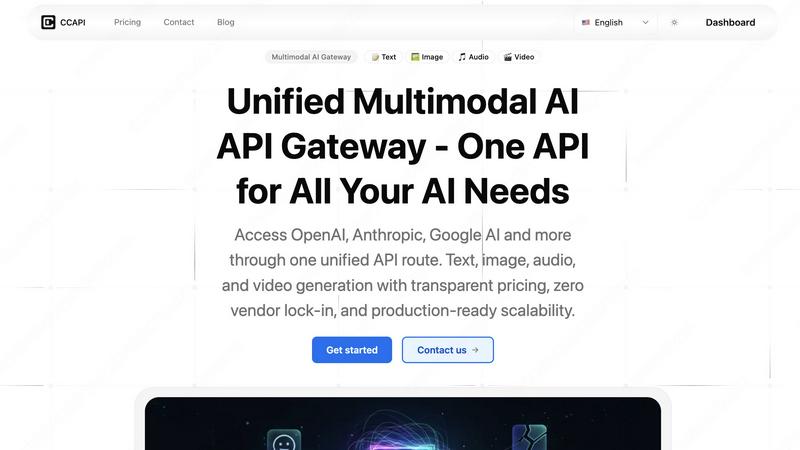
CCAPI is a unified multimodal AI API gateway providing seamless access to various AI models for text, image, audio, and.
Last updated: February 26, 2026

VideoAny
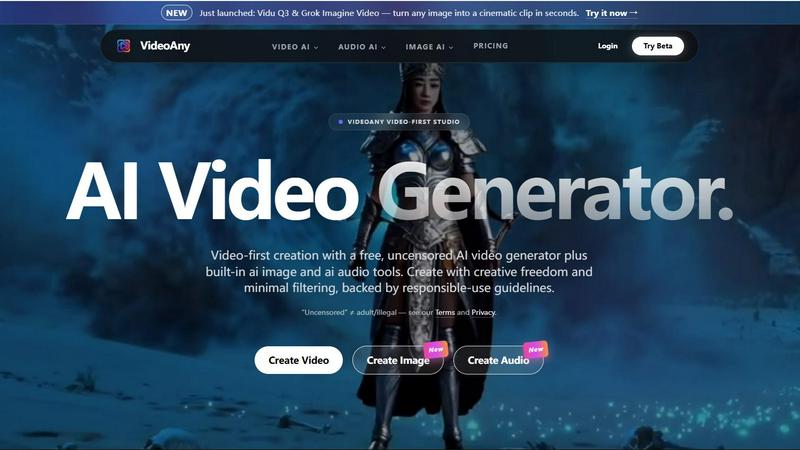
VideoAny is a comprehensive AI video-first studio that integrates video, image, and audio generation tools for creative production.
Last updated: April 13, 2026
Visual Comparison
CCAPI
VideoAny
Feature Comparison
CCAPI
Unified API Access
CCAPI aggregates multiple AI providers, including OpenAI, Anthropic, and Google AI, under a single API endpoint. This means developers can access a variety of AI functionalities without having to integrate multiple APIs separately, thus saving time and reducing complexity.
Smart Routing
One of the standout features of CCAPI is its smart routing capability. In the event of a provider failure, CCAPI automatically switches to a different provider, ensuring that your application remains operational. This auto-failover mechanism minimizes downtime and enhances user experience.
Multimodal AI Capabilities
CCAPI is built to support multiple modalities including text, image, audio, and video generation. Developers can leverage this feature to create diverse applications that require different forms of AI processing, all through one unified endpoint.
Pay-as-You-Go Pricing
CCAPI offers a straightforward pay-as-you-go pricing model, where users only pay for what they use. This eliminates the need for complex subscription plans and hidden fees, providing transparency and allowing developers to control their budgets effectively.
About VideoAny
Uncensored AI Video & Image Generation
VideoAny's flagship feature is its "uncensored" generation mode, which applies minimal filtering to user prompts. This is specifically enabled for its proprietary VideoAny model, allowing for creative exploration of themes and concepts that might be restricted on other platforms due to stringent safety policies. It is crucial to note that this freedom operates within a strict legal and ethical framework that prohibits illegal content. This feature is designed for artists and creators who require fewer constraints on their imaginative process while maintaining responsible creation practices.
Multi-Model AI Studio Integration
The platform aggregates top-tier AI models into one seamless interface. Users are not limited to a single AI's capabilities but can leverage specialized models like Kling 3.0 for high-motion video from images, Vidu Q3 for rapid cinematic clip generation, and Grok Imagine for both video and image tasks. This integration allows creators to choose the best tool for a specific job, whether it's achieving a particular visual style, motion quality, or generation speed, all without leaving the VideoAny ecosystem.
One-Click AI Video Effects Library
VideoAny hosts an extensive library of over 60 pre-built AI video effects that enable rapid, template-style transformations. With a single click, users can apply effects such as making subjects in a photo dance, hug, kiss, or engage in other animated actions. This feature dramatically lowers the barrier to creating engaging, dynamic content from static images, making advanced AI animation accessible to users of all skill levels for creating fun, shareable social media content.
Unified AI Audio Generation Suite
Complementing its visual tools, VideoAny includes a built-in AI audio generator. This suite encompasses text-to-music composition, voice cloning, and sound effects (SFX) generation. This holistic approach ensures creators can score their AI-generated videos, add narrative voiceovers, or include impactful audio cues without relying on external software, enabling a complete, end-to-end production pipeline entirely within the VideoAny studio.
Use Cases
CCAPI
Chatbot Development
Developers can utilize CCAPI to build sophisticated chatbots that leverage the latest language models for natural conversation. By accessing various providers through a single API, they can enhance the chatbot's conversational abilities and responsiveness.
Content Creation
With CCAPI, content creators can generate high-quality articles, blogs, and social media posts using advanced text generation models. This not only speeds up the content creation process but also allows for the exploration of diverse writing styles.
Multimedia Applications
CCAPI's multimodal capabilities enable developers to create applications that generate video content or audio clips alongside traditional text responses. This is ideal for industries such as entertainment and marketing, where engaging multimedia content is crucial.
Research and Data Analysis
Researchers can leverage CCAPI to access a variety of AI models for data analysis, summarization, and insights generation. By integrating different AI capabilities, they can streamline their research processes and gain deeper insights from their data.
VideoAny
Viral Social Media Content Creation
Social media managers and influencers can use VideoAny to rapidly ideate and produce eye-catching, trend-based video clips. By leveraging text-to-video for quick concepts, the AI effects library for adding viral-ready animations to photos, and the audio tools for adding trending sounds or music, creators can maintain a consistent and engaging posting schedule designed to maximize shares and audience growth across platforms like TikTok, Instagram Reels, and YouTube Shorts.
Prototyping and Storyboarding for Filmmakers
Independent filmmakers and animators can utilize VideoAny as a powerful pre-visualization tool. The ability to generate cinematic clips from text descriptions or concept art (using models like Vidu Q3) allows for rapid iteration on scenes, visual styles, and narrative flow. This use case enables directors and producers to create dynamic, low-fidelity storyboards and mood reels to secure funding, communicate vision to crews, and test creative ideas before committing to expensive production phases.
Dynamic Digital Marketing and Advertising
Marketing agencies and e-commerce brands can employ VideoAny to create cost-effective, high-impact ad creatives. The platform allows for the quick generation of product demonstration videos, the animation of static product images to show features, and the creation of branded audio jingles or voiceovers. This enables A/B testing of different creative concepts at scale and the personalization of video ads for different target demographics without traditional production overhead.
Experimental Digital Art and Animation
Digital artists and animators exploring the intersection of AI and art can use VideoAny's uncensored generation and diverse model set as a canvas for experimentation. The platform facilitates the creation of unique, AI-driven visual and audio pieces, the exploration of new aesthetic movements, and the blending of multiple generative styles. Artists can push creative boundaries, generate assets for larger projects, or create standalone pieces for exhibition in digital art spaces.
Overview
About CCAPI
CCAPI is a cutting-edge unified API designed to streamline access to various AI models, including those from industry leaders like OpenAI, Anthropic, Google AI, and more. It provides developers with a single point of contact to generate text, images, audio, and video seamlessly, thereby enhancing productivity and simplifying integration processes. The primary value proposition of CCAPI lies in its robust infrastructure that features smart routing capabilities, allowing it to automatically switch between multiple providers in case of a failure, thus ensuring uninterrupted service. With a remarkable 99.9% success rate and 24/7 monitoring, CCAPI is ideal for developers seeking reliable, high-performance solutions for AI-driven applications. Whether you are building chatbots, content generation tools, or multimedia applications, CCAPI offers the versatility and reliability needed to meet your requirements. The platform supports various programming languages and is designed to be OpenAI-compatible, making it extraordinarily easy to integrate into existing projects with minimal effort.
About VideoAny
VideoAny is a comprehensive, video-first AI creative studio designed to consolidate the entire content creation workflow into a single, powerful platform. It distinguishes itself by offering immense creative freedom with minimal content filtering, positioning itself as an "uncensored" hub for creators. This philosophy is built on a foundation of responsible-use guidelines, explicitly prohibiting illegal or adult content, but allowing for a broader range of artistic and conceptual expression than typically found in mainstream AI tools. The platform integrates three core generative AI modalities: video, image, and audio. Creators can start from text prompts or uploaded images to generate high-quality, fluid videos suitable for social media, advertising, and digital storytelling. It supports a wide array of cutting-edge AI models, including Kling 3.0 for bringing images to life with motion, Vidu Q3 for cinematic clips, and Grok Imagine, providing users with state-of-the-art options for different creative needs. VideoAny is built for a broad spectrum of users, from social media influencers and digital marketers seeking to produce viral content quickly, to independent filmmakers and artists exploring the boundaries of AI-assisted creation. Its core value proposition is the elimination of the need for a fragmented "creative stack," offering an all-in-one intelligent platform that promises to be everything a creator needs to go viral.
Frequently Asked Questions
CCAPI FAQ
What types of AI models can I access through CCAPI?
CCAPI provides access to a wide range of AI models from multiple providers, including text models for chat completions and reasoning, image generation models, audio synthesis models, and video generation models.
Is there a waitlist for accessing CCAPI?
No, CCAPI offers instant API access without any waitlist requirements. This allows developers to get started immediately and integrate the API into their applications without delays.
How does the smart routing feature work?
The smart routing feature automatically detects when a specific AI provider is down or experiencing issues. It swiftly reroutes requests to a different provider, ensuring that your application continues to function smoothly without interruption.
Can I use CCAPI with my existing code?
Yes, CCAPI is designed to be OpenAI-compatible, allowing developers to easily swap their API base URL from OpenAI to CCAPI. This means minimal changes to existing code are required, facilitating a smooth transition.
VideoAny FAQ
What does "uncensored" mean on VideoAny?
On VideoAny, "uncensored" refers to a generation mode with minimal automated content filtering, offering wider creative freedom for artistic and conceptual exploration. It is explicitly not a license for adult or illegal content, which remains strictly prohibited under the platform's Terms of Service. This mode is primarily available on VideoAny's proprietary models, while integrated third-party models (like Kling or Vidu) operate under their own content policies and may apply additional safety filters.
Is there a free plan for VideoAny?
Yes, VideoAny offers a free tier that provides access to core features of the AI video, image, and audio generators. This allows users to test the platform's fundamental capabilities. However, free usage typically comes with limitations, such as lower output resolution, watermarks, standard processing queues, and restrictions on commercial usage, which are expanded upon in paid subscription plans.
Can I use the content I create for commercial purposes?
The rights for commercial use depend on your specific subscription plan. Generally, paid subscribers are granted broader licensing rights that allow for the commercial use of generated content in projects like advertisements, client work, and sold media. Users on the free tier are usually limited to personal, non-commercial use only. It is essential to review the specific Terms of Service for your plan to understand the exact scope of usage rights.
How does VideoAny handle the data and images I upload?
VideoAny states that user uploads are encrypted during transmission to protect data security. The platform's data handling practices are governed by its Privacy Policy. Users retain control over their content, deciding what to publish or share publicly. For detailed information on data storage, processing, and retention, creators should consult the official Privacy Policy document provided on the VideoAny website.
Alternatives
CCAPI Alternatives
CCAPI, the Unified Multimodal AI API Gateway, serves as a versatile solution in the realm of artificial intelligence, allowing developers to access a range of AI services through a single API. This capability simplifies the integration of various AI functionalities, including text, image, audio, and video generation. Users often seek alternatives to CCAPI for several reasons, including pricing structures that better fit their budget, specific feature sets that align more closely with their project requirements, or the need for compatibility with particular platforms or technologies. When searching for alternatives to CCAPI, it is essential to evaluate several factors. Consider the range of AI services offered, the ease of integration with existing systems, the scalability of the API, and the overall cost. Additionally, user support and documentation quality can play a significant role in ensuring a smooth development experience, making these aspects vital in the decision-making process.
VideoAny Alternatives
VideoAny is a comprehensive AI video and image generation platform, categorized as an AI assistant for creative content production. It functions as a video-first AI studio, integrating tools for generating video, images, and audio from text prompts or existing images, with a noted emphasis on offering creators significant creative freedom. Users often explore alternatives for various practical reasons. These can include seeking different pricing models or subscription tiers, requiring specific features not available in one platform, or needing to comply with different content moderation policies for their target audience. The search may also be driven by a desire for different user interfaces, integration capabilities, or support for particular AI models. When evaluating alternatives, key considerations should include the core AI capabilities for video and image generation, the range of supported models and their output quality, the platform's approach to content guidelines, and the overall value proposition regarding cost, ease of use, and workflow integration. Assessing the tool's suitability for your specific creative or professional needs is paramount.