
Decode This Text vs Skene
Side-by-side comparison to help you choose the right product.

Decode This Text
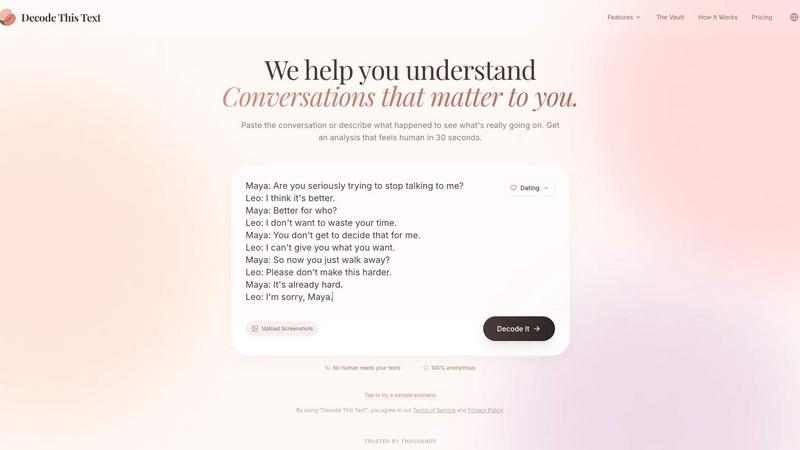
Decode This Text provides instant, human-like analysis of confusing conversations in just thirty seconds.
Last updated: February 28, 2026

Skene embeds product-led growth directly into your codebase, automating onboarding and retention.
Last updated: February 28, 2026
Visual Comparison
Decode This Text
Skene
Feature Comparison
Decode This Text
Multi-Format Input and Contextual Analysis
The platform accepts user input in three flexible formats: direct text pasting, screenshot uploads, or a descriptive narrative of the event. This versatility ensures that any conversational context can be captured and analyzed, whether it's a direct quote, a visual of a chat history, or a user's recollection of an interaction. The AI then performs a deep contextual analysis, examining not just the words but also timing, response patterns, and linguistic cues to construct a holistic understanding of the subtext and underlying dynamics at play.
Tone, Effort, and Intent Metrics
A cornerstone feature is the presentation of clear, quantified metrics for each analyzed message or conversation. The tool evaluates and displays percentages for Tone (the emotional temperature, e.g., friendly, cold, sarcastic), Effort (the level of engagement and investment shown by the other party), and Intent (their underlying motives or interest level). This data-driven breakdown moves users beyond gut feelings to an evidence-based assessment of the communication's true nature.
Pattern Detection and Behavioral Insights
Decode This Text's AI is trained to identify subtle behavioral patterns that individuals might overlook in the heat of the moment. This includes detecting if a contact only messages late at night, consistently avoids answering direct questions, or if their messages are becoming progressively shorter and less engaged. By highlighting these trends, the tool provides crucial "reality check" insights into the other person's communication habits and potential intentions.
AI-Generated Response Suggestions
To bridge analysis into action, the tool provides practical, AI-crafted response options. Users are presented with multiple tailored suggestions for how to reply, categorized by approach—such as calm, direct, or firm. This feature eliminates the paralysis of not knowing what to say next, equipping users with confident, context-appropriate language to navigate the conversation forward effectively.
Skene
Codebase-Derived Growth Signals
Skene performs a deep analysis of your application's source code to automatically identify and extract meaningful growth signals. Instead of relying on manually instrumented events or external analytics snippets, it scans the repository structure, framework, and code patterns to detect user interaction points, potential activation opportunities, and friction areas. This creates a foundational "growth manifest" that serves as a precise, always-up-to-date context layer, ensuring that all growth automation is built upon a real-time understanding of how the product actually works.
Prompt-Driven Growth Implementation
The platform enables a revolutionary workflow where growth loops and optimizations are designed and executed through natural language prompts within the developer's IDE, such as Cursor. Developers or their AI agents can instruct Skene to analyze bottlenecks, generate improved user flows, or implement specific onboarding steps. This shifts the paradigm from managing disparate SaaS dashboards and widgets to shipping growth iterations with the same agility and ownership as feature development, directly within the codebase.
Autonomous PLG Flow Generation & Testing
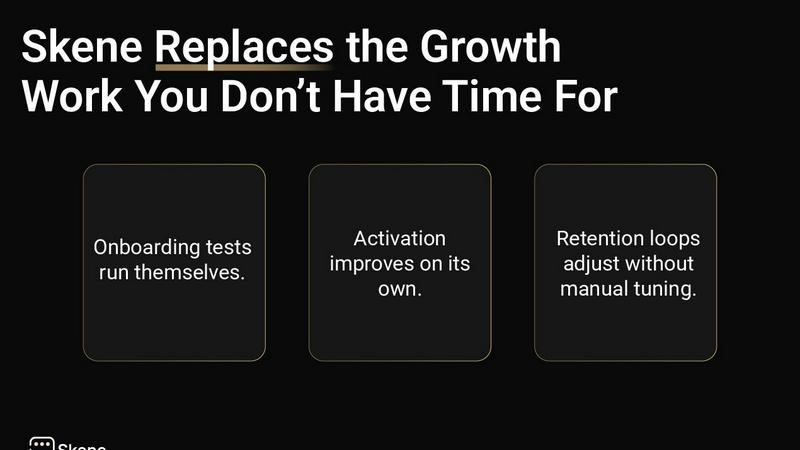
Skene functions as a self-learning growth engine. By continuously monitoring user interactions against the insights from the codebase, it can autonomously create, A/B test, and deploy optimized user journeys. It detects activation drop-offs and friction points, then experiments with improved configurations, measures their impact on key metrics like completion rates, and deploys the most effective versions. This automates the entire cycle of growth iteration without requiring manual intervention from a dedicated team.
Owned & Version-Controlled Growth Infrastructure
A fundamental differentiator of Skene is that it operates as owned infrastructure, not a third-party service. The growth logic, analytics, and automation become part of your codebase, fully version-controlled and integrated into your standard development lifecycle. This eliminates the risks of broken UI overlays after deploys, performance degradation from external scripts, and data silos. Growth logic updates seamlessly whenever you push code, and all data remains within your ecosystem.
Use Cases
Decode This Text
Deciphering Romantic and Dating Ambiguity
This is a primary use case, addressing the common anxieties of modern dating. Users can analyze texts from potential partners to understand mixed signals, gauge genuine interest after a date, interpret sudden changes in communication frequency, or decode the meaning behind vague phrases like "I'll let you know." It helps answer pressing questions such as whether someone is truly busy or is losing interest, providing clarity that prevents over-analysis and regretful messages.
Interpreting Professional and Workplace Communication
The tool is invaluable for navigating office politics and professional etiquette. Employees can use it to parse the meaning behind a terse, one-word email from a manager, understand the real implication behind phrases like "we'll keep your resume on file," or craft a polite but firm way to say "no" to a request. It aids in understanding power dynamics and unspoken expectations in professional correspondence.
Navigating Friendships and Family Dynamics
Decode This Text helps users manage complex social relationships within their inner circle. It can be used to understand why a group chat went silent after a specific message, interpret a family member's passive-aggressive comment, or determine if a friend's distant behavior is a sign of a problem or simply a reflection of their own stress. It acts as an impartial mediator for social friction.
Preventing Regret and Providing Emotional Validation
A critical use case is serving as a preventative "second opinion" before sending an emotionally charged message. By analyzing the situation first, users can avoid sending texts they might "regret forever." Furthermore, for many users, the tool's analysis provides essential emotional validation—confirming their perceptions or offering a wiser, more objective perspective that friends, who may be biased, cannot.
Skene
Automated Onboarding Optimization for Early-Stage Startups
Indie developers and startups with limited resources can use Skene to completely automate their user onboarding process. By connecting their repository, Skene analyzes the code to understand key activation milestones, then automatically generates and iterates on in-app guidance, tutorial flows, and welcome sequences. This ensures new users consistently find value without the startup needing to build or manually maintain a complex onboarding system.
AI-Agent Managed Growth Operations
Engineering teams can integrate Skene's context layer into their AI development workflows. An AI agent, equipped with the insights from Skene's codebase analysis, can be prompted to audit the user journey, identify the top friction point, and implement a fix—all autonomously. This use case allows for fully automated, continuous growth optimization where the AI handles routine iteration, freeing human developers for more complex tasks.
Replacing Legacy Growth & Analytics Stacks
Companies frustrated with a fragmented stack of analytics tools, survey widgets, and intercom-style messengers can use Skene as a unified replacement. It consolidates signal detection, analytics, and lifecycle automation into a single, code-native system. This eliminates the maintenance burden, data disjointedness, and performance overhead associated with managing multiple external SaaS tools and snippets.
Data-Driven Retention and Churn Prevention
Product teams can leverage Skene to strengthen user retention systematically. The platform continuously analyzes user behavior patterns against the codebase to identify signals of potential churn, such as failed feature adoption or support ticket patterns. It can then automatically trigger personalized in-app messages, re-engagement flows, or feature recommendation prompts to proactively address issues and increase customer lifetime value (LTV).
Overview
About Decode This Text
Decode This Text is a sophisticated AI-powered communication analysis tool engineered to demystify the complex subtext of digital conversations. It functions as a personal communication consultant, providing users with a clear, objective breakdown of the underlying intentions, emotional tone, and social dynamics present in text-based exchanges. The tool is designed for anyone navigating the often ambiguous world of modern messaging, from deciphering a partner's vague texts and a friend's sudden silence to interpreting a boss's terse email or a client's non-committal response. Its core value proposition lies in transforming subjective anxiety into objective clarity. By pasting a conversation, uploading a screenshot, or describing a scenario, users receive a comprehensive, human-like analysis in approximately 30 seconds. This process not only decodes what is being said but, more importantly, what is meant, thereby empowering users to respond with confidence, improve interpersonal relationships, and avoid costly misunderstandings. With a staunch commitment to privacy—ensuring no human ever reads the submitted texts—Decode This Text offers a secure, anonymous, and invaluable service for enhancing emotional intelligence and communication efficacy in both personal and professional spheres.
About Skene
Skene is a revolutionary, AI-powered Product-Led Growth (PLG) infrastructure engineered to automate the growth iteration process for software products. It is specifically designed for indie developers, early-stage startups, and engineering teams who lack dedicated growth resources. Skene's core value proposition is transforming growth from a manual, tool-stack-dependent chore into an owned, code-first infrastructure. Unlike traditional third-party tools that operate as external "black boxes" with performance-impacting snippets and siloed data, Skene integrates directly with a product's codebase and IDE. It analyzes the source code to automatically derive growth signals, identify friction points in user journeys (like onboarding drop-offs), and generate context for AI agents to implement optimizations. This allows products to autonomously evolve their activation, onboarding, and retention flows. By treating growth as programmable infrastructure, Skene enables developers to offload growth-related tasks, ship data-driven improvements through simple prompts, and focus on core product development, all while maintaining full ownership, performance, and integration with their existing workflow.
Frequently Asked Questions
Decode This Text FAQ
How does Decode This Text protect my privacy?
Privacy is a fundamental principle of the service. The platform is designed to be 100% anonymous, and the company explicitly states that "no human reads your texts." All analysis is performed by automated AI systems. Users are encouraged to review the platform's Terms of Service and Privacy Policy for detailed information on data handling, security measures, and anonymity guarantees.
What kind of input does the tool accept for analysis?
The tool offers three primary input methods for maximum convenience. You can directly paste the text of the conversation, upload a screenshot or photo of your chat (which the AI will read), or simply provide a written description of what happened. This flexibility ensures you can get an analysis regardless of how the conversation is stored or remembered.
What specific elements does the analysis cover?
The comprehensive analysis examines multiple layers of communication. It assesses the emotional tone (e.g., warmth, sarcasm, hostility), measures the apparent effort and engagement level of the participants, and deduces the underlying intent or motivation. It also detects behavioral patterns, such as avoidance or inconsistent messaging, and synthesizes these elements into a clear explanation of "what's really going on."
How is this tool better than asking a friend for advice?
While friends can offer support, their advice is often biased by their personal relationship with you and their own experiences. Decode This Text provides a completely objective, data-informed analysis focused solely on the communication patterns present in the text. It acts as an impartial, "wise older sibling" figure, offering consistent, pattern-based insights without emotional baggage, and is available instantly without the social burden of asking "for the hundredth time."
Skene FAQ
What is PLG software?
Product-Led Growth (PLG) software is a category of tools designed to help users discover, adopt, and derive value from a product primarily through their direct interaction with the product itself, rather than through manual intervention from sales or customer success teams. It automates key aspects of the user journey, such as onboarding, feature adoption, and retention, using the product as the primary vehicle for growth, guidance, and user education.
How is Skene different from traditional customer experience software?
Traditional customer experience tools (like walkthrough builders or survey tools) are typically external services that require manual, rule-based configuration of UI overlays and tours. These are often brittle, breaking with every code deployment, and create data silos. Skene is fundamentally different: it reads your actual codebase to automatically understand your product and generate context-aware growth flows. It is an owned infrastructure that updates automatically with your code, is fully programmable, and operates without fragile external snippets.
How long does it take to set up?
Setup is designed to be exceptionally fast, taking less than 60 seconds. The primary step involves connecting your GitHub or GitLab repository with read-only access. Once connected, Skene automatically begins analyzing your codebase to generate the initial growth manifest and identify PLG opportunities. No initial code changes, API integrations, or complex configuration is required to get started.
Is my code secure?
Yes, security is a core principle. Skene only requires read-only access to your repository for analysis purposes. All code analysis is performed within a secure, isolated environment. Crucially, because Skene promotes an "owned infrastructure" model, the resulting growth logic and analytics are implemented within your own codebase and systems, meaning your user data and business logic never need to be sent to or stored on an external platform.
Alternatives
Decode This Text Alternatives
Decode This Text is a productivity tool designed to analyze and clarify ambiguous or confusing written communication. It falls within the broader category of communication enhancement and text analysis software, helping users interpret the subtext, tone, and intent behind messages from colleagues, friends, or clients. Users often seek alternatives to such tools for various practical reasons. These can include budget constraints, as pricing models vary widely, or a need for specific features not offered, such as integration with other platforms, support for different languages, or more advanced analytical capabilities. Some may also require a solution that works on a specific operating system or within a particular workflow. When evaluating an alternative, key considerations should include the accuracy and depth of the analysis provided, the tool's ease of use and speed, and its commitment to data privacy and security. It's also wise to assess the cost relative to the value delivered and whether the tool can handle the specific types of communication challenges you face most frequently in your personal or professional life.
Skene Alternatives
Skene is an automated Product-Led Growth (PLG) iteration engine within the productivity and management software category. It is designed to autonomously optimize user onboarding, activation, and retention by analyzing codebase-driven insights and user interactions, making it a powerful tool for indie developers and resource-constrained startups. Users may explore alternatives to Skene for various reasons, including budgetary constraints, specific feature requirements not covered by its automated approach, or a need for platforms that integrate with a different set of existing tools. Some may seek solutions with more manual control or those that cater to larger, established teams with dedicated growth personnel. When evaluating an alternative, key considerations should include the platform's core methodology for driving growth, its integration depth with your development stack, the level of automation versus manual control offered, and the transparency and actionability of its analytics. The ideal solution should align with your team's technical capabilities and strategic growth objectives without compromising product performance.