
Skene
Skene embeds product-led growth directly into your codebase, automating onboarding and retention.
VisitPublished on:
December 4, 2025
Pricing:
About Skene
Skene is a revolutionary, AI-powered Product-Led Growth (PLG) infrastructure engineered to automate the growth iteration process for software products. It is specifically designed for indie developers, early-stage startups, and engineering teams who lack dedicated growth resources. Skene's core value proposition is transforming growth from a manual, tool-stack-dependent chore into an owned, code-first infrastructure. Unlike traditional third-party tools that operate as external "black boxes" with performance-impacting snippets and siloed data, Skene integrates directly with a product's codebase and IDE. It analyzes the source code to automatically derive growth signals, identify friction points in user journeys (like onboarding drop-offs), and generate context for AI agents to implement optimizations. This allows products to autonomously evolve their activation, onboarding, and retention flows. By treating growth as programmable infrastructure, Skene enables developers to offload growth-related tasks, ship data-driven improvements through simple prompts, and focus on core product development, all while maintaining full ownership, performance, and integration with their existing workflow.
Features of Skene
Codebase-Derived Growth Signals
Skene performs a deep analysis of your application's source code to automatically identify and extract meaningful growth signals. Instead of relying on manually instrumented events or external analytics snippets, it scans the repository structure, framework, and code patterns to detect user interaction points, potential activation opportunities, and friction areas. This creates a foundational "growth manifest" that serves as a precise, always-up-to-date context layer, ensuring that all growth automation is built upon a real-time understanding of how the product actually works.
Prompt-Driven Growth Implementation
The platform enables a revolutionary workflow where growth loops and optimizations are designed and executed through natural language prompts within the developer's IDE, such as Cursor. Developers or their AI agents can instruct Skene to analyze bottlenecks, generate improved user flows, or implement specific onboarding steps. This shifts the paradigm from managing disparate SaaS dashboards and widgets to shipping growth iterations with the same agility and ownership as feature development, directly within the codebase.
Autonomous PLG Flow Generation & Testing
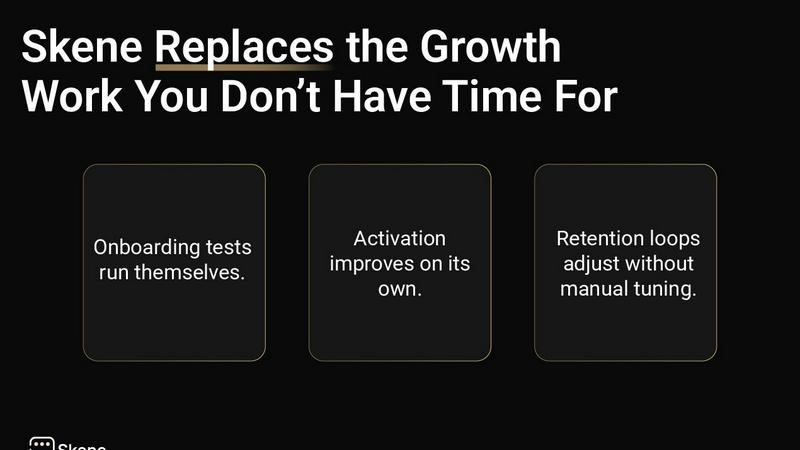
Skene functions as a self-learning growth engine. By continuously monitoring user interactions against the insights from the codebase, it can autonomously create, A/B test, and deploy optimized user journeys. It detects activation drop-offs and friction points, then experiments with improved configurations, measures their impact on key metrics like completion rates, and deploys the most effective versions. This automates the entire cycle of growth iteration without requiring manual intervention from a dedicated team.
Owned & Version-Controlled Growth Infrastructure
A fundamental differentiator of Skene is that it operates as owned infrastructure, not a third-party service. The growth logic, analytics, and automation become part of your codebase, fully version-controlled and integrated into your standard development lifecycle. This eliminates the risks of broken UI overlays after deploys, performance degradation from external scripts, and data silos. Growth logic updates seamlessly whenever you push code, and all data remains within your ecosystem.
Use Cases of Skene
Automated Onboarding Optimization for Early-Stage Startups
Indie developers and startups with limited resources can use Skene to completely automate their user onboarding process. By connecting their repository, Skene analyzes the code to understand key activation milestones, then automatically generates and iterates on in-app guidance, tutorial flows, and welcome sequences. This ensures new users consistently find value without the startup needing to build or manually maintain a complex onboarding system.
AI-Agent Managed Growth Operations
Engineering teams can integrate Skene's context layer into their AI development workflows. An AI agent, equipped with the insights from Skene's codebase analysis, can be prompted to audit the user journey, identify the top friction point, and implement a fix—all autonomously. This use case allows for fully automated, continuous growth optimization where the AI handles routine iteration, freeing human developers for more complex tasks.
Replacing Legacy Growth & Analytics Stacks
Companies frustrated with a fragmented stack of analytics tools, survey widgets, and intercom-style messengers can use Skene as a unified replacement. It consolidates signal detection, analytics, and lifecycle automation into a single, code-native system. This eliminates the maintenance burden, data disjointedness, and performance overhead associated with managing multiple external SaaS tools and snippets.
Data-Driven Retention and Churn Prevention
Product teams can leverage Skene to strengthen user retention systematically. The platform continuously analyzes user behavior patterns against the codebase to identify signals of potential churn, such as failed feature adoption or support ticket patterns. It can then automatically trigger personalized in-app messages, re-engagement flows, or feature recommendation prompts to proactively address issues and increase customer lifetime value (LTV).
Frequently Asked Questions
What is PLG software?
Product-Led Growth (PLG) software is a category of tools designed to help users discover, adopt, and derive value from a product primarily through their direct interaction with the product itself, rather than through manual intervention from sales or customer success teams. It automates key aspects of the user journey, such as onboarding, feature adoption, and retention, using the product as the primary vehicle for growth, guidance, and user education.
How is Skene different from traditional customer experience software?
Traditional customer experience tools (like walkthrough builders or survey tools) are typically external services that require manual, rule-based configuration of UI overlays and tours. These are often brittle, breaking with every code deployment, and create data silos. Skene is fundamentally different: it reads your actual codebase to automatically understand your product and generate context-aware growth flows. It is an owned infrastructure that updates automatically with your code, is fully programmable, and operates without fragile external snippets.
How long does it take to set up?
Setup is designed to be exceptionally fast, taking less than 60 seconds. The primary step involves connecting your GitHub or GitLab repository with read-only access. Once connected, Skene automatically begins analyzing your codebase to generate the initial growth manifest and identify PLG opportunities. No initial code changes, API integrations, or complex configuration is required to get started.
Is my code secure?
Yes, security is a core principle. Skene only requires read-only access to your repository for analysis purposes. All code analysis is performed within a secure, isolated environment. Crucially, because Skene promotes an "owned infrastructure" model, the resulting growth logic and analytics are implemented within your own codebase and systems, meaning your user data and business logic never need to be sent to or stored on an external platform.
Similar to Skene

AgencyFlo is the AI-native operating system for agencies - one platform for projects, time, CRM, proposals, contracts and invoicing.

AI-powered Upwork job feed. Every new job is scored against your profile and strategy in real time, and you get an instant notification


Back up Zoom cloud recordings to Google Drive automatically. Optional auto-delete frees Zoom storage. 60-second setup, then forget it.