
HookMesh vs Hostim.dev
Side-by-side comparison to help you choose the right product.

HookMesh simplifies webhook delivery with automatic retries and a self-service portal, ensuring reliability and peace.
Last updated: February 26, 2026

Hostim.dev
Hostim.dev deploys Docker apps with built-in databases on EU bare-metal for simple, predictable hosting.
Last updated: March 1, 2026
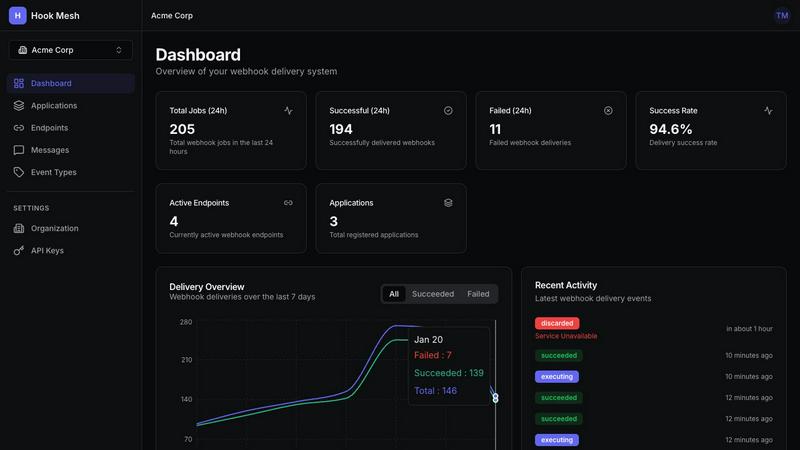
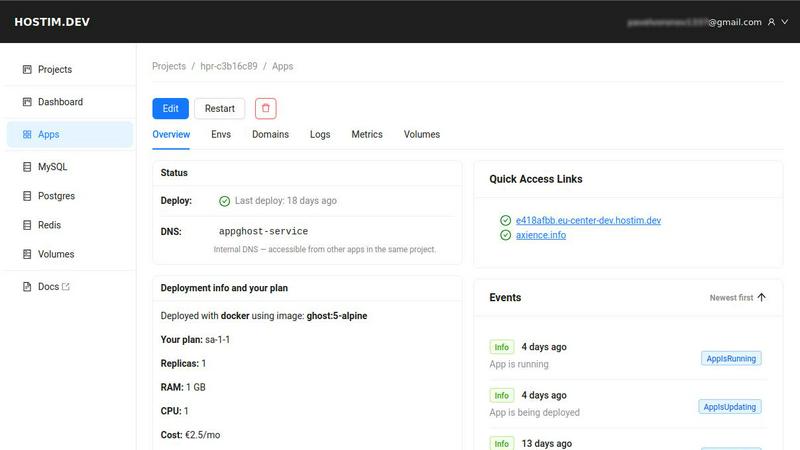
Visual Comparison
HookMesh
Hostim.dev
Feature Comparison
HookMesh
Reliable Delivery
HookMesh ensures that webhook delivery is never compromised. The platform employs automatic retries, utilizing exponential backoff strategies combined with jitter, allowing it to retry failed webhooks for up to 48 hours. This feature guarantees that webhook events reach their intended destinations without loss.
Circuit Breaker
The circuit breaker feature is designed to automatically disable failing endpoints, preventing them from disrupting the entire webhook delivery process. Once the endpoint recovers, it is re-enabled automatically, ensuring that issues are managed efficiently without manual intervention.
Customer Portal
HookMesh provides an embeddable user interface that enhances customer experience. This self-service portal allows customers to manage their endpoints, view detailed delivery logs, and replay failed webhook events with just one click, promoting greater transparency and operational efficiency.
Developer Experience
Designed with developers in mind, HookMesh offers a full REST API and official SDKs for JavaScript, Python, and Go. This comprehensive access allows for seamless integration into existing applications, enabling developers to send webhook events with minimal setup and maximum efficiency.
About Hostim.dev
Simplified Docker and Compose Deployment
Hostim.dev eliminates the need for complex configuration files or deep DevOps knowledge by supporting direct deployment from multiple sources. Users can launch applications by simply providing a public or private Docker image, connecting a Git repository for continuous deployment, or pasting an existing Docker Compose file. The platform handles the orchestration automatically, requiring no modification to standard Compose definitions, which drastically reduces the time from code to production.
Built-in Managed Databases and Persistent Volumes
The platform provides instant, integrated access to essential data services, removing the need to provision and manage separate database instances. Each project can be equipped with managed MySQL, PostgreSQL, and Redis databases, as well as persistent storage volumes, all pre-wired with automatic environment variables for seamless application connectivity. This integrated approach simplifies architecture and ensures data services are consistently available and properly configured.
Per-Project Isolation and Cost Tracking
Every application or client project on Hostim.dev runs within its own isolated Kubernetes namespace, ensuring complete environmental separation, security, and clean resource boundaries. This architecture is perfectly complemented by a transparent per-project billing model. Users can track exact costs for each individual project, providing unparalleled clarity for internal accounting or straightforward client invoicing, eliminating the opacity of aggregated cloud bills.
EU Bare-Metal Hosting with GDPR Compliance
Hostim.dev operates on physical bare-metal servers located in Germany, ensuring high performance and data sovereignty for European users and their clients. This infrastructure choice, combined with a privacy-by-design approach, means the platform is GDPR compliant by default. Users benefit from the performance of dedicated hardware without the management burden, and with the assurance that data residency and regulatory requirements are inherently addressed.
Use Cases
HookMesh
E-commerce Order Notifications
In an e-commerce setting, HookMesh can be utilized to send real-time order notifications to various external services. By ensuring reliable delivery, businesses can keep customers informed about their order status, enhancing the overall shopping experience.
Payment Processing
Payment processors can leverage HookMesh to deliver transaction updates to merchants effectively. The automatic retry and circuit breaker features ensure that critical payment notifications are consistently delivered, even in cases of temporary endpoint failures.
SaaS Integration
For SaaS products that need to communicate with other services, HookMesh simplifies the process of sending webhook events. This integration allows for seamless data flow between applications, enabling features like user account updates, data synchronization, and more.
Event-Driven Architecture
Companies adopting an event-driven architecture can use HookMesh to manage event notifications between microservices. By ensuring that all events are reliably delivered, organizations can maintain operational continuity and responsiveness in their systems.
Hostim.dev
Freelancer Client Project Delivery
Freelancers can use Hostim.dev to rapidly deploy and hand off projects to clients. By deploying via Docker or Compose, they avoid lengthy server setup. The per-project isolation and clear cost tracking allow for creating a dedicated, secure environment for each client with a precise, billable monthly cost, facilitating clean and professional project handovers without ongoing maintenance obligations.
Agency Multi-Client Management
Digital agencies managing applications for multiple clients benefit from the inherent project isolation, which prevents resource or configuration conflicts between different client workloads. The per-project cost tracking provides exact breakdowns for each client, simplifying internal cost allocation and transparent billing. EU hosting also meets common client data residency requirements.
Startup and Side-Project Prototyping
Startups and individual developers working on prototypes or side projects can leverage the platform to go from idea to live deployment in minutes. The free trial, built-in databases, and simple scaling allow for validating concepts with real infrastructure without upfront investment in DevOps expertise or fear of unexpected costs, enabling faster iteration and market testing.
Educational and Portfolio Development
Students and developers looking to build practical skills can use Hostim.dev to learn modern deployment practices using real Docker containers and managed databases without navigating the complexity of cloud consoles. The platform allows them to create live, publicly accessible portfolio projects that demonstrate hands-on experience with professional-grade deployment workflows.
Overview
About HookMesh
HookMesh is a cutting-edge solution designed to streamline and enhance the delivery of webhooks for modern Software as a Service (SaaS) products. It tackles the myriad complexities associated with building webhooks internally, such as implementing retry logic, managing circuit breakers, and diagnosing delivery issues. By adopting HookMesh, businesses can concentrate on their core offerings rather than being encumbered by the intricate technicalities of webhook management. This robust platform boasts a battle-tested infrastructure that guarantees reliable delivery through features like automatic retries, exponential backoff, and idempotency keys. HookMesh is tailored for developers and product teams who aim to deliver a seamless customer experience while ensuring consistent and reliable webhook event delivery. With a self-service portal that empowers users, HookMesh facilitates straightforward endpoint management and visibility. Users can also effortlessly replay failed webhooks with a single click, making it the preferred choice for organizations seeking a dependable webhook strategy that promotes peace of mind.
About Hostim.dev
Hostim.dev is a specialized, developer-centric Platform-as-a-Service (PaaS) that provides a streamlined solution for deploying and managing containerized applications on bare-metal infrastructure. It is engineered to bridge the critical gap between the simplicity of traditional PaaS platforms and the powerful flexibility of container orchestration systems like Kubernetes. The platform is explicitly designed for developers, freelancers, digital agencies, and startups who require the portability and modern workflow of Docker containers but wish to completely avoid the operational overhead, steep learning curve, and unpredictable costs associated with managing underlying infrastructure and DevOps tooling.
Its core value proposition lies in abstracting away complexity while delivering essential, pre-integrated services. Users can deploy applications directly from a Docker image, a Git repository, or a full Docker Compose file without any modification, enabling launch in minutes. Every project is automatically provisioned with an isolated Kubernetes namespace for security and clean separation. A significant differentiator is its transparent, predictable pricing model with per-project cost tracking, coupled with GDPR-compliant hosting on bare-metal servers in Germany. Hostim.dev effectively delivers a controlled, efficient, and cost-predictable environment that empowers teams to focus on building software rather than managing infrastructure.
Frequently Asked Questions
HookMesh FAQ
What are webhooks and how do they work?
Webhooks are automated messages sent from apps when something happens. They send data in real-time to another application, allowing for instant updates. Webhooks work via HTTP requests to a specified URL when triggered by an event in the source application.
How does HookMesh ensure webhook reliability?
HookMesh guarantees webhook reliability through a combination of automatic retries, exponential backoff, and circuit breaker mechanisms. These features work together to ensure that webhook events are delivered successfully, even in the face of temporary failures.
Can I manage my webhook endpoints with HookMesh?
Yes, HookMesh provides a self-service portal that allows users to manage their webhook endpoints easily. This includes adding new endpoints, viewing delivery logs, and replaying failed webhooks with just a click.
What programming languages does HookMesh support?
HookMesh offers official SDKs for JavaScript, Python, and Go, enabling developers to integrate webhook functionalities into their applications quickly. The REST API also supports sending webhook events from any programming language that can make HTTP requests.
Hostim.dev FAQ
What does the free tier include?
The platform offers a 5-day free trial project with no credit card required for signup. This trial allows full access to deploy applications using Docker images, Git, or Compose files, and includes the use of built-in services to test functionality. It provides a complete, time-limited environment to evaluate the platform's capabilities with your actual workload before any commitment.
Can I deploy with just a Docker Compose file?
Yes, this is a core capability of Hostim.dev. You can directly paste your existing Docker Compose file (typically docker-compose.yml) into the platform's interface. The system will parse and deploy the defined services without requiring any modifications, automatically handling networking, service discovery, and orchestration on your behalf, making migration and deployment exceptionally straightforward.
Where is my application hosted?
All applications deployed on Hostim.dev are hosted on bare-metal servers located in Germany within the European Union. This ensures data sovereignty, low latency for European users, and inherent compliance with GDPR regulations. The use of physical servers (bare-metal) also provides performance benefits compared to virtualized cloud instances.
Do I need to know Kubernetes to use Hostim.dev?
No, you do not need any knowledge of Kubernetes. Hostim.dev uses Kubernetes as a robust underlying orchestration layer, but it completely abstracts this complexity away from the user. Developers interact only with familiar concepts like Docker images, Git repos, and Compose files. The platform automatically manages all Kubernetes objects and configurations.
Alternatives
HookMesh Alternatives
HookMesh is a cutting-edge solution that falls within the category of webhook delivery services, designed to optimize and streamline the webhook management process for SaaS products. It alleviates the technical burdens associated with in-house webhook implementations, such as error handling and retry mechanisms, allowing businesses to focus on their core offerings. Users often seek alternatives to HookMesh for various reasons, including pricing considerations, feature sets that may better align with their specific needs, or the desire for a platform that integrates more seamlessly with their existing tech stack. When evaluating alternatives to HookMesh, it is essential to consider several factors. Users should assess the reliability of delivery mechanisms, the usability of customer portals, and the overall developer experience. Additionally, understanding the pricing models, support options, and customizability of the alternatives can significantly impact the decision-making process. A thorough comparison of these attributes will help ensure that the chosen solution meets both current and future webhook management needs.
Hostim.dev Alternatives
Hostim.dev is a specialized bare-metal Platform-as-a-Service (PaaS) designed to simplify the deployment of Docker-based applications. It targets developers and small teams who want the power of containerized environments without the operational overhead of managing infrastructure. The platform automates deployment from Docker images, Git, or Docker Compose and provides built-in managed databases. Users may explore alternatives for various reasons, including budget constraints, specific geographic hosting requirements, or the need for different feature sets like more advanced scaling options or support for non-containerized workloads. The search often stems from a need to balance simplicity, cost, control, and performance. When evaluating alternatives, key considerations include the deployment model's simplicity, the transparency and predictability of pricing, the availability of essential managed services, and compliance with data residency regulations. The ideal platform should align with your team's technical expertise and project requirements without introducing unnecessary complexity.