
Interactive Circle of Fifths vs Polym
Side-by-side comparison to help you choose the right product.

Interactive Circle of Fifths
The Interactive Circle of Fifths is a dynamic tool for visualizing scales, chords, and harmonic progressions across.
Last updated: March 1, 2026

Polym is an audio app that uses active learning techniques to enhance long-term knowledge retention and recall.
Last updated: March 1, 2026
Visual Comparison
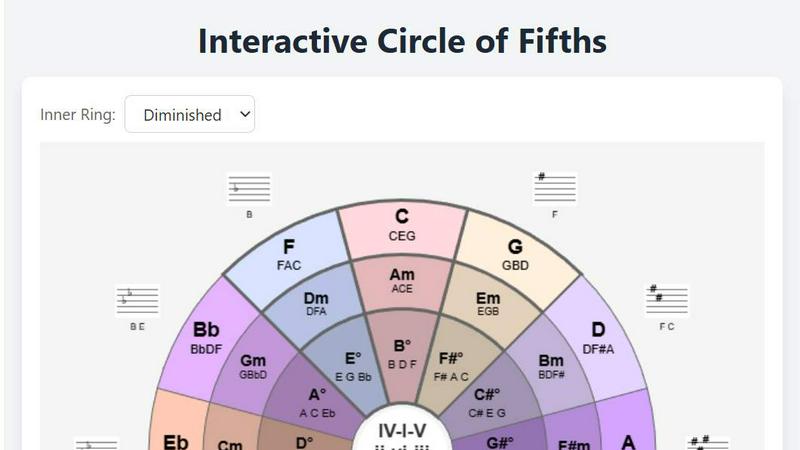
Interactive Circle of Fifths
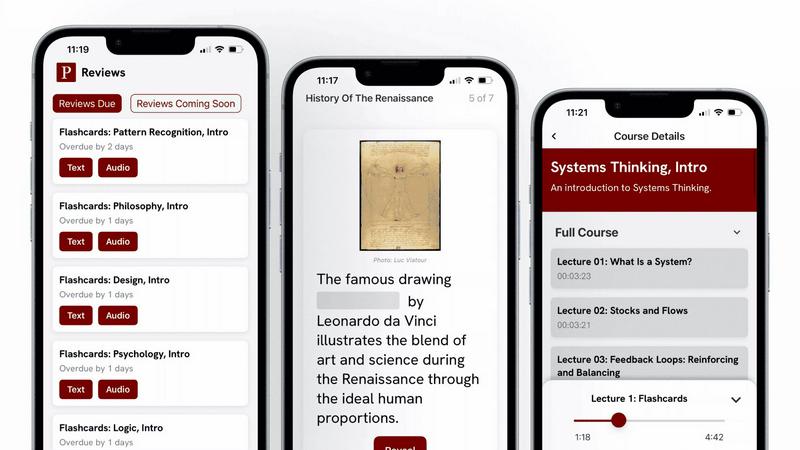
Polym
Feature Comparison
Interactive Circle of Fifths
Dynamic Circle and Key Exploration
The central interactive circle allows users to click on any key to instantly reconfigure the entire interface. This action updates all related information, including the key signature, the harmonized scale chords (I, ii, iii, etc.), and the available scale selections. This dynamic navigation provides an intuitive understanding of how keys relate to one another clockwise (in fifths) and counter-clockwise (in fourths), making the theoretical relationships tangible and immediately applicable to any musical context.
Integrated Piano & Guitar Visualizers
Complementing the circle are synchronized, dynamic visualizers for both piano keyboard and guitar fretboard. When a chord or scale is selected, these tools light up the correct notes, fingerings, and positions on their respective instruments. This feature is crucial for translating theory into practice, helping musicians learn chord shapes, scale patterns, and efficient fingerings directly on their instrument of choice, thereby enhancing muscle memory and fretboard or keyboard knowledge.
Comprehensive Scale and Chord Library
The platform hosts an extensive library of musical scales and chord types accessible via the inner ring and control panels. Users can explore beyond standard major and minor scales to include the Pentatonic Scale, Blues Scale, Diatonic Scale, Diminished Scale, and the Diminished Chord. This allows for deep dives into specific sounds and genres, providing the theoretical building blocks for jazz, blues, rock, and pop improvisation and composition.
Harmonized Scale and Chord Sequencer Panel
This detailed panel displays the seven chords that naturally occur within any selected key (e.g., C, Dm, Em, F, G, Am, B°), labeled with both their musical names and their Roman numeral scale degrees (I, ii, iii, IV, V, vi, vii°). It includes functional analysis, showing how each chord typically "Resolves To" within a progression. This transforms the tool from a passive reference into an active composition aid, helping users understand and create authentic chord progressions.
Polym
Medium-Form Audio Courses
Polym provides in-depth, medium-form audio courses focused on the conceptual understanding of foundational subjects. These courses are carefully curated to cover material that is not only professionally relevant across various fields but also enriching for general knowledge. The content is specifically engineered for the audio format, with a focus on abstract concepts and principles from technical and mathematical fields that are suitable for auditory learning, thereby overcoming a common hurdle in educational media.
Active Learning via Retrieval Practice
The app moves beyond passive consumption by embedding retrieval practice—a core active learning technique—into the user experience. This is operationalized through interactive audio flashcards and prompted recall exercises within courses. By actively requiring the user to retrieve information from memory, this feature strengthens neural pathways, significantly enhancing long-term retention and recall compared to re-reading or re-listening alone.
Spaced Repetition Scheduling
To combat the natural curve of forgetting, Polym incorporates a spaced repetition algorithm. This system intelligently schedules review sessions for key concepts and terms at strategically increasing intervals. By prompting users to revisit material just as they are about to forget it, the app maximizes memory consolidation, ensuring that learned information transitions from short-term to durable long-term knowledge.
Interleaved Practice Sessions
Polym employs the interleaving learning strategy by mixing related topics or questions from different courses during study and review sessions. Instead of blocking study on a single subject, this approach challenges the brain to discriminate between concepts and apply knowledge in varied contexts. This feature enhances deeper learning, improves problem-solving flexibility, and strengthens the connections between interrelated subjects.
Use Cases
Interactive Circle of Fifths
Music Theory Education and Homework Aid
For students in formal music education, the tool serves as an exceptional homework companion and study guide. It allows them to verify key signatures, practice building harmonized scales, and visualize chord functions interactively. This reinforces classroom lessons, provides instant feedback for self-testing, and helps internalize complex concepts like secondary dominants or modal interchange through direct manipulation and auditory confirmation.
Songwriting and Chord Progression Development
Songwriters and composers can use the platform to break out of creative ruts and discover new harmonic pathways. By experimenting with the Chord Sequencer and observing the "Resolves To" suggestions, users can craft compelling progressions, modulate between keys smoothly, or substitute standard chords with more colorful options from the scale library, all while hearing the results in real-time to judge their musical impact.
Instrument-Specific Practice and Fretboard/Keyboard Mastery
Guitarists and pianists utilize the visualizers for targeted technical practice. A guitarist can select a scale like the "Blues Scale" in the key of A and see all its positions across the neck, facilitating methodical practice. Similarly, a pianist can explore complex chord voicings. This direct application accelerates instrument fluency, helping musicians move beyond memorized patterns to a deeper understanding of the instrument's layout.
Improvisation and Solo Construction
Improvisers leverage the tool to understand which scales align with specific chords in a progression. By selecting a key and then cycling through the compatible scales (e.g., major, pentatonic, blues), a musician can learn the "safe" notes for soloing over each chord change. This builds confidence and theoretical knowledge, enabling more melodic and intentional improvisation rather than relying solely on ear or memorized licks.
Polym
Professional Skill Reinforcement
Professionals in data science, finance, engineering, or management can use Polym to reinforce and retain core concepts in statistics, probability, logic, and economics. The audio format allows for learning during commutes or downtime, while the active recall and spaced repetition features ensure that these critical professional foundations remain sharp and readily accessible for application in work projects and decision-making.
Academic Study Aid for Students
University and graduate students can integrate Polym as a supplementary study tool for courses in computer science, philosophy, or history. The medium-form courses provide conceptual overviews, while the abbreviated versions and term-focused sessions are ideal for efficient exam review. The scientifically-backed methods help move information from crammed facts to deeply understood, long-term knowledge.
Lifelong Learning for Aspiring Polymaths
Individuals with broad intellectual curiosity who aim to build a wide base of foundational knowledge across disciplines will find Polym uniquely suited to their goals. The curated selection of subjects and the app's focus on conceptual understanding allow users to systematically explore fields like AI, philosophy, and scientific research, transforming scattered interest into structured, retained expertise.
Preparation for Certifications and Interviews
Job seekers or professionals preparing for technical certifications can utilize Polym to master key terminology and abstract concepts required for tests and interviews. The "Review Key Terms" feature and audio flashcards offer a highly efficient method for drilling definitions and principles, while interleaving helps in understanding how different concepts relate, a common interview question theme.
Overview
About Interactive Circle of Fifths
The Interactive Circle of Fifths is a sophisticated digital educational platform engineered to demystify music theory for musicians, composers, and students across all proficiency levels. It transforms the traditional, static Circle of Fifths—a fundamental diagram illustrating the relationships between the twelve tones of the chromatic scale, their corresponding key signatures, and the associated major and minor keys—into a dynamic, multi-sensory learning environment. Its core value proposition lies in bridging the gap between abstract theoretical concepts and practical, hands-on application. By integrating a fully interactive circle with real-time piano and guitar fretboard visualizers, the tool allows users to not only see but also hear chord progressions, scale patterns, and harmonic functions. It serves as a comprehensive reference for scales, chords, and their interconnections, covering essential elements like the harmonized major scale, pentatonic patterns, blues scales, and diminished structures. This makes it an indispensable resource for songwriting, improvisation, instrument practice, and structured theory education, effectively accelerating the learning curve by providing immediate auditory and visual feedback.
About Polym
Polym is a specialized audio learning application engineered to optimize the long-term retention and recall of foundational knowledge across a diverse range of academic and professional disciplines. Unlike passive listening platforms, Polym is explicitly designed around evidence-based cognitive science principles, integrating active learning techniques directly into its audio format. The app offers structured, medium-form courses on essential subjects such as Statistics, Probability, Logic, Economics, Computer Science, Artificial Intelligence, Philosophy, and History. Each course is supplemented with abbreviated versions and audio flashcards, creating a multi-layered learning system. The core value proposition lies in its systematic application of proven learning strategies—namely retrieval practice, spaced repetition, and interleaving—to transform casual listening into an effective memorization and comprehension tool. It caters to a broad audience of lifelong learners, including students seeking to solidify academic fundamentals, professionals aiming to cross-skill or deepen domain expertise, and intellectually curious individuals or aspiring polymaths who desire a flexible, engaging way to build and retain critical knowledge. By delivering technically tailored audio content that emphasizes abstract concepts, Polym enables users to efficiently learn and, more importantly, remember complex information through scientifically-backed methods, making education both portable and permanent.
Frequently Asked Questions
Interactive Circle of Fifths FAQ
What is the Circle of Fifths and why is it important?
The Circle of Fifths is a circular diagram that visually represents the relationships between the 12 tones of the chromatic scale, their corresponding key signatures, and their associated major and minor keys. It is a foundational tool in music theory because it elegantly shows how keys relate to one another, which chords are diatonic to a key, and how to modulate between keys. Understanding it is crucial for composition, improvisation, and analysis.
How do the piano and guitar visualizers work?
The visualizers are dynamic diagrams that respond to your selections on the circle and scale menus. When you choose a chord or scale, the corresponding notes are highlighted on a virtual piano keyboard and a guitar fretboard. This shows you exactly where to play those notes on each instrument, including different fingering positions on the guitar, bridging the gap between theoretical knowledge and physical execution.
Can I use this tool to learn about scales other than major and minor?
Absolutely. A core feature of the Interactive Circle of Fifths is its extensive scale library. In addition to standard major and minor scales, you can explore and visualize the Pentatonic Scale, Blues Scale, Diatonic Scale, and Diminished Scale within any key. This makes it an invaluable resource for delving into genres like blues, jazz, and rock that heavily utilize these sounds.
What does "Harmonized Scale" mean in the context panel?
The Harmonized Scale refers to the set of seven chords that are built from each note of a major or minor scale. The panel displays these chords for your selected key (e.g., in C Major: C, Dm, Em, F, G, Am, B°). It labels them with their scale degree (I, ii, iii, etc.) and indicates common resolution paths ("Resolves To"). This teaches you the standard chord family of a key and their functional relationships, which is essential for writing and analyzing music.
Polym FAQ
What research supports the learning strategies used in Polym?
The methodologies underpinning Polym—retrieval practice, spaced repetition, and interleaving—are extensively validated by cognitive science research. These techniques are known collectively as desirable difficulties, as they make learning more challenging in the short term but far more effective for long-term retention. A comprehensive starting point for this research can be found in academic reviews, such as the article available through the National Institutes of Health (PMCID: PMC9781761), which synthesizes evidence on effective learning strategies.
What subjects are currently covered by Polym courses?
Polym offers a growing library focused on foundational knowledge. Confirmed subjects include Logic, Logical Fallacies, Cognitive Biases, Statistics, Probability, Scientific Research Methods, Algorithms, Economics, Philosophy, and History. The selection is designed to be relevant across professional fields and for general intellectual enrichment, with an emphasis on concepts that are suitable for and benefit from the audio learning format.
Who is the primary target audience for the Polym app?
Polym is designed for a wide audience united by a desire to learn and remember effectively. This includes students, professionals seeking cross-disciplinary knowledge, and lifelong learners or aspiring polymaths. Essentially, it is for anyone who wants to improve their retention and recall of key subjects that are applicable both in professional contexts and in enriching everyday life and personal decision-making.
Is Polym available for both iOS and Android devices?
Yes, Polym is officially launched and fully available for download on both major mobile platforms. You can install the app directly from the Apple App Store for iOS devices and from the Google Play Store for Android devices, allowing for flexible, on-the-go learning regardless of your preferred mobile operating system.
Alternatives
Interactive Circle of Fifths Alternatives
The Interactive Circle of Fifths is a dynamic, web-based educational tool designed to help musicians understand music theory, specifically the relationships between chords and scales. It falls into the category of digital music education and theory software, providing an interactive visual and auditory learning experience. Users often seek alternatives for a variety of practical reasons, including budget constraints, the need for different feature sets, or compatibility with specific devices and operating systems. When evaluating alternatives, it is crucial to consider several key factors. The core functionality should include robust chord and scale visualization, ideally with support for multiple instruments like piano and guitar. The depth of theoretical content, such as coverage of various scale types and chord progression tools, is another significant consideration. Finally, the user interface's intuitiveness and the platform's accessibility across different devices can greatly impact the learning experience. A thorough comparison should also weigh the overall value proposition. This includes assessing whether the tool is a one-time purchase, a subscription service, or entirely free, and what educational resources or community support accompany it. The goal is to find a solution that not only explains musical concepts but also actively aids in their practical application during practice, composition, and improvisation.
Polym Alternatives
Polym is an audio-based learning application focused on enhancing long-term retention of foundational knowledge in subjects like statistics, economics, computer science, and philosophy. It operates within the education technology and self-study software category, leveraging active learning techniques such as retrieval practice and spaced repetition. Users may seek alternatives to Polym for various reasons, including budget constraints, a preference for different content formats like video or text, the need for specific platform availability, or a desire for a broader or more niche subject library. The search often stems from finding the optimal tool that aligns with an individual's unique learning style and practical requirements. When evaluating alternatives, key considerations should include the core learning methodologies employed, such as active recall and spaced repetition systems. The depth and breadth of the content library, the flexibility of the learning format, pricing transparency, and the overall user experience are also critical factors. The ideal platform effectively balances scientific pedagogy with engaging, accessible delivery.