
Interactive Circle of Fifths vs PseudoRun
Side-by-side comparison to help you choose the right product.

Interactive Circle of Fifths
The Interactive Circle of Fifths is a dynamic tool for visualizing scales, chords, and harmonic progressions across.
Last updated: March 1, 2026

PseudoRun
PseudoRun is the premier free platform for writing, testing, and mastering IGCSE pseudocode algorithms.
Last updated: March 1, 2026
Visual Comparison
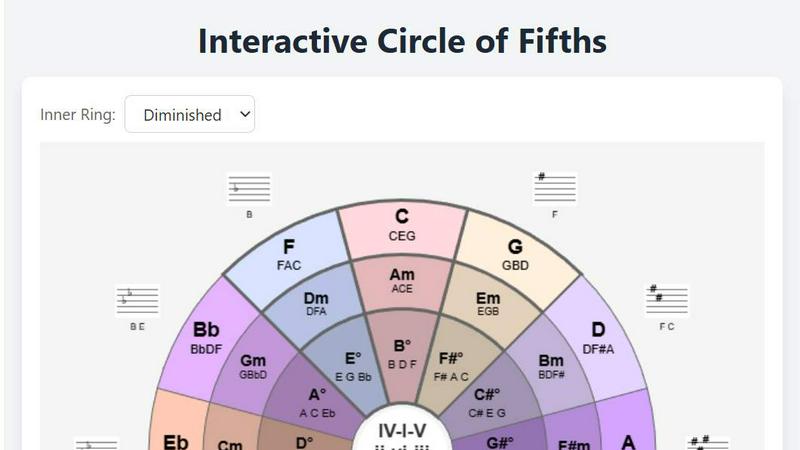
Interactive Circle of Fifths
PseudoRun

Feature Comparison
Interactive Circle of Fifths
Dynamic Circle and Key Exploration
The central interactive circle allows users to click on any key to instantly reconfigure the entire interface. This action updates all related information, including the key signature, the harmonized scale chords (I, ii, iii, etc.), and the available scale selections. This dynamic navigation provides an intuitive understanding of how keys relate to one another clockwise (in fifths) and counter-clockwise (in fourths), making the theoretical relationships tangible and immediately applicable to any musical context.
Integrated Piano & Guitar Visualizers
Complementing the circle are synchronized, dynamic visualizers for both piano keyboard and guitar fretboard. When a chord or scale is selected, these tools light up the correct notes, fingerings, and positions on their respective instruments. This feature is crucial for translating theory into practice, helping musicians learn chord shapes, scale patterns, and efficient fingerings directly on their instrument of choice, thereby enhancing muscle memory and fretboard or keyboard knowledge.
Comprehensive Scale and Chord Library
The platform hosts an extensive library of musical scales and chord types accessible via the inner ring and control panels. Users can explore beyond standard major and minor scales to include the Pentatonic Scale, Blues Scale, Diatonic Scale, Diminished Scale, and the Diminished Chord. This allows for deep dives into specific sounds and genres, providing the theoretical building blocks for jazz, blues, rock, and pop improvisation and composition.
Harmonized Scale and Chord Sequencer Panel
This detailed panel displays the seven chords that naturally occur within any selected key (e.g., C, Dm, Em, F, G, Am, B°), labeled with both their musical names and their Roman numeral scale degrees (I, ii, iii, IV, V, vi, vii°). It includes functional analysis, showing how each chord typically "Resolves To" within a progression. This transforms the tool from a passive reference into an active composition aid, helping users understand and create authentic chord progressions.
PseudoRun
IGCSE Exam-Focused Editor
The editor is the cornerstone of PseudoRun, built from the ground up to adhere strictly to the Cambridge IGCSE Computer Science pseudocode syntax and conventions. It understands and validates the specific commands, data structures, and stylistic guidelines required by the syllabus. This ensures that students are not just learning pseudocode, but are practicing the exact format and style they will encounter in their written examinations, eliminating confusion and building exam-specific competency through consistent, correct practice.
Real-Time Validation and Error Detection
As users type their pseudocode, the platform performs continuous, instantaneous syntax checking. Errors are highlighted in real-time with clear, descriptive messages that explain the nature of the mistake, such as incorrect variable declaration, misuse of keywords, or logical structural flaws. This immediate feedback loop accelerates the learning process by allowing students to correct misunderstandings as they occur, fostering a deeper and more accurate understanding of proper pseudocode construction without the frustration of delayed error discovery.
Interactive Step-by-Step Debugger
This powerful feature allows learners to execute their algorithms one line at a time, observing the flow of control and the changing state of all variables in a dedicated watch panel. Users can set breakpoints, step into loops, and trace procedure calls, which demystifies complex algorithms. This granular visibility into program execution is invaluable for mastering IGCSE topics like trace tables, enabling students to deconstruct and comprehend algorithmic behavior in a way that static textbook examples cannot provide.
Comprehensive IGCSE Practice Library
PseudoRun hosts an extensive and growing repository of over 50 IGCSE-style practice problems and fully worked examples. These exercises are systematically categorized to cover all key syllabus areas, including input/output operations, conditional statements, iterative loops (FOR, WHILE, REPEAT), array manipulation, and procedure/function design. This library serves as a structured curriculum for self-study, allowing students to progress from fundamental concepts to advanced exam-level challenges, reinforcing their learning through applied practice.
Use Cases
Interactive Circle of Fifths
Music Theory Education and Homework Aid
For students in formal music education, the tool serves as an exceptional homework companion and study guide. It allows them to verify key signatures, practice building harmonized scales, and visualize chord functions interactively. This reinforces classroom lessons, provides instant feedback for self-testing, and helps internalize complex concepts like secondary dominants or modal interchange through direct manipulation and auditory confirmation.
Songwriting and Chord Progression Development
Songwriters and composers can use the platform to break out of creative ruts and discover new harmonic pathways. By experimenting with the Chord Sequencer and observing the "Resolves To" suggestions, users can craft compelling progressions, modulate between keys smoothly, or substitute standard chords with more colorful options from the scale library, all while hearing the results in real-time to judge their musical impact.
Instrument-Specific Practice and Fretboard/Keyboard Mastery
Guitarists and pianists utilize the visualizers for targeted technical practice. A guitarist can select a scale like the "Blues Scale" in the key of A and see all its positions across the neck, facilitating methodical practice. Similarly, a pianist can explore complex chord voicings. This direct application accelerates instrument fluency, helping musicians move beyond memorized patterns to a deeper understanding of the instrument's layout.
Improvisation and Solo Construction
Improvisers leverage the tool to understand which scales align with specific chords in a progression. By selecting a key and then cycling through the compatible scales (e.g., major, pentatonic, blues), a musician can learn the "safe" notes for soloing over each chord change. This builds confidence and theoretical knowledge, enabling more melodic and intentional improvisation rather than relying solely on ear or memorized licks.
PseudoRun
Independent Student Exam Preparation
IGCSE Computer Science students can use PseudoRun as a primary study tool to practice writing and debugging pseudocode independently. They can work through the categorized problem sets, utilize the exam mode timer to simulate test conditions, and save their solutions to the free cloud storage for later review. This self-directed practice builds fluency, speed, and confidence, directly translating to higher performance in both paper-based pseudocode questions and practical algorithm design tasks.
Classroom Teaching and Demonstration
Educators can integrate PseudoRun into their lessons as a dynamic teaching aid. During lectures, teachers can project the editor to demonstrate algorithm construction in real-time, use the step-by-step debugger to visually unpack complex logic for the entire class, and assign specific practice problems as homework. The platform's alignment with the official syllabus ensures that classroom instruction is perfectly complemented by hands-on, accurate practice tools.
Algorithmic Concept Reinforcement
For learners struggling with specific abstract concepts—such as how a nested loop iterates, how data passes through a procedure, or how an array is sorted—PseudoRun provides a concrete way to visualize and experiment. By writing small snippets of code and using the debugger to watch variable values change, students can move from rote memorization to genuine comprehension, solidifying their foundational understanding of computer science principles.
Collaborative Learning and Peer Review
Study groups can leverage PseudoRun's cloud storage to share pseudocode solutions for group projects or peer review sessions. Students can load each other's algorithms, run them to check for logic errors, and use the debugging tools to understand different approaches to the same problem. This collaborative analysis fosters deeper discussion, exposes learners to multiple problem-solving strategies, and enhances critical thinking skills.
Overview
About Interactive Circle of Fifths
The Interactive Circle of Fifths is a sophisticated digital educational platform engineered to demystify music theory for musicians, composers, and students across all proficiency levels. It transforms the traditional, static Circle of Fifths—a fundamental diagram illustrating the relationships between the twelve tones of the chromatic scale, their corresponding key signatures, and the associated major and minor keys—into a dynamic, multi-sensory learning environment. Its core value proposition lies in bridging the gap between abstract theoretical concepts and practical, hands-on application. By integrating a fully interactive circle with real-time piano and guitar fretboard visualizers, the tool allows users to not only see but also hear chord progressions, scale patterns, and harmonic functions. It serves as a comprehensive reference for scales, chords, and their interconnections, covering essential elements like the harmonized major scale, pentatonic patterns, blues scales, and diminished structures. This makes it an indispensable resource for songwriting, improvisation, instrument practice, and structured theory education, effectively accelerating the learning curve by providing immediate auditory and visual feedback.
About PseudoRun
PseudoRun is the definitive, free online platform engineered exclusively for mastering the Cambridge IGCSE Computer Science pseudocode syllabus. It serves as a fully integrated interactive editor and simulator, enabling users to write, execute, and debug algorithms in a real-time, browser-based environment. This eliminates the complexity and setup required by traditional programming languages, allowing learners to concentrate purely on algorithmic logic and structure. The platform is meticulously calibrated to be 100% aligned with the official Cambridge IGCSE pseudocode specifications and examination patterns, making it an indispensable resource for students, educators, and beginners embarking on their computer science journey. Its core value proposition is bridging the critical gap between theoretical algorithmic concepts and their practical implementation. By delivering instant feedback, granular step-by-step execution, and an extensive library of curated practice problems, PseudoRun transforms passive study into an engaging, hands-on experiential learning process. Founded on an unwavering commitment to accessible education, the platform is completely free, devoid of any advertisements, and places paramount importance on student privacy. This ensures a clean, distraction-free interface where users can focus entirely on developing the logical reasoning, debugging skills, and exam-ready confidence necessary to excel in their IGCSE Computer Science assessments and build a strong foundation for future programming endeavors.
Frequently Asked Questions
Interactive Circle of Fifths FAQ
What is the Circle of Fifths and why is it important?
The Circle of Fifths is a circular diagram that visually represents the relationships between the 12 tones of the chromatic scale, their corresponding key signatures, and their associated major and minor keys. It is a foundational tool in music theory because it elegantly shows how keys relate to one another, which chords are diatonic to a key, and how to modulate between keys. Understanding it is crucial for composition, improvisation, and analysis.
How do the piano and guitar visualizers work?
The visualizers are dynamic diagrams that respond to your selections on the circle and scale menus. When you choose a chord or scale, the corresponding notes are highlighted on a virtual piano keyboard and a guitar fretboard. This shows you exactly where to play those notes on each instrument, including different fingering positions on the guitar, bridging the gap between theoretical knowledge and physical execution.
Can I use this tool to learn about scales other than major and minor?
Absolutely. A core feature of the Interactive Circle of Fifths is its extensive scale library. In addition to standard major and minor scales, you can explore and visualize the Pentatonic Scale, Blues Scale, Diatonic Scale, and Diminished Scale within any key. This makes it an invaluable resource for delving into genres like blues, jazz, and rock that heavily utilize these sounds.
What does "Harmonized Scale" mean in the context panel?
The Harmonized Scale refers to the set of seven chords that are built from each note of a major or minor scale. The panel displays these chords for your selected key (e.g., in C Major: C, Dm, Em, F, G, Am, B°). It labels them with their scale degree (I, ii, iii, etc.) and indicates common resolution paths ("Resolves To"). This teaches you the standard chord family of a key and their functional relationships, which is essential for writing and analyzing music.
PseudoRun FAQ
Is PseudoRun really completely free to use?
Yes, PseudoRun is completely free with no hidden costs, tiered plans, or premium paywalls. The founders have made a public commitment to keep the platform free and entirely advertisement-free forever. All features, including the editor, debugger, practice library, and cloud storage, are available at no charge to all users, prioritizing accessible education for every IGCSE Computer Science student.
How does PseudoRun ensure it aligns with the Cambridge IGCSE syllabus?
The platform's development was meticulously guided by the official Cambridge IGCSE Computer Science syllabus documentation and past examination papers. The pseudocode syntax parser, keyword set, and allowable structures are programmed to validate code strictly against these specifications. Furthermore, the practice problem library is deliberately crafted to mirror the style, complexity, and topics of actual IGCSE exam questions, ensuring highly relevant preparation.
Can I access my saved programs from different devices?
Absolutely. PseudoRun offers free, unlimited cloud storage for all user programs. Once you save a pseudocode file, it is stored securely in your account and can be retrieved, edited, and executed from any device with an internet connection and a web browser. This facilitates seamless study continuity between school computers, personal laptops, and tablets.
Does PseudoRun require any software installation or login?
No installation is required. PseudoRun is a fully web-based application that runs directly in your browser. While you can use the core editor immediately without an account, creating a free login is recommended to unlock the full suite of features, including saving your work to the cloud, tracking progress, and accessing the complete practice problem library. The sign-up process is simple and does not require a credit card.
Alternatives
Interactive Circle of Fifths Alternatives
The Interactive Circle of Fifths is a dynamic, web-based educational tool designed to help musicians understand music theory, specifically the relationships between chords and scales. It falls into the category of digital music education and theory software, providing an interactive visual and auditory learning experience. Users often seek alternatives for a variety of practical reasons, including budget constraints, the need for different feature sets, or compatibility with specific devices and operating systems. When evaluating alternatives, it is crucial to consider several key factors. The core functionality should include robust chord and scale visualization, ideally with support for multiple instruments like piano and guitar. The depth of theoretical content, such as coverage of various scale types and chord progression tools, is another significant consideration. Finally, the user interface's intuitiveness and the platform's accessibility across different devices can greatly impact the learning experience. A thorough comparison should also weigh the overall value proposition. This includes assessing whether the tool is a one-time purchase, a subscription service, or entirely free, and what educational resources or community support accompany it. The goal is to find a solution that not only explains musical concepts but also actively aids in their practical application during practice, composition, and improvisation.
PseudoRun Alternatives
PseudoRun is a specialized educational platform in the category of IGCSE Computer Science tools. It serves as a premier, free online editor and simulator for writing and mastering Cambridge-aligned pseudocode, bridging the gap between algorithmic theory and practical execution. Users may seek alternatives for various reasons, including the need for different feature sets, such as support for other programming languages or curriculum standards beyond IGCSE. Others might require offline functionality, integration with specific learning management systems, or simply wish to explore different pedagogical approaches and user interfaces. When evaluating an alternative, key considerations include strict adherence to the required exam board's pseudocode syntax, the quality of real-time feedback and debugging tools, and the overall educational design. The platform's cost structure, privacy policies, and whether it offers a distraction-free, ad-free learning environment are also critical factors in ensuring an effective and focused study tool.