
ScopeSnap vs Skene
Side-by-side comparison to help you choose the right product.

ScopeSnap
ScopeSnap transforms discovery notes into structured project scopes, accurate estimates, and polished proposals in minutes for freelancers and.
Last updated: March 18, 2026

Skene embeds product-led growth directly into your codebase, automating onboarding and retention.
Last updated: February 28, 2026
Visual Comparison
ScopeSnap
Skene
Feature Comparison
ScopeSnap
AI-Driven Backlog Creation
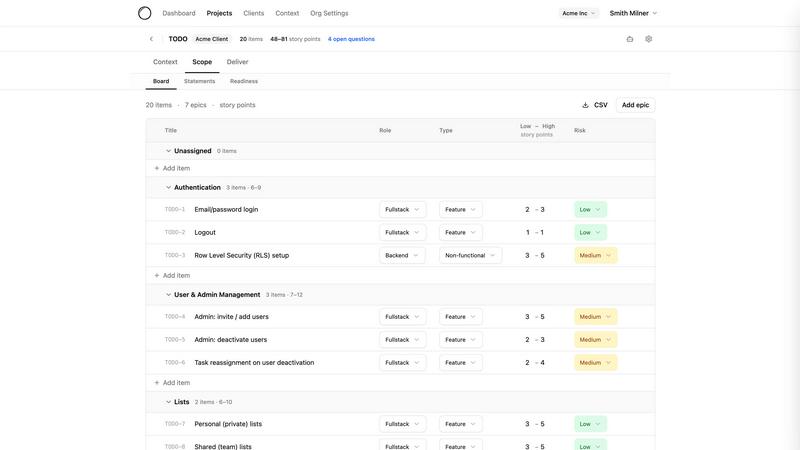
ScopeSnap utilizes advanced AI technology to automatically generate epics and scope items from raw discovery notes. It intelligently surfaces open questions and flags assumptions, which helps users identify gaps in information early in the project planning process.
Streamlined Refinement Process
The platform allows users to iteratively refine their project scopes. Developers can review the structured backlog, assign roles, set estimates, and resolve open questions in a collaborative environment, ensuring that all team members are on the same page.
Proposal Generation
Once the project scope is finalized, ScopeSnap automatically generates a polished Proposal or Statement of Work (SOW). This feature saves users significant time as it eliminates the need to create documents from scratch, ensuring that proposals are not only professional but also aligned with the defined scope.
Client Communication Tools
ScopeSnap includes features that facilitate seamless communication with clients. Users can easily share their proposals and project scopes, making it simple to keep clients informed and engaged throughout the project lifecycle.
About Skene
Codebase-Derived Growth Signals
Skene performs a deep analysis of your application's source code to automatically identify and extract meaningful growth signals. Instead of relying on manually instrumented events or external analytics snippets, it scans the repository structure, framework, and code patterns to detect user interaction points, potential activation opportunities, and friction areas. This creates a foundational "growth manifest" that serves as a precise, always-up-to-date context layer, ensuring that all growth automation is built upon a real-time understanding of how the product actually works.
Prompt-Driven Growth Implementation
The platform enables a revolutionary workflow where growth loops and optimizations are designed and executed through natural language prompts within the developer's IDE, such as Cursor. Developers or their AI agents can instruct Skene to analyze bottlenecks, generate improved user flows, or implement specific onboarding steps. This shifts the paradigm from managing disparate SaaS dashboards and widgets to shipping growth iterations with the same agility and ownership as feature development, directly within the codebase.
Autonomous PLG Flow Generation & Testing
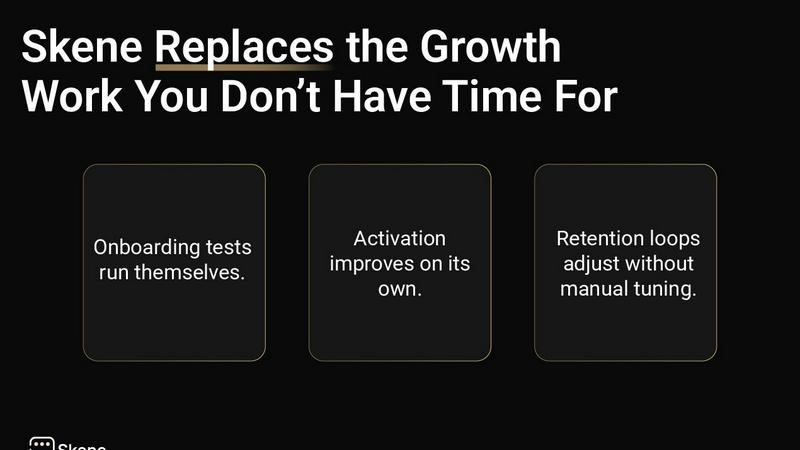
Skene functions as a self-learning growth engine. By continuously monitoring user interactions against the insights from the codebase, it can autonomously create, A/B test, and deploy optimized user journeys. It detects activation drop-offs and friction points, then experiments with improved configurations, measures their impact on key metrics like completion rates, and deploys the most effective versions. This automates the entire cycle of growth iteration without requiring manual intervention from a dedicated team.
Owned & Version-Controlled Growth Infrastructure
A fundamental differentiator of Skene is that it operates as owned infrastructure, not a third-party service. The growth logic, analytics, and automation become part of your codebase, fully version-controlled and integrated into your standard development lifecycle. This eliminates the risks of broken UI overlays after deploys, performance degradation from external scripts, and data silos. Growth logic updates seamlessly whenever you push code, and all data remains within your ecosystem.
Use Cases
ScopeSnap
Freelance Development Projects
Freelancers can leverage ScopeSnap to turn initial discovery conversations into well-defined project scopes and proposals. This ensures that they start projects with a clear understanding of client expectations, reducing the chances of scope creep.
Software Agency Client Engagement
Software agencies can use ScopeSnap to enhance their client engagement processes. By converting messy notes into structured documents, agencies can present professional proposals that reflect their understanding of client needs, thus fostering trust and credibility.
Project Scope Refinement Workshops
Teams can utilize ScopeSnap during project scope refinement workshops. The tool facilitates discussions by providing a structured view of project requirements, helping teams to collaboratively address open questions and concerns before finalizing the scope.
Risk Management in Project Estimation
ScopeSnap assists in risk management by ensuring that all aspects of a project are thoroughly considered during the estimation phase. By identifying assumptions and open questions, developers can mitigate potential issues that could arise later in the project.
Skene
Automated Onboarding Optimization for Early-Stage Startups
Indie developers and startups with limited resources can use Skene to completely automate their user onboarding process. By connecting their repository, Skene analyzes the code to understand key activation milestones, then automatically generates and iterates on in-app guidance, tutorial flows, and welcome sequences. This ensures new users consistently find value without the startup needing to build or manually maintain a complex onboarding system.
AI-Agent Managed Growth Operations
Engineering teams can integrate Skene's context layer into their AI development workflows. An AI agent, equipped with the insights from Skene's codebase analysis, can be prompted to audit the user journey, identify the top friction point, and implement a fix—all autonomously. This use case allows for fully automated, continuous growth optimization where the AI handles routine iteration, freeing human developers for more complex tasks.
Replacing Legacy Growth & Analytics Stacks
Companies frustrated with a fragmented stack of analytics tools, survey widgets, and intercom-style messengers can use Skene as a unified replacement. It consolidates signal detection, analytics, and lifecycle automation into a single, code-native system. This eliminates the maintenance burden, data disjointedness, and performance overhead associated with managing multiple external SaaS tools and snippets.
Data-Driven Retention and Churn Prevention
Product teams can leverage Skene to strengthen user retention systematically. The platform continuously analyzes user behavior patterns against the codebase to identify signals of potential churn, such as failed feature adoption or support ticket patterns. It can then automatically trigger personalized in-app messages, re-engagement flows, or feature recommendation prompts to proactively address issues and increase customer lifetime value (LTV).
Overview
About ScopeSnap
ScopeSnap is an innovative AI-driven tool designed to streamline the process of scoping custom software projects for freelance developers and software agencies. It takes the chaos of messy discovery notes and transforms them into structured project scopes, comprehensive estimates, and polished proposals that are ready to present to clients. The main value proposition of ScopeSnap lies in its ability to simplify the often tedious and error-prone task of project estimation. By leveraging artificial intelligence, it enables users to break down project ideas into clear, estimable tasks, ensuring that all requirements are captured and understood. This not only saves time but also mitigates the risks associated with vague project scopes, allowing developers to focus on delivering quality solutions instead of getting bogged down in paperwork.
About Skene
Skene is a revolutionary, AI-powered Product-Led Growth (PLG) infrastructure engineered to automate the growth iteration process for software products. It is specifically designed for indie developers, early-stage startups, and engineering teams who lack dedicated growth resources. Skene's core value proposition is transforming growth from a manual, tool-stack-dependent chore into an owned, code-first infrastructure. Unlike traditional third-party tools that operate as external "black boxes" with performance-impacting snippets and siloed data, Skene integrates directly with a product's codebase and IDE. It analyzes the source code to automatically derive growth signals, identify friction points in user journeys (like onboarding drop-offs), and generate context for AI agents to implement optimizations. This allows products to autonomously evolve their activation, onboarding, and retention flows. By treating growth as programmable infrastructure, Skene enables developers to offload growth-related tasks, ship data-driven improvements through simple prompts, and focus on core product development, all while maintaining full ownership, performance, and integration with their existing workflow.
Frequently Asked Questions
ScopeSnap FAQ
How does ScopeSnap ensure accuracy in project estimates?
ScopeSnap enhances accuracy by breaking down project ideas into detailed tasks and allowing users to refine estimates through a structured process. This collaborative approach ensures that all team members contribute their insights, leading to more reliable estimates.
Can I integrate ScopeSnap with other project management tools?
Yes, ScopeSnap is designed to integrate with various project management tools, allowing users to seamlessly transition from scope creation to project execution without losing valuable information.
Is ScopeSnap suitable for teams of all sizes?
Absolutely. Whether you are a solo freelancer or part of a large software agency, ScopeSnap scales to meet your needs, providing tools that enhance collaboration and efficiency regardless of team size.
What types of projects can ScopeSnap be used for?
ScopeSnap is versatile and can be used for a wide range of custom software projects, including web applications, mobile apps, and enterprise solutions. Its structured approach to project scoping makes it applicable across various domains and industries.
Skene FAQ
What is PLG software?
Product-Led Growth (PLG) software is a category of tools designed to help users discover, adopt, and derive value from a product primarily through their direct interaction with the product itself, rather than through manual intervention from sales or customer success teams. It automates key aspects of the user journey, such as onboarding, feature adoption, and retention, using the product as the primary vehicle for growth, guidance, and user education.
How is Skene different from traditional customer experience software?
Traditional customer experience tools (like walkthrough builders or survey tools) are typically external services that require manual, rule-based configuration of UI overlays and tours. These are often brittle, breaking with every code deployment, and create data silos. Skene is fundamentally different: it reads your actual codebase to automatically understand your product and generate context-aware growth flows. It is an owned infrastructure that updates automatically with your code, is fully programmable, and operates without fragile external snippets.
How long does it take to set up?
Setup is designed to be exceptionally fast, taking less than 60 seconds. The primary step involves connecting your GitHub or GitLab repository with read-only access. Once connected, Skene automatically begins analyzing your codebase to generate the initial growth manifest and identify PLG opportunities. No initial code changes, API integrations, or complex configuration is required to get started.
Is my code secure?
Yes, security is a core principle. Skene only requires read-only access to your repository for analysis purposes. All code analysis is performed within a secure, isolated environment. Crucially, because Skene promotes an "owned infrastructure" model, the resulting growth logic and analytics are implemented within your own codebase and systems, meaning your user data and business logic never need to be sent to or stored on an external platform.
Alternatives
ScopeSnap Alternatives
ScopeSnap is an innovative tool designed to streamline the process of project scoping and proposal creation for freelance developers and software agencies. By leveraging AI technology, ScopeSnap transforms chaotic discovery notes into well-structured project scopes, estimates, and client-ready proposals, significantly enhancing productivity in the software development space. Users often seek alternatives to ScopeSnap for a variety of reasons, including pricing considerations, specific feature requirements, or the need for compatibility with different platforms. When exploring alternatives, it is essential to consider factors such as ease of use, the ability to customize scopes and proposals, integration with existing tools, and the overall effectiveness of the solution in addressing the unique challenges of project estimation and management in software development.
Skene Alternatives
Skene is an automated Product-Led Growth (PLG) iteration engine within the productivity and management software category. It is designed to autonomously optimize user onboarding, activation, and retention by analyzing codebase-driven insights and user interactions, making it a powerful tool for indie developers and resource-constrained startups. Users may explore alternatives to Skene for various reasons, including budgetary constraints, specific feature requirements not covered by its automated approach, or a need for platforms that integrate with a different set of existing tools. Some may seek solutions with more manual control or those that cater to larger, established teams with dedicated growth personnel. When evaluating an alternative, key considerations should include the platform's core methodology for driving growth, its integration depth with your development stack, the level of automation versus manual control offered, and the transparency and actionability of its analytics. The ideal solution should align with your team's technical capabilities and strategic growth objectives without compromising product performance.