
Dreamflow vs Prompt Coder
Side-by-side comparison to help you choose the right product.

Dreamflow
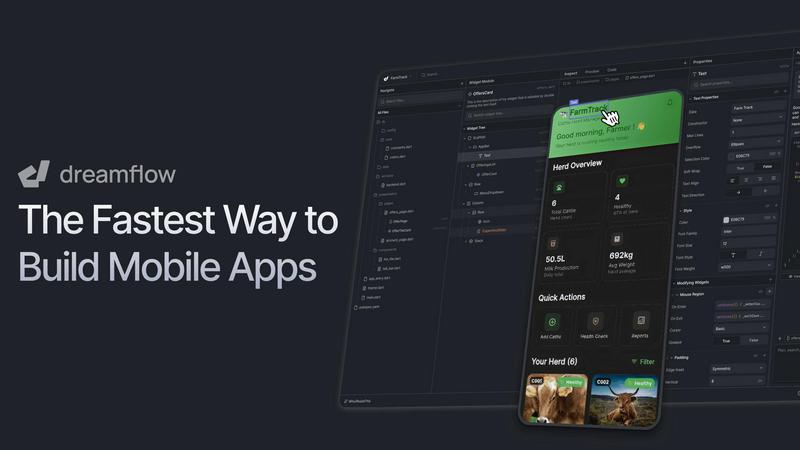
Dreamflow is an AI-powered platform that builds production-ready mobile apps from natural language descriptions.
Last updated: March 1, 2026
Prompt Coder
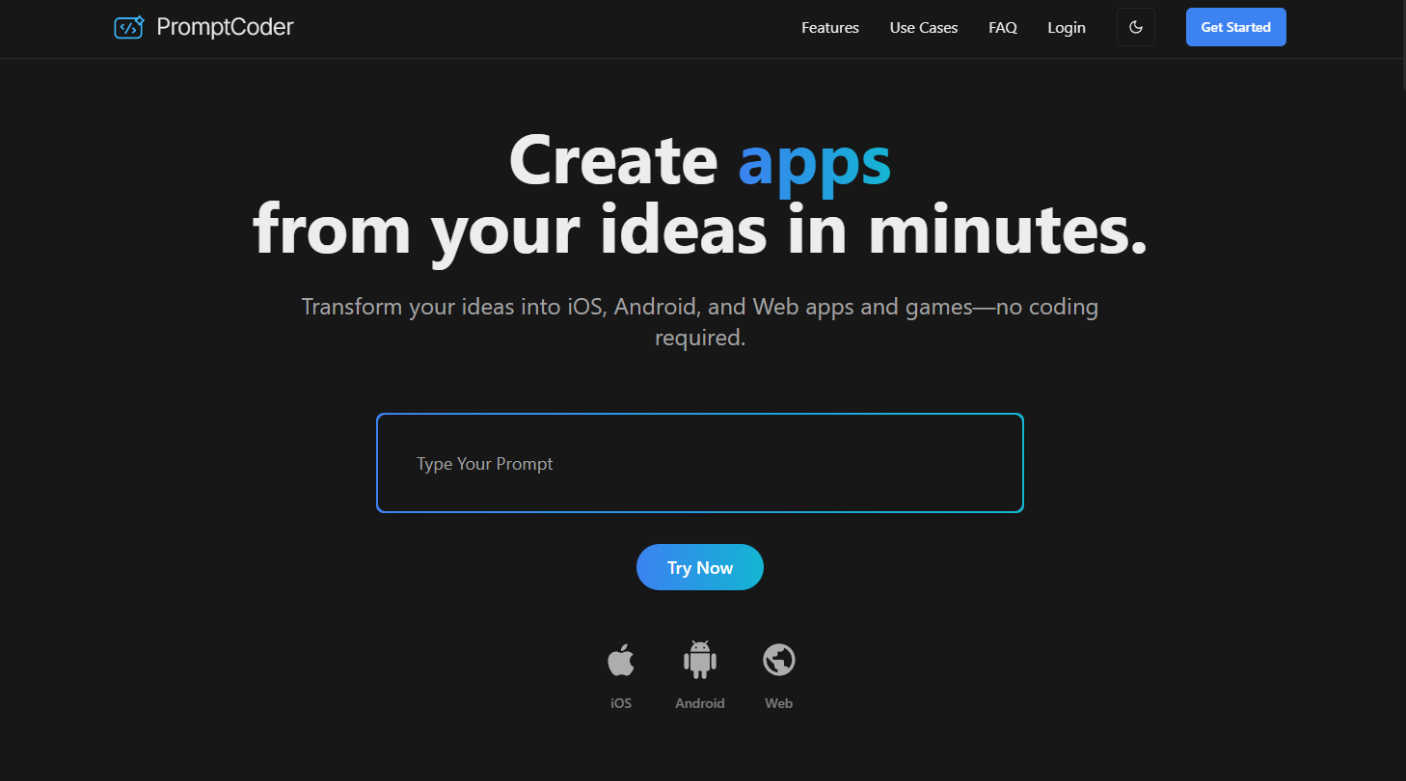
Prompt Coder uses AI to instantly transform your ideas into cross-platform apps and games.
Last updated: March 1, 2026
Visual Comparison
Dreamflow
Prompt Coder
Feature Comparison
Dreamflow
Tri-Surface Editing
Dreamflow's signature feature is its seamless Tri-Surface Editing environment. This innovative approach allows builders to interact with their project through three interconnected interfaces: an Agentic AI prompt interface, a Visual drag-and-drop canvas, and direct access to the underlying Code. Users can start by describing a feature in natural language to the AI agent, then fine-tune the layout and styling visually, and finally dive into the generated Flutter code for custom logic or optimizations. All modifications made in any surface are instantly reflected across the others, providing unparalleled flexibility and control without breaking the development flow.
AI-Powered Context-Aware Generation
The platform is powered by sophisticated artificial intelligence that goes beyond simple code generation. It is context-aware, meaning it understands the patterns, best practices, and the existing structure of your project. When you ask it to scaffold a new feature, such as a user authentication flow or a product catalog, it intelligently generates the appropriate UI components, navigation, and backend integration code that fits cohesively within your app's architecture. This smart assistance dramatically accelerates development while promoting maintainable and well-structured code from the outset.
Full-Stack Backend Integrations
Dreamflow provides out-of-the-box, managed integrations with leading backend-as-a-service platforms, specifically Firebase and Supabase. This allows developers to build fully functional, data-driven applications without managing server infrastructure. Features like real-time databases, user authentication, cloud functions, and storage can be configured and connected directly through the visual editor or via the AI agent. This integrated full-stack capability means projects can scale from a simple prototype to a live application with a robust backend from day one.
Multi-Platform Deployment & Export
Built on Google's Flutter framework, Dreamflow enables true multi-platform development. Users can create a single application that is automatically responsive and adaptable to any screen size. With just a few clicks, projects can be deployed directly to the web or prepared for submission to the Apple App Store and Google Play Store. Crucially, Dreamflow offers full code export, providing the complete, standard Flutter project. This allows teams to run the app on local simulators, real devices, and integrate it into any existing CI/CD pipeline, ensuring zero vendor lock-in.
About Prompt Coder
Natural Language to Code Conversion
This is the foundational technology of Prompt Coder, where sophisticated AI models interpret human-written prompts and descriptions to generate the underlying source code for applications. The system understands context, desired features, and user interface elements from plain English (or other supported languages), translating abstract ideas into structured programming syntax for multiple platforms. This feature handles the complexity of syntax, frameworks, and platform-specific requirements automatically.
Cross-Platform Deployment Engine
Prompt Coder's architecture is designed for inherent multi-platform support. When an application is generated, the AI ensures the core logic and assets are adapted to create native-compatible versions for iOS, Android, and responsive web applications simultaneously. This engine manages the nuances of each operating system, from UI/UX guidelines to API integrations, providing a true "write once, deploy everywhere" experience without sacrificing native performance or feel.
AI-Powered Iteration and Prototyping
The platform facilitates rapid prototyping and iterative design. Users can provide follow-up prompts to modify existing applications, such as "add a user login screen" or "change the primary color to blue," and the AI will intelligently update the codebase accordingly. This allows for real-time experimentation and refinement, turning the development process into a dynamic conversation between the creator and the AI, significantly accelerating the journey from prototype to polished product.
Integrated Publishing Suite
Beyond development, Prompt Coder provides tools and guidance for publishing completed applications to major platforms. This includes assistance with generating necessary assets (like icons and screenshots), configuring app store listings, and understanding submission guidelines for the Apple App Store and Google Play Store, as well as web hosting setup. This end-to-end support streamlines the path from a working build to a publicly available software product.
Use Cases
Dreamflow
Rapid Prototyping and MVP Development
Entrepreneurs and product managers can use Dreamflow to transform a raw idea into a functional minimum viable product (MVP) in a matter of hours or days, not weeks. By describing the app concept to the AI and iterating visually, they can quickly create a clickable prototype to validate the idea with potential users or investors, significantly reducing time-to-market and initial development costs before committing to a full-scale build.
Cross-Platform App Development for Startups
Startups needing to establish a presence on both iOS and Android, and often the web, can leverage Dreamflow's Flutter foundation to build a single, high-quality codebase for all platforms. The integrated backend and one-click deployment streamline the launch process, allowing small teams to focus on product iteration and user growth rather than managing complex, platform-specific codebases and infrastructure.
Enterprise Application Modernization
Larger organizations can utilize Dreamflow, particularly its Enterprise plan, to modernize internal tools or customer-facing applications. Features like version control (Git), advanced access control, private cloud deployment, and the ability to bring custom AI models make it suitable for secure, scalable, and governed development within a corporate IT environment, accelerating digital transformation initiatives.
Educational Tool for Developers
Aspiring developers and students learning mobile development can use Dreamflow as an educational bridge. They can start by building apps visually to understand UI/UX principles and component structure, then seamlessly transition to examining and modifying the generated Flutter code. This provides a practical, hands-on way to learn a professional-grade framework while immediately seeing the results of their code changes.
Prompt Coder
Entrepreneurial MVP Development
Startup founders and solo entrepreneurs can use Prompt Coder to rapidly build a Minimum Viable Product (MVP) for their business idea. By describing the core functionality—such as a marketplace, a booking system, or a content delivery app—they can generate a working prototype in minutes. This allows for quick market validation, user testing, and pitching to investors without the initial high cost and time investment of hiring a development team.
Educational Tool and Resource Creation
Educators and instructional designers can create custom interactive learning applications, quizzes, or simulation tools tailored to their specific curriculum. For instance, a teacher could prompt the AI to "create an app for practicing vocabulary with flashcards and a multiple-choice quiz," resulting in a personalized educational tool for their students without needing any programming knowledge.
Small Business Digital Solutions
Local business owners can develop custom applications to enhance their operations and customer engagement. Examples include creating a loyalty rewards app, a simple menu and ordering system for a restaurant, an appointment booking app for a service provider, or a portfolio showcase for a freelancer. This empowers small businesses to compete digitally with customized tools that would otherwise be cost-prohibitive.
Personal Project and Hobbyist Development
Individuals with creative ideas for games, utility apps, or personal productivity tools can bring their concepts to life. A hobbyist could describe a simple 2D game concept, a habit-tracking application, or a personal finance dashboard, and Prompt Coder will handle the complex coding. This opens up software creation as a form of personal expression and problem-solving for a non-technical audience.
Overview
About Dreamflow
Dreamflow is a revolutionary application development platform that fundamentally redefines the process of building mobile and web applications. It is engineered to bridge the gap between rapid AI-assisted prototyping, intuitive visual design, and full, unrestricted code-level control. The platform's core value proposition lies in its "Tri-Surface Editing" paradigm, which allows developers and entrepreneurs to fluidly switch between describing features to an AI agent, manipulating a visual canvas, and editing raw Flutter code, with all changes synchronized in real-time. This eliminates the traditional compromise between development speed and technical flexibility, ensuring users are never locked into a proprietary framework or a specific workflow.
Built by the team behind the widely adopted FlutterFlow, Dreamflow is trusted by over two million builders and is designed for a broad spectrum of users. Solo developers and indie hackers can leverage it to go from a concept to a market-ready MVP in record time. Startups can utilize its integrated backend and deployment features to scale their product efficiently. Even larger enterprises benefit from its production-grade capabilities, including version control, custom AI model integration, and private cloud deployment options. By combining AI-powered scaffolding with the power of the Flutter framework, Dreamflow enables the creation of robust, natively compiled applications for iOS, Android, and the web from a single codebase, positioning itself as the fastest and most versatile way to build production-ready apps.
About Prompt Coder
Prompt Coder is an AI-powered software publisher and development platform that fundamentally democratizes the creation of digital applications. It serves as a transformative bridge between conceptual ideas and functional software by leveraging advanced natural language processing. Users can articulate their vision for an application or game in simple text descriptions, and the platform's AI engine interprets these prompts to generate complete, production-ready code. This process eliminates the traditional requirement for extensive programming expertise, enabling a broad spectrum of users including entrepreneurs, educators, content creators, and small business owners to build and publish their own software. The core value proposition lies in its ability to drastically reduce development time and technical barriers, allowing creators to focus purely on innovation and user experience. Prompt Coder specializes in delivering cross-platform compatibility, ensuring the applications it helps create are natively functional for iOS and Android mobile ecosystems as well as modern web browsers. By integrating artificial intelligence directly into the software development lifecycle, the platform ensures the output is not only functional but also adheres to contemporary standards of scalability, reliability, and user-centric design.
Frequently Asked Questions
Dreamflow FAQ
What is the difference between Dreamflow and FlutterFlow?
While both products are from the same team and utilize Flutter, they serve different primary purposes. FlutterFlow is a powerful low-code visual builder focused on enabling non-coders and business teams to create applications. Dreamflow is its successor, designed as a professional development platform that adds a foundational AI agent and full, synchronized code access to the visual canvas, targeting developers who demand ultimate control and flexibility without sacrificing speed.
Can I get the source code for my Dreamflow project?
Yes, absolutely. A core principle of Dreamflow is providing full code access and ownership. All paid plans, starting with the Hobby tier, include the ability to export the complete, standard Flutter project. This code can be opened in IDEs like VS Code or Android Studio, run on simulators, built locally, and integrated into any version control system, ensuring you are never locked into the Dreamflow platform.
Which backend services does Dreamflow support?
Dreamflow offers managed, out-of-the-box integration with two leading backend services: Google's Firebase and the open-source alternative, Supabase. These integrations handle core functionalities like database (Firestore/PostgreSQL), user authentication, file storage, and serverless functions, allowing you to build full-stack applications without writing backend boilerplate code.
Is there a free plan to try Dreamflow?
Yes, Dreamflow offers a comprehensive Free plan that allows users to explore the platform's core capabilities at no cost. This plan includes private projects with both visual and code editing, managed backend integrations (Firebase/Supabase), one-click web deployment, and a starter pack of AI credits, making it ideal for experimentation and learning the workflow before upgrading for production deployment.
Prompt Coder FAQ
What is PromptCoder?
Prompt Coder is an AI-powered software publisher and development platform that transforms natural language descriptions into fully functional applications for iOS, Android, and the web. It acts as both a tool for users to create software without coding and as a publisher that leverages AI to build innovative applications. The platform's core mission is to democratize software development by removing technical barriers through artificial intelligence.
What types of applications do you publish?
As a publisher, Prompt Coder creates and releases a wide range of software solutions across categories, all powered by its underlying AI technology. This includes innovative mobile applications for productivity, education, utilities, and entertainment on both iOS and Android platforms, as well as modern web-based software solutions designed to work seamlessly across all browsers and devices.
How does AI power your software development?
The company utilizes artificial intelligence throughout its development lifecycle. AI algorithms are employed to automate code generation, optimize user interface and experience design, perform rigorous testing, and ensure the software is scalable and reliable. This AI-centric approach allows for faster development cycles, consistent code quality, and the ability to rapidly prototype and iterate on software concepts based on natural language input.
Which platforms do you support?
Prompt Coder provides comprehensive support for all major digital platforms. This includes native application development for Apple's iOS ecosystem and Google's Android platform, ensuring apps meet each system's specific design and performance standards. Additionally, the platform develops fully responsive web applications that are compatible with all modern desktop and mobile browsers, providing universal access.
Alternatives
Dreamflow Alternatives
Dreamflow is an AI-powered mobile app development platform that falls within the low-code and rapid application development category. It uniquely combines AI-driven design assistance, a visual editor, and direct code access to streamline the creation of production-ready applications. Users may explore alternatives to Dreamflow for various reasons, including budget constraints, specific feature requirements not covered by the platform, or a need to target different operating systems or development frameworks. The search for a different tool is often driven by the need to find a solution that aligns perfectly with a project's technical stack, team skill set, or long-term scalability plans. When evaluating alternatives, key considerations include the core development philosophy—whether it's purely visual, code-centric, or a hybrid model—as well as the supported output platforms, integration capabilities, and the overall cost structure. The ideal tool should balance development speed with the flexibility and control required for the specific application being built.
Prompt Coder Alternatives
Prompt Coder is an AI-powered development assistant that allows users to generate functional applications and games for iOS, Android, and the web using simple text descriptions. It belongs to the category of AI assistants, specifically those designed to democratize software creation by translating natural language into code. This no-code approach enables rapid prototyping and cross-platform deployment, making it a powerful tool for non-technical creators. Users often explore alternatives to find a solution that better aligns with their specific requirements. Common reasons include seeking different pricing models, more granular control over the generated code, specialized features for particular types of applications, or integration with other development tools and workflows. The needs of a solo entrepreneur, a large enterprise team, and an educational institution can vary significantly, driving the search for a tailored platform. When evaluating alternatives, key considerations include the platform's core technology and output quality, the range of target platforms it supports, and the depth of customization and iteration it allows. It is also crucial to assess the learning curve, the availability of support and community resources, and the long-term viability of the projects created. The ideal choice balances ease of use with the flexibility to grow with your project's complexity.