
Dreamflow
Dreamflow is an AI-powered platform that builds production-ready mobile apps from natural language descriptions.
Visit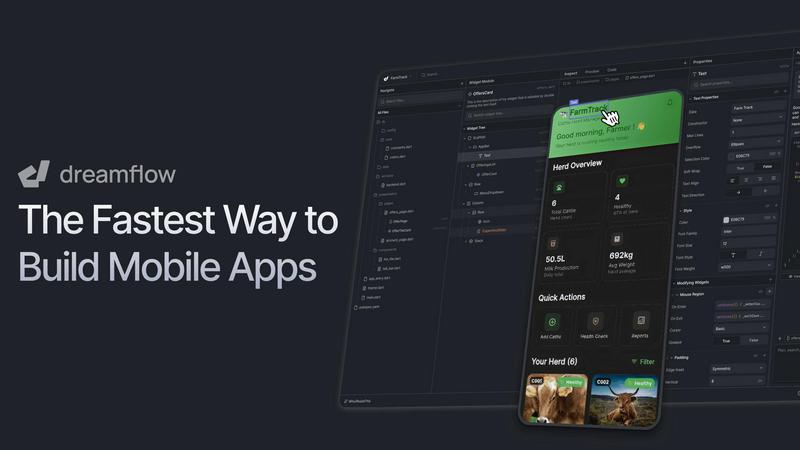
About Dreamflow
Dreamflow is a revolutionary application development platform that fundamentally redefines the process of building mobile and web applications. It is engineered to bridge the gap between rapid AI-assisted prototyping, intuitive visual design, and full, unrestricted code-level control. The platform's core value proposition lies in its "Tri-Surface Editing" paradigm, which allows developers and entrepreneurs to fluidly switch between describing features to an AI agent, manipulating a visual canvas, and editing raw Flutter code, with all changes synchronized in real-time. This eliminates the traditional compromise between development speed and technical flexibility, ensuring users are never locked into a proprietary framework or a specific workflow.
Built by the team behind the widely adopted FlutterFlow, Dreamflow is trusted by over two million builders and is designed for a broad spectrum of users. Solo developers and indie hackers can leverage it to go from a concept to a market-ready MVP in record time. Startups can utilize its integrated backend and deployment features to scale their product efficiently. Even larger enterprises benefit from its production-grade capabilities, including version control, custom AI model integration, and private cloud deployment options. By combining AI-powered scaffolding with the power of the Flutter framework, Dreamflow enables the creation of robust, natively compiled applications for iOS, Android, and the web from a single codebase, positioning itself as the fastest and most versatile way to build production-ready apps.
Features of Dreamflow
Tri-Surface Editing
Dreamflow's signature feature is its seamless Tri-Surface Editing environment. This innovative approach allows builders to interact with their project through three interconnected interfaces: an Agentic AI prompt interface, a Visual drag-and-drop canvas, and direct access to the underlying Code. Users can start by describing a feature in natural language to the AI agent, then fine-tune the layout and styling visually, and finally dive into the generated Flutter code for custom logic or optimizations. All modifications made in any surface are instantly reflected across the others, providing unparalleled flexibility and control without breaking the development flow.
AI-Powered Context-Aware Generation
The platform is powered by sophisticated artificial intelligence that goes beyond simple code generation. It is context-aware, meaning it understands the patterns, best practices, and the existing structure of your project. When you ask it to scaffold a new feature, such as a user authentication flow or a product catalog, it intelligently generates the appropriate UI components, navigation, and backend integration code that fits cohesively within your app's architecture. This smart assistance dramatically accelerates development while promoting maintainable and well-structured code from the outset.
Full-Stack Backend Integrations
Dreamflow provides out-of-the-box, managed integrations with leading backend-as-a-service platforms, specifically Firebase and Supabase. This allows developers to build fully functional, data-driven applications without managing server infrastructure. Features like real-time databases, user authentication, cloud functions, and storage can be configured and connected directly through the visual editor or via the AI agent. This integrated full-stack capability means projects can scale from a simple prototype to a live application with a robust backend from day one.
Multi-Platform Deployment & Export
Built on Google's Flutter framework, Dreamflow enables true multi-platform development. Users can create a single application that is automatically responsive and adaptable to any screen size. With just a few clicks, projects can be deployed directly to the web or prepared for submission to the Apple App Store and Google Play Store. Crucially, Dreamflow offers full code export, providing the complete, standard Flutter project. This allows teams to run the app on local simulators, real devices, and integrate it into any existing CI/CD pipeline, ensuring zero vendor lock-in.
Use Cases of Dreamflow
Rapid Prototyping and MVP Development
Entrepreneurs and product managers can use Dreamflow to transform a raw idea into a functional minimum viable product (MVP) in a matter of hours or days, not weeks. By describing the app concept to the AI and iterating visually, they can quickly create a clickable prototype to validate the idea with potential users or investors, significantly reducing time-to-market and initial development costs before committing to a full-scale build.
Cross-Platform App Development for Startups
Startups needing to establish a presence on both iOS and Android, and often the web, can leverage Dreamflow's Flutter foundation to build a single, high-quality codebase for all platforms. The integrated backend and one-click deployment streamline the launch process, allowing small teams to focus on product iteration and user growth rather than managing complex, platform-specific codebases and infrastructure.
Enterprise Application Modernization
Larger organizations can utilize Dreamflow, particularly its Enterprise plan, to modernize internal tools or customer-facing applications. Features like version control (Git), advanced access control, private cloud deployment, and the ability to bring custom AI models make it suitable for secure, scalable, and governed development within a corporate IT environment, accelerating digital transformation initiatives.
Educational Tool for Developers
Aspiring developers and students learning mobile development can use Dreamflow as an educational bridge. They can start by building apps visually to understand UI/UX principles and component structure, then seamlessly transition to examining and modifying the generated Flutter code. This provides a practical, hands-on way to learn a professional-grade framework while immediately seeing the results of their code changes.
Frequently Asked Questions
What is the difference between Dreamflow and FlutterFlow?
While both products are from the same team and utilize Flutter, they serve different primary purposes. FlutterFlow is a powerful low-code visual builder focused on enabling non-coders and business teams to create applications. Dreamflow is its successor, designed as a professional development platform that adds a foundational AI agent and full, synchronized code access to the visual canvas, targeting developers who demand ultimate control and flexibility without sacrificing speed.
Can I get the source code for my Dreamflow project?
Yes, absolutely. A core principle of Dreamflow is providing full code access and ownership. All paid plans, starting with the Hobby tier, include the ability to export the complete, standard Flutter project. This code can be opened in IDEs like VS Code or Android Studio, run on simulators, built locally, and integrated into any version control system, ensuring you are never locked into the Dreamflow platform.
Which backend services does Dreamflow support?
Dreamflow offers managed, out-of-the-box integration with two leading backend services: Google's Firebase and the open-source alternative, Supabase. These integrations handle core functionalities like database (Firestore/PostgreSQL), user authentication, file storage, and serverless functions, allowing you to build full-stack applications without writing backend boilerplate code.
Is there a free plan to try Dreamflow?
Yes, Dreamflow offers a comprehensive Free plan that allows users to explore the platform's core capabilities at no cost. This plan includes private projects with both visual and code editing, managed backend integrations (Firebase/Supabase), one-click web deployment, and a starter pack of AI credits, making it ideal for experimentation and learning the workflow before upgrading for production deployment.
Pricing of Dreamflow
Dreamflow offers a simple, tiered pricing model designed to scale with user needs, from exploration to enterprise production.
Free Plan ($0/month): Ideal for exploration, it includes private projects, visual + code editing, managed backend integrations, 1-click web deployment, and a one-time starter pack of 10 AI credits.
Hobby Plan ($20/month): Targeted at builders ready to launch, it includes everything in Free, plus 1-click deployment to iOS and Android app stores, full Flutter code export, the ability to run apps on local simulators/devices, and 100 AI credits per month.
Pro Plan ($90/month): The most popular plan for professional production workflows, it includes all Hobby features, plus integrated version control (Git), priority access to premium AI models, and 500 AI credits per month.
Enterprise Plan (Custom Pricing): For teams using Dreamflow as a core platform, offering dedicated support, onboarding, advanced access control, custom AI model integration, SLAs, uptime guarantees, and private cloud deployment options.
Explore more in this category:
Similar to Dreamflow

MECH AI is your pocket-sized automotive assistant for diagnosing, repairing, and sourcing parts for any car model in real time.

VibeBot.gg is an AI-powered platform that lets anyone create, customize, and launch a fully hosted Discord bot using natural language, no coding.

A marketplace of premium vetted no-code templates for websites and apps across dozens of categories and platforms.

Airway Trainer offers simple 5-minute exercises to naturally eliminate snoring and improve sleep quality without devices or surgery.

Miget offers a flat-rate plan for unlimited app deployments with 99.95% uptime, enabling rapid scaling without per-service fees.

Coloring Pages Pro offers over 10,000 free printable coloring pages for all ages, perfect for creativity, relaxation, and learning.

Twinkle Timer uses AI to transform a child's selfie into a magical reward, motivating them through two full minutes of focused toothbrushing.

FilexHost simplifies file hosting and sharing with instant URLs and built-in viewers for various file types.