
Code Word Solver - Missing Words Finder vs PseudoRun
Side-by-side comparison to help you choose the right product.

Code Word Solver - Missing Words Finder
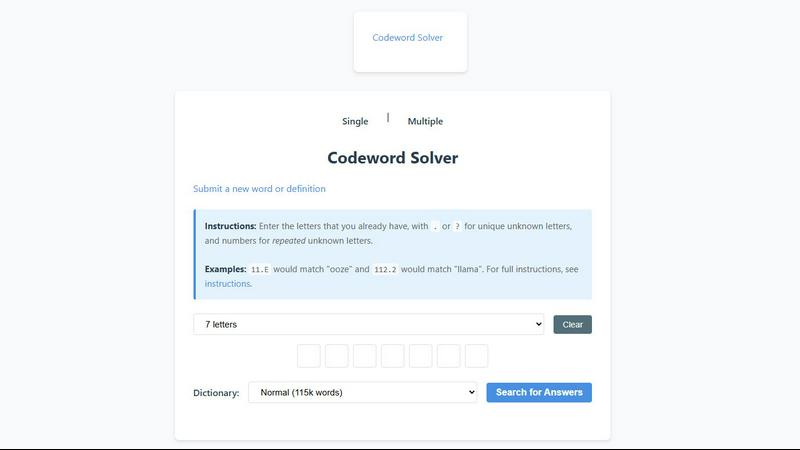
Effortlessly solve codewords with our intuitive tool that helps you find missing letters and words quickly.
Last updated: February 26, 2026

PseudoRun
PseudoRun is the premier free platform for writing, testing, and mastering IGCSE pseudocode algorithms.
Last updated: March 1, 2026
Visual Comparison
Code Word Solver - Missing Words Finder
PseudoRun

Feature Comparison
Code Word Solver - Missing Words Finder
Single Pattern Solving
The single pattern solving feature allows users to input one specific word pattern and retrieve a list of matching word candidates. This capability is essential for players who want to focus on individual words within a larger puzzle, ensuring they can find the correct letter combinations quickly. By simply entering known letters and placeholders for unknown ones, users can streamline their solving process and enhance their overall performance.
Multi-Pattern Solving
With the multi-pattern solving functionality, users can enter two patterns simultaneously to solve linked words side-by-side. This feature is particularly useful when the same number-letter relationships appear across multiple words in the puzzle. By correlating patterns, players can uncover further clues, leading to faster and more accurate solutions. This capability sets the Code Word Solver apart, allowing for complex interrelations between words to be resolved efficiently.
Customizable Difficulty Dictionary
Understanding that different puzzles cater to varying levels of expertise, Code Word Solver offers a choice of difficulty dictionaries. Users can select from hard (260k words), normal (115k words), or easy (20k words) dictionaries based on their skill level and puzzle requirements. This feature ensures that players can tailor their experience to match their proficiency, making the tool accessible to both casual players and serious enthusiasts.
Community-Powered Word Coverage
The community-powered word coverage feature invites users to submit new words or definitions to enhance the solver’s database. This collaborative approach allows the tool to grow over time, incorporating a broader spectrum of vocabulary that may not be present initially. By participating in this community effort, users can contribute to the continuous improvement of the tool, making it more robust and comprehensive for everyone.
About PseudoRun
IGCSE Exam-Focused Editor
The editor is the cornerstone of PseudoRun, built from the ground up to adhere strictly to the Cambridge IGCSE Computer Science pseudocode syntax and conventions. It understands and validates the specific commands, data structures, and stylistic guidelines required by the syllabus. This ensures that students are not just learning pseudocode, but are practicing the exact format and style they will encounter in their written examinations, eliminating confusion and building exam-specific competency through consistent, correct practice.
Real-Time Validation and Error Detection
As users type their pseudocode, the platform performs continuous, instantaneous syntax checking. Errors are highlighted in real-time with clear, descriptive messages that explain the nature of the mistake, such as incorrect variable declaration, misuse of keywords, or logical structural flaws. This immediate feedback loop accelerates the learning process by allowing students to correct misunderstandings as they occur, fostering a deeper and more accurate understanding of proper pseudocode construction without the frustration of delayed error discovery.
Interactive Step-by-Step Debugger
This powerful feature allows learners to execute their algorithms one line at a time, observing the flow of control and the changing state of all variables in a dedicated watch panel. Users can set breakpoints, step into loops, and trace procedure calls, which demystifies complex algorithms. This granular visibility into program execution is invaluable for mastering IGCSE topics like trace tables, enabling students to deconstruct and comprehend algorithmic behavior in a way that static textbook examples cannot provide.
Comprehensive IGCSE Practice Library
PseudoRun hosts an extensive and growing repository of over 50 IGCSE-style practice problems and fully worked examples. These exercises are systematically categorized to cover all key syllabus areas, including input/output operations, conditional statements, iterative loops (FOR, WHILE, REPEAT), array manipulation, and procedure/function design. This library serves as a structured curriculum for self-study, allowing students to progress from fundamental concepts to advanced exam-level challenges, reinforcing their learning through applied practice.
Use Cases
Code Word Solver - Missing Words Finder
Enhancing Puzzle Solving Speed
Players who regularly engage in codeword puzzles can utilize this tool to enhance their solving speed significantly. By quickly narrowing down letter combinations, users can spend less time guessing and more time solving, ultimately improving their overall enjoyment and satisfaction with the puzzles.
Educational Use for Beginners
For individuals new to codeword puzzles, the solver serves as an excellent educational tool. By seeing how letter patterns correlate to potential words, beginners can develop a better understanding of the mechanics behind codewords. This can foster confidence and skill development as they progress in their puzzle-solving journey.
Competitive Play
In competitive puzzle-solving scenarios, such as tournaments or timed challenges, the Code Word Solver can provide a strategic advantage. By allowing players to quickly identify possible answers, competitors can outpace their rivals and perform better under pressure, making it an essential tool for serious puzzle enthusiasts.
Community Engagement and Contribution
The ability to submit new words and definitions fosters community engagement among users. Puzzle solvers are encouraged to contribute, creating a sense of belonging and collaboration. This feature not only enriches the solver’s database but also inspires users to explore new vocabulary and improve their language skills while enjoying their favorite pastime.
PseudoRun
Independent Student Exam Preparation
IGCSE Computer Science students can use PseudoRun as a primary study tool to practice writing and debugging pseudocode independently. They can work through the categorized problem sets, utilize the exam mode timer to simulate test conditions, and save their solutions to the free cloud storage for later review. This self-directed practice builds fluency, speed, and confidence, directly translating to higher performance in both paper-based pseudocode questions and practical algorithm design tasks.
Classroom Teaching and Demonstration
Educators can integrate PseudoRun into their lessons as a dynamic teaching aid. During lectures, teachers can project the editor to demonstrate algorithm construction in real-time, use the step-by-step debugger to visually unpack complex logic for the entire class, and assign specific practice problems as homework. The platform's alignment with the official syllabus ensures that classroom instruction is perfectly complemented by hands-on, accurate practice tools.
Algorithmic Concept Reinforcement
For learners struggling with specific abstract concepts—such as how a nested loop iterates, how data passes through a procedure, or how an array is sorted—PseudoRun provides a concrete way to visualize and experiment. By writing small snippets of code and using the debugger to watch variable values change, students can move from rote memorization to genuine comprehension, solidifying their foundational understanding of computer science principles.
Collaborative Learning and Peer Review
Study groups can leverage PseudoRun's cloud storage to share pseudocode solutions for group projects or peer review sessions. Students can load each other's algorithms, run them to check for logic errors, and use the debugging tools to understand different approaches to the same problem. This collaborative analysis fosters deeper discussion, exposes learners to multiple problem-solving strategies, and enhances critical thinking skills.
Overview
About Code Word Solver - Missing Words Finder
Code Word Solver - Missing Words Finder is an innovative tool designed to assist puzzle enthusiasts in decoding codeword puzzles more efficiently. Codewords, also known as code-cracker puzzles, challenge players by replacing letters with numbers from 1 to 26. This tool leverages the patterns already present in the puzzle to help users identify possible answers with greater confidence and accuracy. It is particularly beneficial for players of all skill levels, from newcomers seeking to learn the ropes to seasoned veterans aiming to enhance their puzzle-solving speed. By narrowing down potential letter combinations, users can eliminate guesswork and enjoy a more rewarding puzzle-solving experience. The solver offers both single and multi-pattern solving capabilities, making it versatile for various puzzle scenarios. Additionally, it supports a community-driven approach, allowing users to contribute new words and definitions, further enriching the tool's database and improving overall word coverage.
About PseudoRun
PseudoRun is the definitive, free online platform engineered exclusively for mastering the Cambridge IGCSE Computer Science pseudocode syllabus. It serves as a fully integrated interactive editor and simulator, enabling users to write, execute, and debug algorithms in a real-time, browser-based environment. This eliminates the complexity and setup required by traditional programming languages, allowing learners to concentrate purely on algorithmic logic and structure. The platform is meticulously calibrated to be 100% aligned with the official Cambridge IGCSE pseudocode specifications and examination patterns, making it an indispensable resource for students, educators, and beginners embarking on their computer science journey. Its core value proposition is bridging the critical gap between theoretical algorithmic concepts and their practical implementation. By delivering instant feedback, granular step-by-step execution, and an extensive library of curated practice problems, PseudoRun transforms passive study into an engaging, hands-on experiential learning process. Founded on an unwavering commitment to accessible education, the platform is completely free, devoid of any advertisements, and places paramount importance on student privacy. This ensures a clean, distraction-free interface where users can focus entirely on developing the logical reasoning, debugging skills, and exam-ready confidence necessary to excel in their IGCSE Computer Science assessments and build a strong foundation for future programming endeavors.
Frequently Asked Questions
Code Word Solver - Missing Words Finder FAQ
How does the Code Word Solver work?
The Code Word Solver functions by allowing users to enter known letters and placeholders for unknown ones. It then filters potential word candidates based on the provided pattern, enabling users to quickly identify possible answers.
Can I use the solver for different types of puzzles?
While primarily designed for codeword puzzles, the principles behind the Code Word Solver can be adapted for similar word puzzles where letter-number relationships are used. However, it is optimized specifically for codewords.
Is there a limit to the number of words I can submit?
There is no specified limit on the number of words or definitions you can submit. The community-driven aspect encourages users to contribute as much as they want, helping to expand the tool's vocabulary and coverage.
Can I choose the difficulty level of the words?
Yes, the Code Word Solver allows users to select from three different difficulty dictionaries: hard, normal, and easy. This feature enables players to tailor their experience based on their skill level and the complexity of the puzzles they are tackling.
PseudoRun FAQ
Is PseudoRun really completely free to use?
Yes, PseudoRun is completely free with no hidden costs, tiered plans, or premium paywalls. The founders have made a public commitment to keep the platform free and entirely advertisement-free forever. All features, including the editor, debugger, practice library, and cloud storage, are available at no charge to all users, prioritizing accessible education for every IGCSE Computer Science student.
How does PseudoRun ensure it aligns with the Cambridge IGCSE syllabus?
The platform's development was meticulously guided by the official Cambridge IGCSE Computer Science syllabus documentation and past examination papers. The pseudocode syntax parser, keyword set, and allowable structures are programmed to validate code strictly against these specifications. Furthermore, the practice problem library is deliberately crafted to mirror the style, complexity, and topics of actual IGCSE exam questions, ensuring highly relevant preparation.
Can I access my saved programs from different devices?
Absolutely. PseudoRun offers free, unlimited cloud storage for all user programs. Once you save a pseudocode file, it is stored securely in your account and can be retrieved, edited, and executed from any device with an internet connection and a web browser. This facilitates seamless study continuity between school computers, personal laptops, and tablets.
Does PseudoRun require any software installation or login?
No installation is required. PseudoRun is a fully web-based application that runs directly in your browser. While you can use the core editor immediately without an account, creating a free login is recommended to unlock the full suite of features, including saving your work to the cloud, tracking progress, and accessing the complete practice problem library. The sign-up process is simple and does not require a credit card.
Alternatives
Code Word Solver - Missing Words Finder Alternatives
Code Word Solver - Missing Words Finder is an online tool designed to assist users in solving codeword puzzles more efficiently. This tool falls under the category of puzzle-solving assistance, specifically targeting those who enjoy word games and code-based challenges. Users often seek alternatives when they encounter issues such as pricing concerns, a lack of desired features, or compatibility with their preferred platforms. When choosing an alternative, it's essential to consider factors such as the comprehensiveness of the word database, ease of use, and the variety of solving methods available.
PseudoRun Alternatives
PseudoRun is a specialized educational platform in the category of IGCSE Computer Science tools. It serves as a premier, free online editor and simulator for writing and mastering Cambridge-aligned pseudocode, bridging the gap between algorithmic theory and practical execution. Users may seek alternatives for various reasons, including the need for different feature sets, such as support for other programming languages or curriculum standards beyond IGCSE. Others might require offline functionality, integration with specific learning management systems, or simply wish to explore different pedagogical approaches and user interfaces. When evaluating an alternative, key considerations include strict adherence to the required exam board's pseudocode syntax, the quality of real-time feedback and debugging tools, and the overall educational design. The platform's cost structure, privacy policies, and whether it offers a distraction-free, ad-free learning environment are also critical factors in ensuring an effective and focused study tool.