
Mailopoly vs Skene
Side-by-side comparison to help you choose the right product.

Mailopoly
Mailopoly is an AI email client that streamlines your inbox, extracts key details, and automates replies to enhance.
Last updated: February 26, 2026

Skene embeds product-led growth directly into your codebase, automating onboarding and retention.
Last updated: February 28, 2026
Visual Comparison
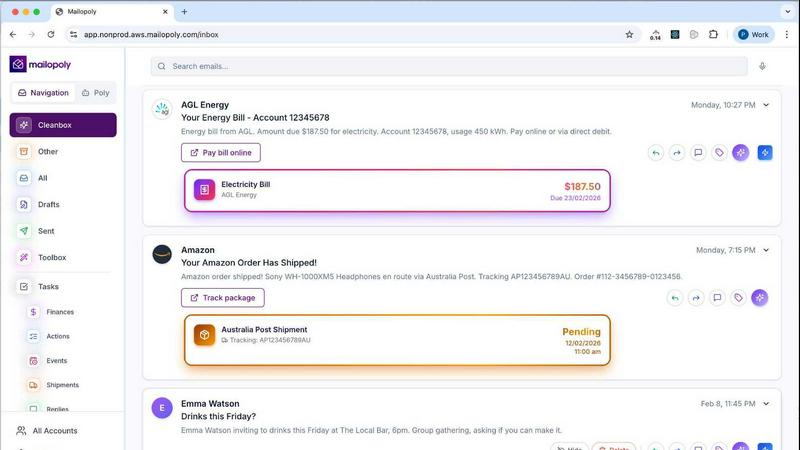
Mailopoly
Skene
Feature Comparison
Mailopoly
Intelligent Email Management
Mailopoly's intelligent email management system automatically filters and organizes incoming messages, ensuring that only the most relevant emails appear in your inbox. This feature minimizes distractions and helps users prioritize critical communications without the need for manual sorting.
AI-Powered Reply Generation
The platform includes an AI-powered reply generation feature that drafts responses in the user's unique voice. By analyzing prior communications, Mailopoly creates contextually appropriate replies, allowing users to respond quickly without worrying about tone or grammar.
Integrated Task Manager
Mailopoly incorporates a built-in task manager that helps users track personal finances, events, and deliveries. This feature provides a comprehensive timeline of tasks and updates, enabling users to manage their responsibilities efficiently and keep all pertinent information in one place.
Instant Unsubscribe Functionality
With Mailopoly, users can effortlessly unsubscribe from unwanted email senders with a single click. This feature helps declutter the inbox and ensures that users are only receiving communications that they genuinely wish to engage with, creating a more enjoyable email experience.
Skene
Codebase-Derived Growth Signals
Skene performs a deep analysis of your application's source code to automatically identify and extract meaningful growth signals. Instead of relying on manually instrumented events or external analytics snippets, it scans the repository structure, framework, and code patterns to detect user interaction points, potential activation opportunities, and friction areas. This creates a foundational "growth manifest" that serves as a precise, always-up-to-date context layer, ensuring that all growth automation is built upon a real-time understanding of how the product actually works.
Prompt-Driven Growth Implementation
The platform enables a revolutionary workflow where growth loops and optimizations are designed and executed through natural language prompts within the developer's IDE, such as Cursor. Developers or their AI agents can instruct Skene to analyze bottlenecks, generate improved user flows, or implement specific onboarding steps. This shifts the paradigm from managing disparate SaaS dashboards and widgets to shipping growth iterations with the same agility and ownership as feature development, directly within the codebase.
Autonomous PLG Flow Generation & Testing
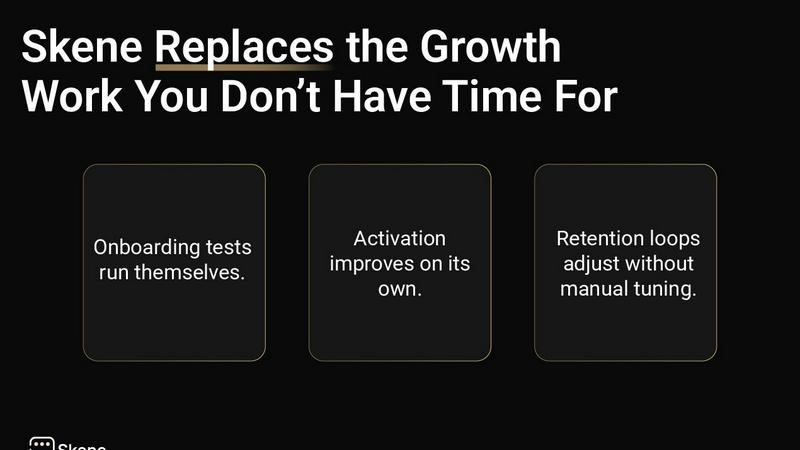
Skene functions as a self-learning growth engine. By continuously monitoring user interactions against the insights from the codebase, it can autonomously create, A/B test, and deploy optimized user journeys. It detects activation drop-offs and friction points, then experiments with improved configurations, measures their impact on key metrics like completion rates, and deploys the most effective versions. This automates the entire cycle of growth iteration without requiring manual intervention from a dedicated team.
Owned & Version-Controlled Growth Infrastructure
A fundamental differentiator of Skene is that it operates as owned infrastructure, not a third-party service. The growth logic, analytics, and automation become part of your codebase, fully version-controlled and integrated into your standard development lifecycle. This eliminates the risks of broken UI overlays after deploys, performance degradation from external scripts, and data silos. Growth logic updates seamlessly whenever you push code, and all data remains within your ecosystem.
Use Cases
Mailopoly
Streamlining Professional Communications
Professionals can utilize Mailopoly to manage their work-related emails effectively. The intelligent filtering and AI-generated replies allow users to focus on high-priority messages and respond promptly, enhancing productivity and communication efficiency within the workplace.
Managing Personal and Side Hustle Emails
For individuals juggling multiple responsibilities, Mailopoly simplifies the management of personal and side hustle emails. By organizing messages from different accounts into one interface, users can easily keep track of important tasks and deadlines across various life domains.
Financial Tracking and Management
Mailopoly's task manager facilitates personal finance tracking by providing updates on invoices, payment due dates, and other financial responsibilities. This feature enables users to stay on top of their finances without the hassle of sifting through numerous emails for essential information.
Event Planning and Coordination
With its integrated event manager, Mailopoly aids users in planning and coordinating various events. Users can create custom invitations, track RSVPs, and manage all related communications seamlessly, making event organization a stress-free process.
Skene
Automated Onboarding Optimization for Early-Stage Startups
Indie developers and startups with limited resources can use Skene to completely automate their user onboarding process. By connecting their repository, Skene analyzes the code to understand key activation milestones, then automatically generates and iterates on in-app guidance, tutorial flows, and welcome sequences. This ensures new users consistently find value without the startup needing to build or manually maintain a complex onboarding system.
AI-Agent Managed Growth Operations
Engineering teams can integrate Skene's context layer into their AI development workflows. An AI agent, equipped with the insights from Skene's codebase analysis, can be prompted to audit the user journey, identify the top friction point, and implement a fix—all autonomously. This use case allows for fully automated, continuous growth optimization where the AI handles routine iteration, freeing human developers for more complex tasks.
Replacing Legacy Growth & Analytics Stacks
Companies frustrated with a fragmented stack of analytics tools, survey widgets, and intercom-style messengers can use Skene as a unified replacement. It consolidates signal detection, analytics, and lifecycle automation into a single, code-native system. This eliminates the maintenance burden, data disjointedness, and performance overhead associated with managing multiple external SaaS tools and snippets.
Data-Driven Retention and Churn Prevention
Product teams can leverage Skene to strengthen user retention systematically. The platform continuously analyzes user behavior patterns against the codebase to identify signals of potential churn, such as failed feature adoption or support ticket patterns. It can then automatically trigger personalized in-app messages, re-engagement flows, or feature recommendation prompts to proactively address issues and increase customer lifetime value (LTV).
Overview
About Mailopoly
Mailopoly is a revolutionary email client designed to transform how users manage their email communications and daily activities. Unlike traditional email clients that simply display messages, Mailopoly employs advanced artificial intelligence to automatically extract key information from emails, allowing users to engage with their inboxes in a more efficient manner. With its innovative features, Mailopoly reduces the volume of notifications and streamlines the inbox experience, making it easy to focus on what truly matters. This tool is ideal for busy professionals, entrepreneurs, and anyone seeking to regain control over their email management. By integrating personal finance tracking, event management, and an AI chatbot, Mailopoly serves as a comprehensive command center for managing various aspects of life, ensuring that users can stay organized and stress-free.
About Skene
Skene is a revolutionary, AI-powered Product-Led Growth (PLG) infrastructure engineered to automate the growth iteration process for software products. It is specifically designed for indie developers, early-stage startups, and engineering teams who lack dedicated growth resources. Skene's core value proposition is transforming growth from a manual, tool-stack-dependent chore into an owned, code-first infrastructure. Unlike traditional third-party tools that operate as external "black boxes" with performance-impacting snippets and siloed data, Skene integrates directly with a product's codebase and IDE. It analyzes the source code to automatically derive growth signals, identify friction points in user journeys (like onboarding drop-offs), and generate context for AI agents to implement optimizations. This allows products to autonomously evolve their activation, onboarding, and retention flows. By treating growth as programmable infrastructure, Skene enables developers to offload growth-related tasks, ship data-driven improvements through simple prompts, and focus on core product development, all while maintaining full ownership, performance, and integration with their existing workflow.
Frequently Asked Questions
Mailopoly FAQ
How does Mailopoly ensure my privacy?
Mailopoly is designed with a privacy-first approach, adhering to SOC 2 certification standards. User data is secure, and the platform prioritizes maintaining the confidentiality of personal information.
Can I use Mailopoly with multiple email providers?
Yes, Mailopoly supports multiple email accounts, including Gmail, Outlook, Yahoo, Hotmail, and any IMAP provider. This versatility allows users to manage all their email communications from one centralized platform.
Is there a learning curve to using Mailopoly?
No, Mailopoly is designed for ease of use. It requires zero setup or migration, and users can start experiencing the benefits of the intelligent email assistant immediately upon registration.
What if I want to customize Mailopoly's features?
Mailopoly allows users to customize their preferences. You can adjust notification settings, filter criteria, and reply styles to align with your unique needs, ensuring a personalized experience tailored to your daily routine.
Skene FAQ
What is PLG software?
Product-Led Growth (PLG) software is a category of tools designed to help users discover, adopt, and derive value from a product primarily through their direct interaction with the product itself, rather than through manual intervention from sales or customer success teams. It automates key aspects of the user journey, such as onboarding, feature adoption, and retention, using the product as the primary vehicle for growth, guidance, and user education.
How is Skene different from traditional customer experience software?
Traditional customer experience tools (like walkthrough builders or survey tools) are typically external services that require manual, rule-based configuration of UI overlays and tours. These are often brittle, breaking with every code deployment, and create data silos. Skene is fundamentally different: it reads your actual codebase to automatically understand your product and generate context-aware growth flows. It is an owned infrastructure that updates automatically with your code, is fully programmable, and operates without fragile external snippets.
How long does it take to set up?
Setup is designed to be exceptionally fast, taking less than 60 seconds. The primary step involves connecting your GitHub or GitLab repository with read-only access. Once connected, Skene automatically begins analyzing your codebase to generate the initial growth manifest and identify PLG opportunities. No initial code changes, API integrations, or complex configuration is required to get started.
Is my code secure?
Yes, security is a core principle. Skene only requires read-only access to your repository for analysis purposes. All code analysis is performed within a secure, isolated environment. Crucially, because Skene promotes an "owned infrastructure" model, the resulting growth logic and analytics are implemented within your own codebase and systems, meaning your user data and business logic never need to be sent to or stored on an external platform.
Alternatives
Mailopoly Alternatives
Mailopoly is an innovative AI-powered email client designed to streamline your inbox and enhance productivity. By automatically extracting essential information from your emails, it significantly reduces the clutter and notifications that often accompany traditional email management. This powerful tool not only serves as an email client but also integrates features like a personal AI assistant, task management, and event tracking, making it a comprehensive solution for personal organization. Users commonly seek alternatives to Mailopoly for various reasons, including pricing, specific feature sets, or compatibility with different platforms. When exploring alternatives, it's crucial to consider aspects such as user interface, integration capabilities, and the extent of AI functionality. A well-rounded alternative should offer similar efficiency in managing communications while also addressing individual user needs and preferences.
Skene Alternatives
Skene is an automated Product-Led Growth (PLG) iteration engine within the productivity and management software category. It is designed to autonomously optimize user onboarding, activation, and retention by analyzing codebase-driven insights and user interactions, making it a powerful tool for indie developers and resource-constrained startups. Users may explore alternatives to Skene for various reasons, including budgetary constraints, specific feature requirements not covered by its automated approach, or a need for platforms that integrate with a different set of existing tools. Some may seek solutions with more manual control or those that cater to larger, established teams with dedicated growth personnel. When evaluating an alternative, key considerations should include the platform's core methodology for driving growth, its integration depth with your development stack, the level of automation versus manual control offered, and the transparency and actionability of its analytics. The ideal solution should align with your team's technical capabilities and strategic growth objectives without compromising product performance.