
LLM Reference
LLM Reference is the definitive directory for tech leaders to discover, compare, and select the optimal AI model and provider for any project.
Visit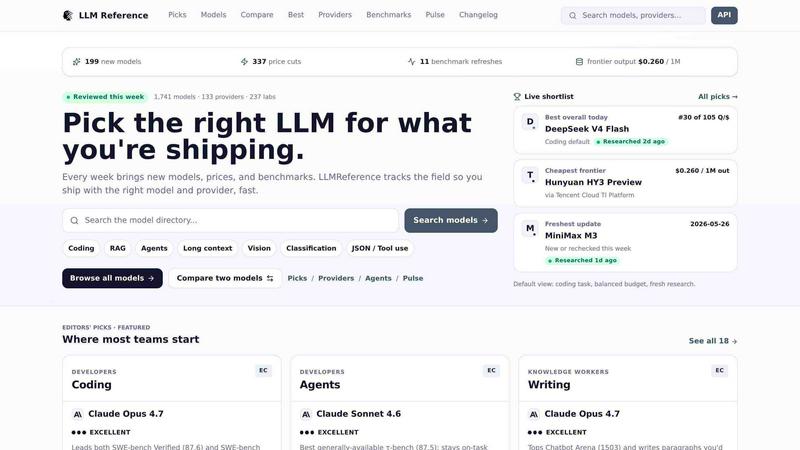
About LLM Reference
LLM Reference is a comprehensive decision-support directory engineered specifically for software developers, engineering teams, and technology leaders who must navigate the increasingly complex landscape of large language models (LLMs) and their providers. In an era where new models, pricing changes, and benchmark results emerge weekly, this platform serves as a single, authoritative source of truth for comparing and selecting the optimal LLM for any given task. The product tracks an extensive catalog of over 1,843 language models sourced from more than 140 providers and 247 research labs, with data refreshed on a weekly basis to capture new releases, verified price changes, and updated benchmark scores. The core value proposition is eliminating the time-consuming and error-prone process of hunting through scattered sources, allowing users to ship their applications with confidence. Whether building a coding assistant, an agentic workflow, a writing tool, a research pipeline, or a creative application, LLM Reference provides a structured environment for side-by-side model comparison, identification of the cheapest frontier output pricing, and access to curated editors' picks for specific tasks such as coding, agents, writing, research, image generation, and video creation. The platform is designed for rapid triage, enabling users to quickly identify the right model for their job, determine the most cost-effective provider, and return to building. A Pulse feed highlights weekly changes including new models, price cuts, and benchmark refreshes, keeping users informed without information overload. Built by the Data Advantage project and updated daily, LLM Reference has become an essential resource for anyone needing to stay current with the exploding LLM ecosystem.
Features of LLM Reference
Comprehensive Model Directory
The platform maintains an exhaustive, searchable directory of 1,843 language models from 140 providers and 247 labs, making it the most thorough aggregation of LLM data available. Users can search by model name, provider, or specific capabilities such as coding, RAG, agents, long context, vision, classification, and JSON or tool use. Each model entry includes verified pricing, benchmark scores, and provider details, all updated weekly to reflect the fast-moving market.
Curated Editors' Picks
LLM Reference features expert-curated selections organized by use case, providing immediate guidance for common tasks. These editors' picks cover six primary categories: coding, agents, writing, research, image generation, and video creation. Each pick includes a detailed rationale, benchmark evidence, and eligibility information, helping users understand why a particular model excels for a specific job. For example, Claude Fable 5 is highlighted for coding with an 80.3% SWE-bench Pro score, while FLUX.2 Dev is recommended for photorealistic image generation.
Dynamic Pulse Feed
The Pulse feed delivers a weekly summary of market movements, tracking three key metrics: new models added (177 this week), verified price cuts (53 this week), and benchmark refreshes (368 this week). This feature allows users to monitor the competitive landscape without manual research, ensuring they always have access to the most current information about frontier pricing and model capabilities. The feed also highlights the cheapest frontier output pricing, currently at $0.260 per 1M output tokens.
Side-by-Side Model Comparison
The platform includes a dedicated comparison tool that enables users to evaluate two models directly against each other. This feature is particularly useful for making nuanced decisions between similar models, such as comparing Claude Fable 5 against Claude Opus 4.8 or GPT-5.5 against Gemini 3.1 Pro Preview. The comparison includes benchmark scores, pricing data, and provider information, all presented in a clear, digestible format.
Use Cases of LLM Reference
Selecting a Coding Assistant Model
Engineering teams building AI-powered coding tools can use LLM Reference to identify the best model for their specific requirements. The platform's coding-specific editors' picks highlight models like Claude Fable 5, which achieves 80.3% on SWE-bench Pro and 96% on SWE-bench Verified, making it ideal for non-trivial engineering tasks. Users can compare multiple coding models, evaluate their benchmark performance, and select the most cost-effective provider for their deployment scale.
Optimizing Agentic Workflow Performance
Developers creating autonomous agent systems can leverage the agents board to find models with proven performance in tool-use scenarios. The platform highlights Claude Sonnet 4.6 for its best generally-available tau-bench score of 87.5, demonstrating superior ability to stay on-task across long tool loops and self-correct without prompting. This allows teams to select models that minimize failure rates in production agent deployments.
Choosing the Most Cost-Effective Provider
Technology leaders managing LLM budgets can use LLM Reference's frontier pricing data to identify the cheapest provider for high-quality output. The platform tracks verified price changes weekly, currently showing Hunyuan HY3 Preview via Tencent Cloud TI Platform at $0.260 per 1M output tokens as the cheapest frontier option. This enables organizations to balance performance requirements with cost constraints, potentially saving thousands of dollars in monthly API costs.
Researching Model Capabilities for Academic Projects
Researchers and knowledge workers can use the platform's research board to find models excelling in analytical tasks. Claude Fable 5 is highlighted for general knowledge work with a GDPval-AA ELO of 1932 and strong performance in finance, trading, and analytics benchmarks. The platform's comprehensive benchmark data allows researchers to verify claims and select models that align with their specific research requirements.
Frequently Asked Questions
How often is the model data updated on LLM Reference?
The data on LLM Reference is updated weekly, with new models, verified price changes, and benchmark refreshes added every week. The Pulse feed specifically tracks these changes, and the platform is maintained by the Data Advantage project with daily updates to ensure accuracy. Users can rely on the Changelog for detailed records of all modifications.
What types of models and providers are included in the directory?
The directory currently includes 1,843 language models from 140 providers and 247 labs. This covers a wide range of model types including proprietary models from major companies like Anthropic, OpenAI, Google, and Meta, as well as open-weight models from research labs and smaller providers. The platform also tracks models across various capabilities including coding, agents, long context, vision, and image generation.
How are the Editors' Picks determined?
Editors' Picks are curated by the LLM Reference team based on comprehensive benchmark analysis, real-world performance data, and expert evaluation. Each pick includes specific benchmark scores, eligibility criteria, and a detailed rationale explaining why the model is recommended for that particular use case. The picks are updated regularly as new models and benchmark results become available.
Can I compare models directly on the platform?
Yes, LLM Reference includes a dedicated comparison tool that allows users to compare two models side-by-side. Users can access this feature from the Compare section and select any two models from the directory. The comparison includes pricing information, benchmark scores, provider details, and other relevant metrics to facilitate informed decision-making.
Pricing of LLM Reference
LLM Reference is a free resource for all users. There are no subscription tiers, paywalls, or usage limits for accessing the model directory, editors' picks, comparison tools, Pulse feed, or any other feature on the platform. The service is provided by the Data Advantage project as a public resource to help the AI community make informed decisions about large language model selection. While the platform tracks pricing data for third-party model providers, access to LLM Reference itself is completely free.
Similar to LLM Reference

Planning a relocation or long-term stay abroad? Compare places on sunshine, cost, tax, visa and stay duration, then ask AI about your shortlist.

SlabCalc is a free suite of 34 concrete calculators plus AI tools for crack diagnosis and quote analysis. Instant answers for your concrete project.


Automatically get personalized actions from your YT, podcast, and email subscriptions.


AI Chat, Chat AI, AI Detector & AI Checker. Chat with AI, detect AI writing, humanize text and create content powered by Chat GPT 5.5.