
LayoffAlert vs Redbark
Side-by-side comparison to help you choose the right product.

LayoffAlert
LayoffAlert notifies you of potential layoffs at your job and offers resources for preparation and legal help.
Last updated: February 26, 2026

Redbark automatically syncs your Australian bank and brokerage data to apps like Google Sheets and YNAB.
Last updated: March 4, 2026
Visual Comparison
LayoffAlert
Redbark
Feature Comparison
LayoffAlert
Comprehensive WARN Act Database
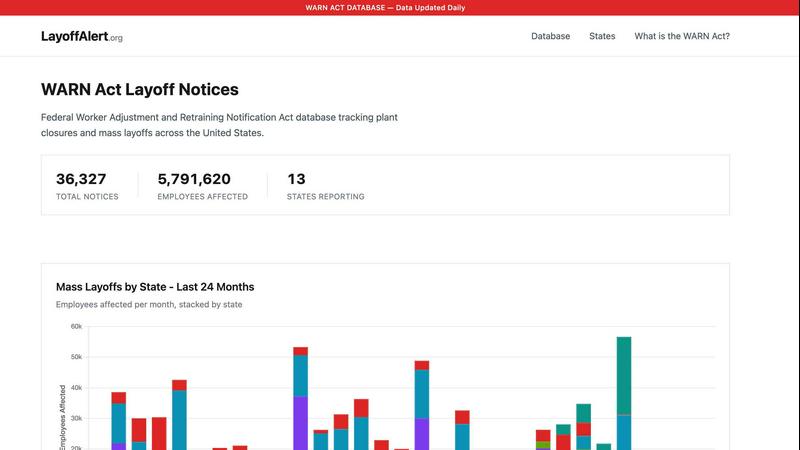
LayoffAlert features a robust database that aggregates WARN Act notices from 49 states, providing users with a centralized location to access the latest information on mass layoffs and plant closures. This data is updated daily, ensuring that users have the most current insights into workforce reductions across various industries.
Search and Filter Functionality
The platform allows users to conduct detailed searches of layoff notices based on several criteria, including company name, location, industry, and date. This powerful search functionality enables users to find relevant information quickly, facilitating informed decision-making regarding their careers or investments.
Email Alerts for New Filings
Users can opt to receive email alerts whenever new WARN notices are filed for specific companies or regions they are monitoring. This feature ensures that users are promptly notified of any potential job losses, allowing them to take proactive steps in response to evolving employment situations.
Statewide Layoff Trends Visualization
LayoffAlert provides a geographic view of layoffs by state, presenting data on the number of employees affected over the last 24 months. This visual representation helps users easily identify trends in layoffs by state, making it easier to understand regional job market dynamics and assess areas of concern.
About Redbark
Pass-Through Data Architecture
Redbark operates on a fundamental principle of data minimalism and security through its pass-through architecture. Financial data, including transactions, balances, and account details, flows directly from the user's bank or brokerage to their selected destination tool, such as Google Sheets or YNAB. Crucially, this data is never stored or persisted on Redbark's own servers. This design eliminates a central point of vulnerability for sensitive financial information and ensures that Redbark itself cannot access, analyze, or monetize user transaction history, aligning with stringent privacy-by-design principles and reducing regulatory data handling burdens.
Multi-Destination and Multi-Account Support
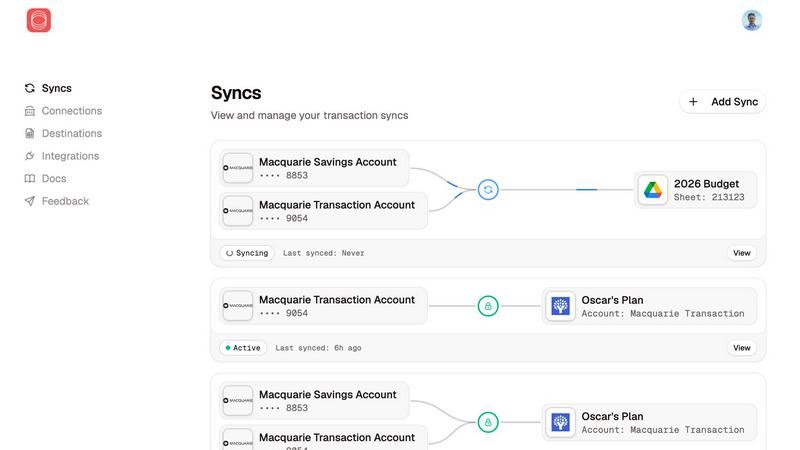
The platform offers exceptional flexibility by allowing users to synchronize their financial data to multiple destinations simultaneously. A single bank account can feed data into a Google Sheet for custom analysis, into YNAB for budgeting, and into Actual Budget for local-first finance management, all at once. Furthermore, Redbark supports syncing every financial account individually—be it savings, transaction accounts, credit cards, or loans. Each account can be configured to update its own dedicated sheet, database, or budget category, enabling highly granular and organized financial tracking and reporting tailored to complex financial situations.
Smart Deduplication & Automated Sync
Redbark incorporates intelligent logic to ensure data cleanliness and timeliness. Its smart deduplication system uses unique transaction identifiers and employs overlap buffers to catch late-posting transactions, effectively preventing duplicate entries from appearing in destination tools. Synchronization is fully automated and can be triggered via webhooks, where supported, meaning the platform can initiate a data sync the moment a bank pushes new transaction information. This enables near real-time updates without requiring manual refresh commands, ensuring financial dashboards and budgets are always current.
Regulated CDR & Open Banking Connections
Unlike legacy methods that rely on risky and often prohibited screen-scraping, Redbark connects to Australian financial institutions using the official Consumer Data Right (CDR) framework through an ACCC-accredited intermediary, Fiskil. This regulated approach provides bank-approved, secure, and consent-based access to data. Users grant explicit, transparent consent for data sharing, which can be revoked at any time. This method is not only more secure and reliable but also future-proof, as it aligns with government-mandated open banking standards, ensuring ongoing access and compliance.
Use Cases
LayoffAlert
Monitoring Employer Stability
Employees can use LayoffAlert to keep track of their current employer's stability by monitoring WARN notices. This proactive approach helps workers stay informed about potential layoffs, enabling them to prepare for any necessary career transitions.
Job Seeking and Career Planning
Job seekers can leverage LayoffAlert to identify companies in distress or industries experiencing significant layoffs. Understanding these trends can inform their job search strategy, guiding them toward more stable opportunities or sectors less likely to experience downsizing.
Industry Trend Analysis
Business analysts and industry researchers can utilize LayoffAlert to gain insights into workforce trends within specific sectors. By analyzing layoff data, they can identify patterns that may influence market dynamics, investment opportunities, or regulatory considerations.
Legal and Financial Advisory
Legal and financial advisors can benefit from LayoffAlert by obtaining timely data on corporate layoffs that may impact their clients. With access to comprehensive WARN notices, advisors can better assist clients in navigating potential employment issues or financial ramifications related to layoffs.
Redbark
Freelancer and Contractor Financial Management
Freelancers and independent contractors can leverage Redbark to automate the tracking of income and business expenses directly into a spreadsheet or database. By connecting their business transaction accounts, all invoices paid and operational costs are synced automatically. This eliminates manual receipt entry and CSV imports, providing a real-time view of cash flow, simplifying quarterly BAS preparation, and offering a clear, always-updated financial picture for more accurate project pricing and profitability analysis without administrative overhead.
Investment Portfolio Consolidation and Monitoring
Investors with holdings across multiple platforms, such as CommSec for ASX shares, Stake for US equities, and Coinbase for cryptocurrencies, can use Redbark to consolidate all investment data into a single Google Sheet or Notion database. The platform automatically syncs holding values and transaction histories, allowing for the creation of a unified, auto-updating portfolio dashboard. This provides a comprehensive view of asset allocation, performance, and cost basis across all accounts, enabling more informed and timely investment decisions.
Small Business Cash Flow and Bookkeeping
Small business owners can connect their business checking, savings, and credit card accounts to automate core bookkeeping tasks. Transactions flow directly into a customized Google Sheets ledger or into accounting-friendly formats, categorizing income and expenses in real time. This automation provides an immediate, accurate view of cash flow, simplifies reconciliation, and reduces the time and potential errors associated with manual data entry, allowing owners to focus on strategic decisions rather than data administration.
Personal Budgeting and Financial Planning
Individuals seeking to gain control over their personal finances can use Redbark to connect all their everyday accounts, savings, and loans directly into budgeting tools like YNAB or Actual Budget. As transactions occur, they are automatically categorized and reflected in the budget, providing a live, truthful picture of spending against plan. This automation enforces financial discipline, removes the friction of manual transaction entry, and helps users stay on track with savings goals and debt repayment plans effortlessly.
Overview
About LayoffAlert
LayoffAlert is a specialized tool designed to track mass layoffs and plant closures across the United States. By aggregating official Worker Adjustment and Retraining Notification (WARN) Act notices filed with state governments, LayoffAlert provides real-time insights into corporate downsizing activities. Companies with over 100 employees are legally obligated to file WARN notices at least 60 days prior to mass layoffs, ensuring that employees receive advance notification. LayoffAlert organizes over 6,000 notices from 49 states into a single, searchable database, impacting more than 561,000 employees. Users can search for layoff notices by company name, location, industry, or date, thereby allowing them to stay informed about potential job losses in their vicinity. Additionally, LayoffAlert offers email alerts when new WARN notices are filed for tracked companies or regions, ensuring that users receive the earliest possible warning to prepare for potential employment disruptions. The platform is particularly valuable for employees, job seekers, industry analysts, and legal or financial advisors seeking timely information on workforce changes.
About Redbark
Redbark is a sophisticated financial data automation platform engineered to serve as a secure, compliant conduit between an individual's or business's financial institutions and their preferred productivity and analysis tools. Its core function is to eliminate the inefficiency and error inherent in manual financial data entry by establishing automated, scheduled synchronizations. The platform connects directly to Australian bank accounts via the nation's official Consumer Data Right (CDR) open banking framework, as well as to global investment portfolios and brokerages through partnerships like SnapTrade, and New Zealand banks via Akahu. This data is then seamlessly routed to destinations including Google Sheets, Notion, Airtable, YNAB, and Actual Budget. Redbark's foundational architecture is built upon a pass-through model, meaning transaction, balance, and holding data flows directly from the financial institution to the user's chosen endpoint without being stored on Redbark's servers. This design prioritizes user privacy and security, ensuring data sovereignty remains under Australian jurisdiction. The product is designed for a broad user base, including freelancers needing to track income and expenses, investors monitoring diverse portfolios, small business owners managing cash flow, and personal finance enthusiasts seeking a consolidated, real-time view of their finances within familiar spreadsheets or dashboards. Its value proposition centers on providing automated, accurate, and secure financial data integration without requiring technical expertise, thereby transforming raw data into actionable insights with minimal setup and ongoing maintenance.
Frequently Asked Questions
LayoffAlert FAQ
What is the WARN Act?
The Worker Adjustment and Retraining Notification (WARN) Act is a U.S. labor law that requires employers to provide advance notice of mass layoffs or plant closings. Companies with 100 or more employees must file WARN notices at least 60 days before significant job cuts to inform affected workers.
How often is the data updated on LayoffAlert?
LayoffAlert updates its database daily, ensuring that users have access to the most current WARN Act filings. This frequent update cycle is crucial for users who rely on timely information regarding layoffs and plant closures.
How can I track specific companies or regions?
Users can set up email alerts by entering their email address and specifying the company name or region they want to monitor. This allows for personalized tracking of WARN notices, ensuring users receive notifications as soon as new filings occur.
Is LayoffAlert free to use?
Yes, LayoffAlert is free to use, providing users with access to a wealth of information regarding mass layoffs and WARN notices without any cost, ensuring that everyone can stay informed about employment trends.
Redbark FAQ
How does Redbark access my bank data securely?
Redbark accesses your Australian bank data exclusively through the regulated Consumer Data Right (CDR) open banking framework via an ACCC-accredited data recipient, Fiskil. This is not screen-scraping. You provide explicit consent through a secure, bank-hosted authentication flow, similar to online banking login. This consent is limited, transparent, and can be revoked at any time. For global brokerages, secure, read-only API connections via partners like SnapTrade are used. All credentials and tokens are encrypted with AES-256-GCM.
Does Redbark store my financial transaction data?
No, Redbark employs a pass-through data architecture. Your raw financial transaction data, account balances, and holding details are never stored on Redbark's servers. The data flows directly from your financial institution (bank/brokerage) to your chosen destination (e.g., Google Sheets). Redbark only temporarily processes the data in memory to facilitate the transfer and formatting, after which it is discarded. This is a core tenet of its privacy-by-design approach.
Which Australian banks and financial institutions are supported?
Redbark supports all major Australian banks and a wide range of credit unions and smaller institutions that participate in the Consumer Data Right (CDR) regime. This includes Commonwealth Bank, Westpac, NAB, ANZ, Macquarie Bank, and many others. The platform connects to these via an accredited intermediary, ensuring compliant and reliable access. You can view the full, updated list of supported connections on the Redbark website.
Can I sync data to multiple tools at the same time?
Yes, multi-destination support is a key feature of Redbark. You can configure a single financial account to sync its data to multiple tools simultaneously. For example, your everyday transaction account could update a Google Sheet for custom reporting, feed into YNAB for budgeting, and also populate a Notion database for project cost tracking. Each destination can have its own specific data formatting and mapping rules applied independently.
Alternatives
LayoffAlert Alternatives
LayoffAlert is a specialized service designed to notify users in advance about potential layoffs at their workplace by tracking WARN Act notices filed by companies in the United States. As part of the HR and recruiting category, it plays a critical role in helping workers stay informed about job security and prepare for potential changes in their employment status. Users often seek alternatives to LayoffAlert for various reasons, including pricing, specific feature sets, or compatibility with different platforms and personal needs. When considering alternatives, it is essential to evaluate the comprehensiveness of the data provided, the frequency of updates, the user interface and experience, as well as any additional resources offered, such as financial or legal assistance. A good alternative should maintain a balance between functionality and cost-efficiency while delivering timely and accurate information relevant to mass layoffs and employment trends.
Redbark Alternatives
Redbark is a financial data connectivity service that automates the transfer of transaction, balance, and investment data from Australian banks and global brokerages into productivity applications like Google Sheets and Notion. It operates within the personal and business finance automation category, focusing on eliminating manual data entry through secure, direct integrations. Users may seek alternatives to Redbark for various reasons, including different pricing structures, a need for specific features like built-in budgeting tools or reporting dashboards, compatibility with non-Australian financial institutions, or a preference for a different user interface or platform ecosystem. The search often stems from a desire to find a solution that more precisely aligns with their unique financial workflow or geographic requirements. When evaluating alternatives, key considerations should include the security model and data access method, the range of supported financial institutions and destination apps, the automation capabilities and sync frequency, and the overall cost relative to the value provided. The ideal solution should offer reliable, hands-free data flow that integrates seamlessly into your existing financial management processes.