
Ember
Ember is a daily AI market call service that locks public, uneditable probability scores before outcomes, flagging high-conviction divergences from.
Visit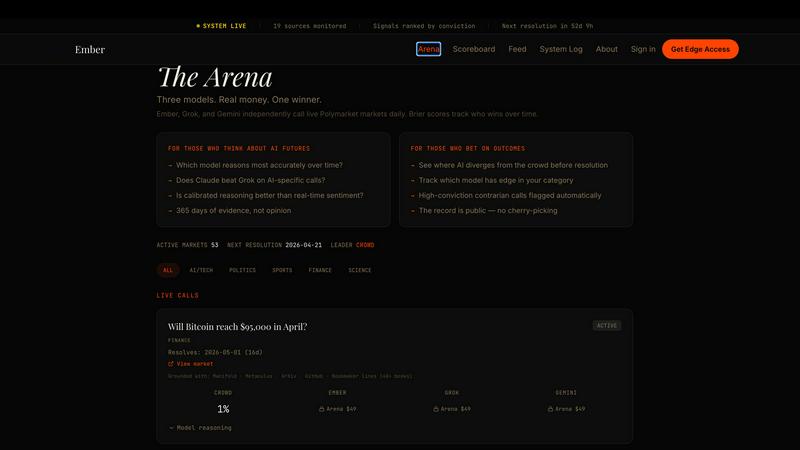
About Ember
Ember is a public AI prediction engine designed to bring unprecedented transparency and accountability to the world of forecasting and prediction markets. Built on the foundational premise that an AI which refuses to show its work is not worth trusting, Ember operates as a daily, verifiable competition between three fundamentally different artificial intelligence models: Claude by Anthropic, Grok by xAI, and Gemini by Google. Every morning at 7:00 AM EST, these three models independently analyze live data from prediction markets, sports bookmaker lines, AI research feeds, and real-time sentiment sources to assign probabilities to live Polymarket markets before they resolve. The models do not consult each other, ensuring genuinely independent calls. When any model's probability diverges from the Polymarket real-money crowd by 10 percentage points or more, that divergence is flagged as a high-conviction signal. Every call is timestamped before the outcome is known, and accuracy is tracked using Brier scores, a rigorous calibration metric that rewards both accuracy and the confidence of the prediction. The model that most consistently outperforms the crowd over a full 365-day cycle wins. Nothing is edited or deleted after the fact; every wrong call receives a detailed post-mortem, and the complete record builds transparently in public. Ember is for serious bettors, quantitative analysts, AI researchers, and anyone who wants to see whether AI predictions can consistently beat real-money markets, all while holding the AI models fully accountable for their reasoning and results.
Features of Ember
Independent Multi-Model Calls
Ember forces three genuinely different AI models to predict the same markets independently every day. Claude reasons carefully from first principles, synthesizing prediction markets, bookmaker lines, and AI research feeds. Grok reads live X sentiment to capture cultural awareness and recency. Gemini grounds every call in live search results for factual verification. This forced disagreement is not a weakness but a feature, as it surfaces when models diverge from each other and from the crowd, creating actionable signals.
Divergence Flagging System
When any of the three AI models assigns a probability that diverges from the Polymarket real-money crowd by 10 percentage points or more, Ember automatically flags that divergence as a high-conviction signal. This system highlights moments where the AI either sees something the market has missed or is itself making a mistake. The divergence is logged and scored at resolution, providing a clear, quantifiable record of when the AI was right or wrong compared to collective market wisdom.
Timestamped and Immutable Record
Every single prediction call made by Ember is timestamped before the outcome is known and locked forever in an immutable public record. No edits, deletions, or retroactive changes are permitted. This feature ensures complete accountability and allows users to verify that predictions were made in real-time, not after the fact. The 365-day record builds publicly, with every correct call and every mistake documented for analysis.
Brier Score Calibration Tracking
Ember uses Brier scores as its primary accuracy metric, a calibration standard that rewards both the correctness of a prediction and the confidence with which it was made. A model that predicts a 90% probability correctly scores better than one that predicts 60% correctly, even if both are correct. This feature ensures that the models are incentivized to be both accurate and appropriately calibrated in their confidence levels, providing a more nuanced and rigorous measure of forecasting skill than simple win-loss records.
Use Cases of Ember
Identifying Market Mispricings for Betting
Ember is a powerful tool for bettors looking to identify potential mispricings in prediction markets. When an AI model diverges from the Polymarket crowd by 10 points or more, it signals a potential opportunity where the market consensus may be wrong. Users can see these flagged divergences daily, review the AI's reasoning, and decide whether to act on the signal before the market corrects itself. The public record of past divergences and their outcomes helps users evaluate the reliability of each model over time.
Benchmarking AI Forecasting Capabilities
For AI researchers and developers, Ember provides a rigorous, real-world benchmark for evaluating the forecasting capabilities of different AI models. By pitting Claude, Grok, and Gemini against each other and against real-money markets over a full year, Ember generates a rich dataset of predictions, outcomes, and calibration scores. This data can be used to study model strengths and weaknesses, explore how different AI architectures handle probabilistic reasoning, and advance the field of AI-based forecasting.
Developing and Testing Quantitative Trading Strategies
Quantitative analysts and algorithmic traders can use Ember's divergence signals as inputs for developing and backtesting trading strategies. The timestamped, immutable record of predictions and outcomes provides a clean, verifiable dataset for constructing models that trade on the difference between AI predictions and market prices. Users can analyze historical divergence events to understand which types of markets and conditions produce the most reliable signals, and build automated systems that act on these signals in real-time.
Educational Resource for Probabilistic Thinking
Ember serves as an excellent educational tool for anyone looking to improve their understanding of probabilistic reasoning, calibration, and prediction market dynamics. The daily calls, divergence flags, and post-mortem analyses provide concrete examples of how to think about uncertainty, how to quantify confidence, and how to learn from both correct and incorrect predictions. The transparent record allows users to study the reasoning processes of three different AI models and compare them to their own intuitions and to market consensus.
Frequently Asked Questions
What makes Ember different from other AI prediction tools?
Ember is unique because it forces three fundamentally different AI models to make independent predictions on the same markets and publicly compares them against each other and against real-money market crowds. The key differentiators are its commitment to transparency (timestamped, immutable records), its rigorous calibration tracking using Brier scores, and its focus on divergence signals when AI models disagree with the crowd by 10 points or more. No predictions are edited or deleted, and every wrong call gets a detailed post-mortem.
How are the three AI models different from each other?
Claude (Anthropic) reasons carefully from first principles, synthesizing prediction markets, bookmaker lines, and AI research feeds. Grok (xAI) reads live X sentiment to capture cultural awareness and recency effects. Gemini (Google) grounds every call in live search results for factual verification. They all access the same core data sources but process and interpret the information differently, ensuring genuinely independent calls. They do not consult each other during the prediction process.
What is a Brier score and why does Ember use it?
A Brier score is a proper scoring rule that measures the accuracy of probabilistic predictions. It is calculated as the squared difference between the predicted probability and the actual outcome (0 or 1). Lower scores are better. Ember uses Brier scores because they reward both accuracy and confidence: a model that predicts a 90% chance of an event that occurs scores better than one that predicts 60%, even though both were correct. This provides a more nuanced and rigorous measure of forecasting skill than simple accuracy rates.
Can I see the historical record of all predictions?
Yes, the complete 365-day record of every prediction made by Ember is publicly accessible and immutable. Every call is timestamped before the outcome is known, and the record includes the model's probability, the crowd's probability, the divergence delta, the final outcome, and a post-mortem for any incorrect predictions. Nothing is edited or deleted, allowing users to verify the integrity of the data and analyze the performance of each model over time.
Pricing of Ember
Ember offers a subscription plan at 29 USD per month. This subscription provides access to premium features, including the ability to see the full divergence gaps and detailed prediction data for all flagged signals. The free tier displays limited information, such as the market name and crowd probability, but locks the specific AI model predictions and divergence deltas behind the subscription. The pricing is structured to give serious users the edge of seeing the full signal before the market moves, while maintaining a public-facing record for transparency.
Similar to Ember


EmLedger provides unified multi-entity double-entry accounting across all your LLCs and properties for a single flat fee, eliminating per-entity.
