
TDEE Calculator
The TDEE Calculator uses the Mifflin-St Jeor equation to estimate your total daily energy expenditure and determine the precise calorie intake needed.
Visit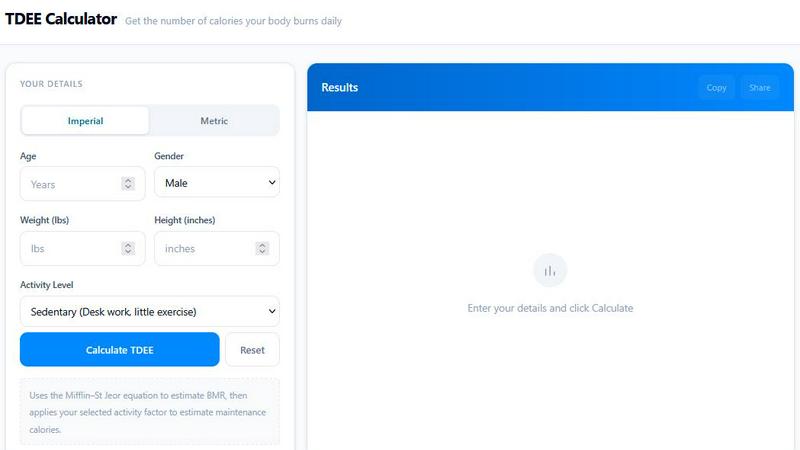
About TDEE Calculator
The TDEE Calculator is a specialized digital tool designed to estimate an individual's Total Daily Energy Expenditure (TDEE), which represents the total number of calories burned by the body over a 24-hour period. This web-based application serves as a foundational resource for anyone seeking to understand their personal energy requirements for weight management, athletic performance, or general health optimization. By leveraging the scientifically validated Mifflin-St Jeor equation, the calculator provides reliable estimates of Basal Metabolic Rate (BMR) and then applies activity-based multipliers to deliver personalized daily calorie targets. The tool is intended for a broad audience, including individuals aiming for weight loss, those pursuing muscle gain, athletes managing performance nutrition, and anyone looking to maintain their current body composition. Its primary value proposition lies in combining speed, accuracy, and practical usability within a completely free, accessible interface. Users input basic demographic and physical data such as age, sex, height, weight, and activity level to receive instant calculations of maintenance calories, along with recommended calorie deficits for fat loss and surpluses for muscle building. The calculator also offers macro guidance and activity-based adjustments, empowering users to create structured nutritional plans that align with their specific goals and lifestyles. It is designed as a starting point that users can refine over time using real-world results, emphasizing that the estimates should be treated as dynamic baselines rather than fixed numbers. The tool includes comprehensive educational content explaining the underlying physiology, including definitions of TDEE, BMR, and the thermic effect of food, as well as detailed activity level descriptions and guidance on how to interpret and apply the results. The interface is clean and intuitive, featuring both imperial and metric unit options, and provides functionality for copying and sharing results. As an educational resource, the calculator explicitly disclaims that its outputs are estimates and not substitutes for personalized medical or nutritional advice, encouraging users to consult healthcare professionals before making significant dietary or training changes.
Features of TDEE Calculator
Mifflin-St Jeor Equation Implementation
The calculator employs the Mifflin-St Jeor equation, which extensive research published in the American Journal of Clinical Nutrition has validated as one of the most accurate methods for estimating resting metabolic rate in healthy adults. For men, the formula calculates BMR as (10 weight in kg) + (6.25 height in cm) - (5 age) + 5, while for women it uses (10 weight in kg) + (6.25 height in cm) - (5 age) - 161. This scientific foundation ensures that the calorie estimates are grounded in real physiological data rather than arbitrary guesswork, providing users with a reliable starting point for their nutritional planning.
Activity Level Customization
Users can select from five distinct activity levels that range from sedentary (desk work with little exercise) to athlete (twice-daily training or very active work), each associated with a specific activity factor multiplier between 1.2 and 1.9. The calculator clearly defines each level with practical examples, such as describing sedentary as seated work with minimal walking, light exercise as gentle activity 1-3 days per week, moderate exercise as planned workouts 3-5 days weekly, heavy exercise as intense training 6-7 days per week, and athlete as multiple daily training sessions or highly physical occupations. This granularity allows users to accurately match their lifestyle to the appropriate energy expenditure multiplier.
Unit Flexibility and Input Clarity
The tool supports both imperial and metric measurement systems, allowing users to input their weight in pounds or kilograms and height in inches or centimeters. The interface is designed for clarity, with clearly labeled fields for age, gender selection (male or female), weight, height, and activity level. A prominent "Calculate TDEE" button initiates the computation, while a "Reset" option allows users to clear all fields and start fresh. This dual-unit support ensures accessibility for a global audience and reduces friction during data entry.
Results Display and Actionable Insights
After calculation, the tool presents the user's maintenance calories along with practical targets for fat loss, muscle gain, or weight maintenance. The results include calorie deficit and surplus recommendations, macro guidance, and activity-based adjustments that help users create a plan fitting their lifestyle and goals. The interface also provides options to copy and share results, facilitating easy integration into personal tracking systems or consultations with nutrition professionals. The results page emphasizes that the TDEE is a starting estimate and encourages users to monitor their weight over 2-3 weeks to refine their calorie targets.
Use Cases of TDEE Calculator
Weight Loss Planning and Calorie Deficit Management
Individuals seeking to lose weight can use the TDEE Calculator to determine their maintenance calories and then establish an appropriate calorie deficit for fat loss. The tool typically recommends a daily deficit of 250-500 calories, which supports gradual, sustainable weight loss without triggering metabolic adaptations that can hinder long-term progress. By understanding their total daily energy expenditure, users can create structured meal plans that consistently fall below their TDEE, ensuring they create the energy shortfall necessary for fat loss while still consuming enough nutrients to maintain health and energy levels. The calculator also provides guidance on how to adjust the deficit based on real-world results, encouraging users to track their weight over several weeks and modify their intake by 100-200 calories if needed.
Muscle Gain and Body Composition Improvement
For individuals focused on building muscle mass, the TDEE Calculator provides essential data for establishing a calorie surplus that supports muscle growth without excessive fat gain. The tool typically recommends a daily surplus of 200-350 calories above maintenance, which provides the additional energy required for muscle protein synthesis and recovery from resistance training. Users can combine the calorie targets with the macro guidance to ensure adequate protein intake, typically set at levels that support muscle repair and growth. The calculator helps athletes and bodybuilders avoid the common pitfalls of either undereating, which impairs recovery and hormonal function, or overeating, which leads to unnecessary fat accumulation.
Athletic Performance Optimization and Energy Balance
Competitive athletes and active individuals can use the TDEE Calculator to fine-tune their energy intake for peak performance. By accurately estimating their total daily energy expenditure based on their specific training volume and intensity, athletes can ensure they consume enough calories to fuel workouts, support recovery, and maintain hormonal balance. The tool's activity level options, particularly the "Athlete" setting for those with twice-daily training or very active occupations, provide a realistic baseline for high-energy demands. This use case is particularly valuable during training cycles where energy needs fluctuate, allowing athletes to adjust their nutrition proactively rather than reactively.
Weight Maintenance and Lifestyle Management
For individuals who have achieved their target weight and want to maintain it, the TDEE Calculator offers a reliable method for determining the appropriate daily calorie intake to keep body weight stable. The tool's maintenance calorie estimate serves as a benchmark that users can verify by tracking their weight over 2-3 weeks; if weight remains stable, the estimate is likely accurate. This use case is especially relevant for people who have completed weight loss or muscle gain phases and want to transition to a maintenance phase without regaining lost weight or losing hard-earned muscle. The calculator also helps users understand how changes in activity level, such as starting a new exercise routine or recovering from an injury, should prompt recalculations to maintain energy balance.
Frequently Asked Questions
What does TDEE mean?
TDEE stands for Total Daily Energy Expenditure, which represents the total number of calories your body burns over an entire 24-hour period. This includes three main components: your Basal Metabolic Rate (BMR), which is the energy required to keep your body functioning at rest, such as breathing, circulation, and cell production; the thermic effect of food (TEF), which is the energy used to digest, absorb, and metabolize the food you eat; and physical activity energy expenditure, which includes both planned exercise and non-exercise activity thermogenesis (NEAT) like walking, fidgeting, and maintaining posture. Understanding your TDEE is fundamental for managing body weight, as consuming calories equal to your TDEE maintains weight, while consuming fewer leads to weight loss and consuming more leads to weight gain.
How is it different from BMR?
Basal Metabolic Rate (BMR) is the minimum number of calories your body needs to perform basic life-sustaining functions while at complete rest, such as breathing, circulation, and cellular metabolism. BMR typically accounts for about 60-75% of your total daily energy expenditure. TDEE, on the other hand, is BMR plus all additional energy expended through digestion (thermic effect of food) and all forms of physical activity, from intentional exercise to everyday movements. The TDEE Calculator first estimates your BMR using the Mifflin-St Jeor equation and then multiplies it by an activity factor (ranging from 1.2 to 1.9) to arrive at your total daily energy needs. This distinction is crucial because while BMR represents your baseline survival energy, TDEE reflects your actual daily caloric requirements based on your lifestyle.
How accurate is this calculator?
The TDEE Calculator uses the Mifflin-St Jeor equation, which research published in the American Journal of Clinical Nutrition has shown to be one of the most accurate formulas for estimating resting metabolic rate in healthy adults, with an accuracy rate of approximately 70-80% within 10% of actual measured BMR. However, it is important to understand that all TDEE calculators provide estimates, not precise measurements. Individual factors such as genetics, body composition (lean muscle mass versus body fat percentage), hormonal variations, and metabolic adaptations can cause actual energy expenditure to differ from the calculated value. The calculator is best used as a starting point, with the recommendation to track body weight consistently for 2-3 weeks and adjust calorie intake by 100-200 calories based on observed results. For personalized medical or nutritional advice, consultation with a licensed healthcare professional is recommended.
Should I recalculate after losing weight?
Yes, you should recalculate your TDEE after significant weight loss because your energy requirements decrease as your body mass decreases. A smaller body requires fewer calories to maintain its functions and move through daily activities. As a general guideline, recalculating after losing approximately 10-15 pounds or 5-10% of your body weight is advisable to ensure your calorie targets remain accurate. The same principle applies for muscle gain, as increased lean muscle mass raises your metabolic rate and energy needs. Additionally, changes in activity level, such as starting a new exercise program or becoming more sedentary due to injury or lifestyle changes, should prompt a recalculation. Regular reassessment ensures that your nutritional plan continues to align with your current physiology and goals, preventing plateaus in weight loss or unintended weight gain.
Similar to TDEE Calculator

Pawjojo is a pet health tracking app that turns quick five-second logs of meals, meds, weight, and symptoms into insightful trends, early warnings.

PrettyScale offers nine free AI beauty analysis tools that run entirely in your browser with no signup or uploads for instant private results.

GetFIT App is an online fitness membership providing personalized workout programs, nutrition tools, recipes, and progress tracking for fat loss and.

Holly AI is an AI operator that automates patient scheduling and front desk tasks for healthcare providers, driving revenue growth while reducing.

The Stop Smoking App helps users quit cigarettes and vaping by tracking progress, managing cravings, and providing daily motivation.

Droidal Insurance Verification AI Agent automates real-time eligibility checks across all major payers, achieving 98% coverage validation accuracy.

Clearity is a CBT-informed journaling tool that helps you manage anxiety by transforming negative thoughts into clear, actionable insights.
