
Unicode to Bamini Converter
This free online tool instantly converts Tamil text between Unicode and Bamini encodings along with 20 other formats.
Visit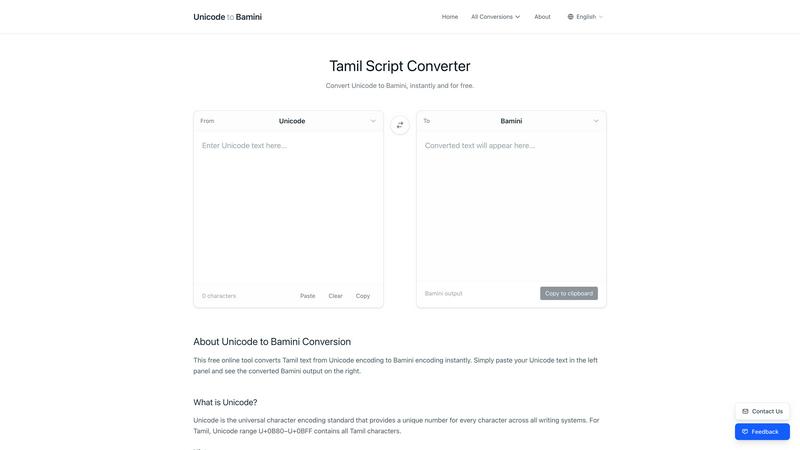
About Unicode to Bamini Converter
The Unicode to Bamini Converter is a sophisticated, web-based utility engineered to address a critical challenge in Tamil digital linguistics: the conversion of text between modern Unicode and legacy font encodings. This tool specializes in transforming Tamil script across more than 25 distinct encoding formats, with a primary focus on the bidirectional conversion between the universal Unicode standard and the historically significant Bamini encoding. It serves as an essential bridge between the past and present of Tamil computing, enabling seamless text interoperability. The converter is designed for instant, real-time translation without requiring page reloads, software installation, or any financial commitment, making it highly accessible. Its core value proposition lies in liberating vast archives of Tamil literature, journalism, and official documentation from the constraints of obsolete font-dependent systems, thereby ensuring their preservation, accessibility, and utility in the contemporary digital ecosystem. It is an indispensable resource for publishers, archivists, developers, and researchers who engage with Tamil textual data across different technological generations.
Features of Unicode to Bamini Converter
Extensive Multi-Encoding Support
This converter provides comprehensive support for over 25 Tamil font encodings, far beyond simple Unicode-Bamini translation. Key supported formats include TSCII, Anjal, TAB, Dinamani, and Murasoli, among others. This extensive library allows users to convert between any pairing of these legacy systems and Unicode, making it a universal hub for Tamil text transformation. It effectively handles the nuanced character mappings and positional differences inherent in each proprietary encoding scheme, ensuring accurate and reliable conversions for a wide array of document sources and publishing standards.
Real-Time Conversion Engine
The tool operates on a sophisticated client-side conversion engine that processes text instantaneously as the user types or pastes it. This real-time functionality eliminates the need to submit forms or reload the web page, providing an immediate visual feedback loop. The converted text appears simultaneously in the output panel, streamlining the workflow for editing and verification. This feature is particularly valuable for processing large documents or for users who need to make iterative adjustments, as it allows for rapid experimentation and correction without any perceptible delay.
Comprehensive Character Mapping Reference
A defining feature of this converter is its integrated, detailed character map that visually displays the correspondence between Unicode code points and their Bamini (or other encoding) equivalents. This reference table, which can display all 289+ mappings, serves an educational and verification purpose. Users can consult it to understand the underlying transformation logic, troubleshoot specific character conversion issues, or manually verify the accuracy of the automated process, ensuring full transparency and trust in the conversion results.
Cross-Platform and Multilingual Accessibility
Built as a responsive web application, the converter functions flawlessly on any modern device, including desktop computers, laptops, tablets, and smartphones. It requires no operating system-specific software, running directly within a standard web browser. Furthermore, the interface is available in five languages: English, Tamil, Sinhala, Hindi, and Chinese. This multilingual support dramatically broadens its usability across different regions and user groups within the global Tamil-speaking and research communities, removing language as a barrier to accessing its core functionality.
Use Cases of Unicode to Bamini Converter
Digital Archiving and Document Preservation
Libraries, universities, and historical societies possess extensive archives of Tamil newspapers, books, and government documents created with Bamini or TSCII fonts. This converter is pivotal for digitization projects, transforming these legacy files into Unicode. This process future-proofs the archives, making them readable on any modern device without requiring the original, often obsolete, fonts to be installed. It ensures that cultural and historical records are preserved in a standardized, accessible format for future generations.
Legacy System Migration and Data Integration
Organizations and businesses, especially in publishing and administration, often operate with older software systems that exclusively accept or output Bamini-encoded text. When upgrading systems or integrating data with modern Unicode-based platforms (like contemporary CMS, databases, or web services), this converter acts as a critical middleware tool. It enables the batch conversion of existing data repositories, facilitating a smooth transition to new technologies without losing access to historical information.
Academic and Linguistic Research
Researchers and linguists studying Tamil literature, historical texts, or computational linguistics frequently encounter materials in various encodings. The converter allows them to normalize diverse source materials into a single, analyzable Unicode format for corpus analysis, textual comparison, or encoding study. Conversely, they may need to produce output in a legacy format to interface with specific analysis tools or to recreate historical digital typography for publication.
Content Modernization for Publishers and Journalists
Publishing houses and news agencies with back catalogs of articles and books in formats like Bamini or Anjal can use this tool to repurpose content for modern digital platforms. Converting old articles to Unicode allows them to be easily published on contemporary websites, e-books, and mobile apps, reaching a wider audience. It also simplifies the process of merging new Unicode-based content with older archives into a unified, searchable digital library.
Frequently Asked Questions
What is the difference between Unicode and Bamini encoding?
Unicode is an international standard that assigns a unique numerical code to every character used in all the world's writing systems, including Tamil. It is platform-independent and ensures consistent display across devices. Bamini, in contrast, is a proprietary 8-bit font encoding that uses positions within the ASCII table to represent Tamil characters. It requires the specific Bamini font to be installed to display correctly, whereas Unicode text will render with any standard Unicode-compliant Tamil font.
Is my text data safe when using this online converter?
Yes. The Unicode to Bamini Converter is designed with privacy in mind. The conversion process occurs entirely within your web browser (client-side). This means the text you paste into the tool is never sent to or stored on any external server. Your data never leaves your computer, ensuring complete confidentiality, which is especially important when handling sensitive or copyrighted documents.
Can I convert files (like .doc or .pdf) directly with this tool?
No, this is a text-based converter. It works with plain text content. To convert text from within a file (such as a Word document or PDF), you must first open that file in its respective application, copy the relevant Tamil text, and then paste it into the converter. For bulk file conversion, you would typically use a script or specialized software that can automate extracting text and applying the encoding transformation.
Why would I need to convert from Unicode back to Bamini?
While converting legacy data to Unicode is the most common need, reverse conversion is sometimes necessary. This includes updating or adding to existing Bamini-encoded documents without changing their format, preparing text for input into older software systems that only accept Bamini, or maintaining stylistic consistency in archival projects where the original encoding is part of the document's historical digital artifact.
Explore more in this category:
Similar to Unicode to Bamini Converter

MeloLingua helps you learn languages through personalized stories, boosting confidence in listening and speaking from.

Glossa provides real-time AI translation of sermons into 100+ languages, bridging language gaps for diverse.

Lovalingo enables rapid, zero-flash translation of React apps in over 20 languages with automated SEO and no JSON.

Pathoura creates AI-powered multilingual audio guides for museums that work instantly on visitors' smartphones.

Bargou One is an all-in-one AI suite for creating, translating, and transcribing diverse media effortlessly.

Translate books effortlessly in over 100 languages in just one minute with BookTranslator's AI-powered service.