
Self-Healing Integrations
Plumbed.io delivers self-healing enterprise integrations through an AI-managed lifecycle that automates monitoring, maintenance, and updates to.
Visit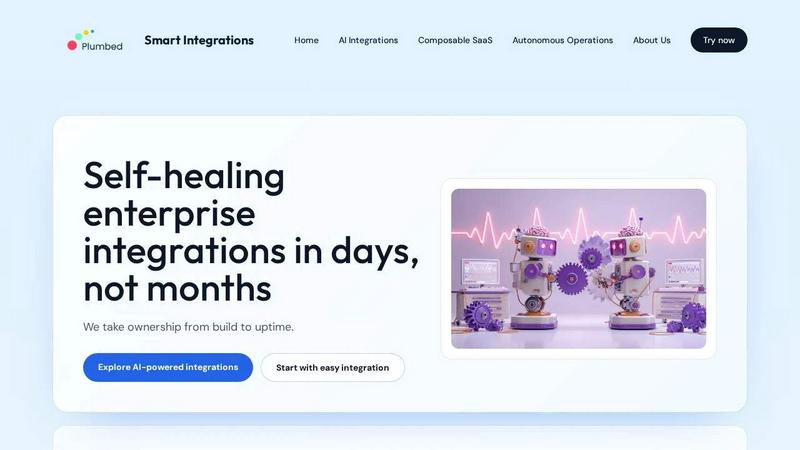
About Self-Healing Integrations
Self-Healing Integrations, as delivered by the Plumbed.io platform, represent a fundamental shift in how enterprises approach system connectivity and data flow management. Unlike traditional integration tools that focus solely on the initial build phase, this product introduces an AI-managed lifecycle that takes full ownership of integrations from conception through to ongoing maintenance and uptime. The core value proposition is simple yet transformative: Plumbed.io does not just build integrations; it ensures they stay operational, reliable, and continuously up-to-date without requiring constant human intervention. The product is specifically designed for custom enterprise integrations that demand ongoing changes, proactive monitoring, and automated maintenance after go-live. It addresses the pervasive "integration tax" that makes launching new channels, systems, or partners both slow and expensive. By replacing traditional custom integration projects with a prompt-driven, production-ready, and self-healing architecture, Plumbed.io enables organizations to deploy new connections in record time, significantly lower operational costs, and eliminate the overhead typically associated with legacy integration solutions. The target audience includes enterprise teams, system architects, and operations managers who are burdened by fragile point-to-point integrations and seek a more autonomous, reliable approach to managing complex system connections.
Features of Self-Healing Integrations
AI-Managed Integration Lifecycle
This feature automates the entire lifecycle of an integration, moving beyond simple build-and-forget approaches. The intelligent software continuously monitors integration performance, proactively handles errors before they escalate, and applies system updates automatically. By replacing manual maintenance with AI-driven oversight, the platform ensures that integrations remain robust and adaptive to changing business requirements, eliminating the need for dedicated engineering teams to constantly patch and fix broken connections.
Prompt-Driven Integration Design
Plumbed.io introduces a novel approach where integrations are configured through natural language prompts rather than complex coding or configuration files. This prompt-driven architecture allows users to define integration logic, data mappings, and error handling rules in plain language, which the AI then interprets and implements. This dramatically reduces the technical barrier to creating sophisticated integrations and accelerates the deployment timeline from months to days for even complex enterprise scenarios.
Self-Healing Operational Engine
At the heart of the platform is a self-healing engine that continuously monitors data flows and system states. When anomalies, failures, or performance degradations are detected, the engine autonomously executes predefined remediation strategies. This includes retrying failed transactions, rerouting data through alternative paths, adjusting error thresholds, and even reconfiguring integration parameters without human intervention. The result is consistent uptime and reliable data flow with zero manual overhead.
Autonomous Error Handling and Monitoring
This feature provides comprehensive, real-time visibility into integration health while automating the response to common failure patterns. The system logs all transactions, detects error trends, and learns from historical incidents to improve its predictive capabilities. It proactively alerts stakeholders only when human intervention is genuinely required, while handling the vast majority of routine issues automatically. This reduces operational burden and ensures that engineering teams can focus on strategic initiatives rather than integration firefighting.
Use Cases of Self-Healing Integrations
Enterprise CRM and ERP Synchronization
Large organizations often struggle to keep customer relationship management (CRM) and enterprise resource planning (ERP) systems in sync. Self-Healing Integrations automate the bidirectional flow of data between these critical systems, handling complex data transformations, deduplication, and conflict resolution. The self-healing engine ensures that even when one system experiences downtime or data format changes, the integration continues to operate reliably, maintaining data consistency across the enterprise without manual intervention.
Multi-Channel Ecommerce and Marketplace Connectivity
Retailers and brands connecting to multiple ecommerce platforms, marketplaces, and payment gateways face constant maintenance challenges as APIs evolve and new channels emerge. Plumbed.io enables rapid deployment of integrations to platforms like Shopify, Amazon, and custom payment systems. The AI-managed lifecycle automatically adapts to API version changes, handles rate limiting, and retries failed orders or inventory updates, ensuring that product listings, orders, and fulfillment data flow seamlessly across all sales channels.
Healthcare Data Exchange Between EHR and Practice Management
Healthcare providers require reliable, HIPAA-compliant data exchange between electronic health records (EHR) and practice management systems. Self-Healing Integrations automate patient demographics, appointment scheduling, billing codes, and clinical data synchronization. The platform's proactive error handling ensures that critical patient information is never lost during transmission, and the self-healing engine can automatically resolve common data format mismatches or connectivity issues, maintaining operational continuity for healthcare practices.
Financial Services and Banking System Integration
Banks and financial institutions integrate with numerous core banking systems, payment processors, fraud detection platforms, and regulatory reporting tools. Plumbed.io handles the complex data mappings and security requirements inherent in financial transactions. The autonomous monitoring feature tracks transaction success rates, detects anomalies in data flows, and automatically retries failed transactions or escalates issues that require compliance review. This ensures that financial data remains accurate, timely, and auditable without overwhelming IT teams.
Frequently Asked Questions
How does Self-Healing Integrations differ from traditional iPaaS solutions?
Traditional integration platform as a service (iPaaS) solutions primarily focus on providing tools to build integrations, often requiring significant ongoing manual maintenance to handle API changes, system updates, and error resolution. Self-Healing Integrations from Plumbed.io fundamentally shift this paradigm by introducing an AI-managed lifecycle that takes ownership of integrations from build through to ongoing operations. The platform automatically monitors, heals, and updates integrations without human intervention, replacing the reactive maintenance model with a proactive, autonomous approach that dramatically reduces operational overhead and improves reliability.
What types of systems can be connected using this platform?
Plumbed.io is designed to connect virtually any system with an API, including cloud-based SaaS applications, on-premises legacy systems, custom databases, and third-party services. The platform supports REST, SOAP, GraphQL, and other common API protocols, as well as file-based integrations using formats like CSV, XML, and JSON. The prompt-driven design allows users to quickly define connections to both standard enterprise applications like Salesforce, SAP, and NetSuite, as well as custom or niche systems that require specialized handling.
How does the self-healing capability actually work in practice?
The self-healing engine operates through a continuous monitoring loop that tracks every transaction, response time, and error code across all active integrations. When a failure is detected, the AI analyzes the root cause by examining error patterns, system status, and historical data. It then executes a predefined or learned remediation strategy, which may include retrying the transaction with exponential backoff, switching to a backup endpoint, reformatting data to match schema changes, or temporarily pausing the integration to prevent cascading failures. Only if the automated remediation fails multiple times does the system escalate to human operators with detailed context about the issue.
Is technical expertise required to use Plumbed.io?
While the platform is designed to be accessible to non-technical users through its prompt-driven interface, some familiarity with the systems being integrated and basic understanding of data structures is beneficial. The prompt-based configuration allows business analysts and operations managers to define integration logic in natural language, significantly reducing the need for specialized coding skills. However, for complex enterprise integrations involving custom data transformations or security requirements, collaboration between business users and IT teams may still be valuable during the initial setup phase. Ongoing maintenance, however, is largely automated by the self-healing engine.
Explore more in this category:
Similar to Self-Healing Integrations

AIQualityHQ is a free browser tool that instantly evaluates your AI prompts for structure, safety, and privacy, providing actionable optimization.

EchoLeads AI is an enterprise-grade omnichannel platform using intelligent AI voice agents to automate cold calling, lead qualification, and.

VideoAny is an all-in-one AI creation studio for generating videos, images, and audio from text or photos with advanced models like Seedance 2.0 and.

GeoRank combines interactive map layers with AI to help you compare places worldwide on sunshine, cost, taxes, and visas for relocation decisions.

SlabCalc is a free suite of 34 concrete calculators and AI tools providing instant volume, cost, and crack diagnosis for any project.

BlueHumanizer transforms AI-generated text into clear, natural writing while preserving meaning, tone, and citations in one click.

Adviserry analyzes your subscriptions and delivers personalized, actionable insights to drive real progress on your specific goals.

PaperChat is an AI-powered customer support platform that trains on your business data to automate lead collection, multilingual conversations, and.