
Fallom
Fallom provides comprehensive AI observability for real-time tracking, debugging, and cost analysis of LLM agents.
Visit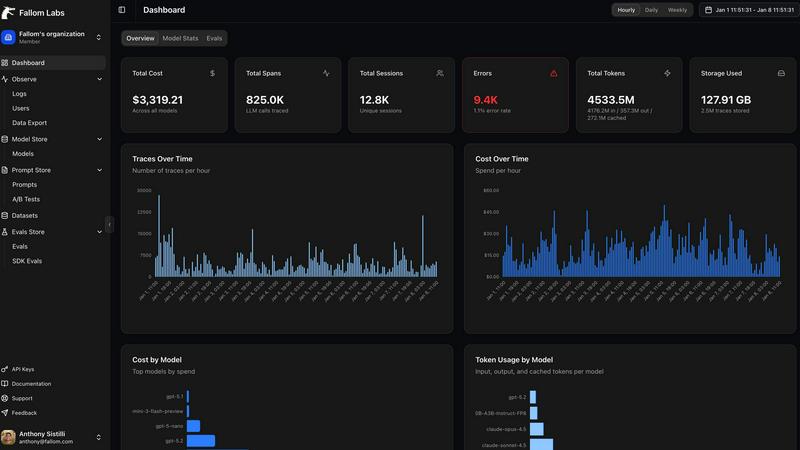
About Fallom
Fallom is an AI-native observability platform engineered to provide comprehensive, granular visibility into production large language model (LLM) and AI agent workloads. It serves as a critical operational layer for engineering, product, and compliance teams building and scaling AI-powered applications. The platform's core value proposition lies in its ability to monitor every LLM interaction in real-time with end-to-end tracing, capturing a complete telemetry dataset including prompts, outputs, tokens, latency, cost, and the intricate details of tool and function calls. This depth of insight is particularly vital for debugging complex, multi-step AI agents, where understanding the sequence and timing of operations is essential. Fallom is built for the enterprise, offering robust session, user, and customer-level context, alongside features like model versioning and consent tracking that address stringent compliance requirements such as the EU AI Act, GDPR, and SOC 2. By utilizing a single, OpenTelemetry-native SDK, Fallom ensures vendor-agnostic instrumentation, enabling rapid deployment, real-time monitoring, and precise cost attribution across models, teams, and end-users. Ultimately, Fallom transforms opaque AI operations into transparent, manageable, and optimizable systems, driving reliability, cost efficiency, and informed decision-making.
Features of Fallom
End-to-End LLM Tracing
Fallom provides comprehensive, OpenTelemetry-native tracing for every LLM call and agentic workflow. Each trace captures a complete picture of the interaction, including the exact prompt sent, the model's raw output, token usage (input and output), precise latency metrics, and the calculated per-call cost. For AI agents, it extends this visibility to every tool call, logging function arguments and results, creating a detailed execution graph that is indispensable for debugging complex, stateful operations and understanding the root cause of failures or unexpected behavior.
Granular Cost Attribution & Analytics
The platform offers unparalleled transparency into AI expenditure by breaking down costs across multiple dimensions. Teams can track and attribute spend per specific LLM model (e.g., GPT-4o vs. Claude-3.5), per internal team or project, and per end-user or customer. This feature enables precise budgeting, internal chargeback mechanisms, and data-driven decisions on model selection. Interactive dashboards visualize cost distribution, helping identify optimization opportunities and justify AI investments with clear, auditable financial data.
Enterprise Compliance & Audit Trails
Fallom is architected to meet the rigorous demands of regulated industries. It maintains immutable, complete audit trails of all LLM interactions, which is a foundational requirement for frameworks like the EU AI Act and GDPR. Key capabilities include detailed input/output logging, model version lineage to track which model generated a specific output, and user consent tracking. A configurable "Privacy Mode" allows organizations to redact sensitive content or log only metadata, ensuring observability without compromising data privacy or confidentiality.
Advanced Performance & Testing Tools
Beyond basic monitoring, Fallom includes a suite of tools for performance optimization and quality assurance. The Timing Waterfall visualization breaks down latency within multi-step agent calls, pinpointing bottlenecks in LLM responses or tool execution. Integrated evaluation frameworks allow teams to run automated tests on LLM outputs for metrics like accuracy, relevance, and hallucination rates. Coupled with model A/B testing and a version-controlled Prompt Store, these features enable systematic performance comparison, safe rollouts of new models or prompts, and proactive regression detection.
Use Cases of Fallom
Debugging and Optimizing AI Agents
Development and operations teams use Fallom to debug intricate AI agent workflows that involve sequential LLM calls and external tool usage (e.g., database queries, API calls). By examining the detailed trace with tool call visibility and timing waterfalls, engineers can quickly identify which step in a chain failed, why a particular tool was called with unexpected arguments, or where latency is accumulating, drastically reducing mean time to resolution (MTTR) and improving agent reliability.
Ensuring Regulatory Compliance and Audit Readiness
Legal, compliance, and security teams in finance, healthcare, or enterprise software leverage Fallom to demonstrate adherence to AI regulations. The platform's comprehensive audit trails, consent tracking, and model versioning provide the necessary documentation to prove how AI models are used, what data they processed, and that appropriate governance controls are in place. This is critical for passing internal and external audits and mitigating regulatory risk.
Managing and Controlling AI Operational Costs
Engineering leads and finance departments utilize Fallom's cost attribution dashboards to gain full visibility into AI spending. By analyzing costs per model, team, or feature, they can identify inefficient patterns, optimize prompts, right-size model selection, and implement chargeback or showback models. This transforms AI costs from an opaque overhead into a manageable and accountable operational expense, ensuring sustainable scaling.
Monitoring Production Health and User Experience
Site reliability engineers (SREs) and product managers rely on Fallom's real-time dashboard to monitor the health and performance of AI features in production. They can spot anomalies in latency, error rates, or token usage as they happen, set alerts for thresholds, and understand usage patterns by customer or session. This proactive monitoring ensures a high-quality user experience and allows for rapid response to incidents before they impact a broad user base.
Frequently Asked Questions
What is OpenTelemetry, and why is Fallom built on it?
OpenTelemetry (OTEL) is a vendor-neutral, open-source standard for generating, collecting, and exporting telemetry data like traces, metrics, and logs. Fallom's native OTEL foundation means it uses a single, standardized SDK to instrument your application, ensuring you are not locked into a proprietary agent. This provides maximum flexibility, simplifies setup (often in under 5 minutes), and guarantees compatibility with a vast ecosystem of existing OTEL-compatible tools and backends for a future-proof observability strategy.
How does Fallom handle sensitive or private user data?
Fallom is designed with enterprise-grade privacy controls. Its configurable "Privacy Mode" allows administrators to disable full content capture for sensitive workflows. In this mode, the platform can be set to log only metadata (e.g., token counts, latency, model used) while redacting the actual prompts and completions. This enables teams to maintain full operational and cost observability while complying with data privacy policies and regulations like GDPR, ensuring user confidentiality is protected.
Can Fallom compare performance between different LLM models?
Yes, Fallom includes robust A/B testing and comparison features. Teams can split traffic between different models (e.g., GPT-4o and Claude-3.5) and use the platform to compare their performance in real-time across key dimensions such as cost per call, latency, token usage, and custom evaluation scores (e.g., accuracy). This data-driven approach allows for informed decisions when selecting or switching models, ensuring optimal balance between cost, speed, and quality for specific use cases.
Is Fallom suitable for small development teams or startups?
Absolutely. Fallom offers a free tier to start tracing, making it accessible for small teams and startups to instrument their AI applications quickly. The value of having immediate observability into LLM costs, performance, and errors is significant even at early stages, preventing technical debt and establishing best practices for scaling. The platform's simplicity and OpenTelemetry approach mean small teams can gain enterprise-grade insights without requiring dedicated observability personnel.
Explore more in this category:
Similar to Fallom

Decision support framework for high consideration businesses with mix of online and offline channels, content-rich sites, and long customer journeys.

The launch platform for indie makers — schedule your launch, get in front of buyers, and blast across directories.


AI sales assistant providing real-time objection handling and tactical phrasing directly during live calls to boost team close rates.

MCPize is a marketplace where developers can discover, install, and manage 1,000+ premium MCP servers while publishers keep 80% of revenue.

EnsembleData provides real-time social media data APIs for seamless extraction of posts, profiles, comments, and analytics at scale.
