
Kompy
Kompy provides live Walmart product data including prices, stock, sellers, and price history as clean JSON via a REST API or MCP server for.
Visit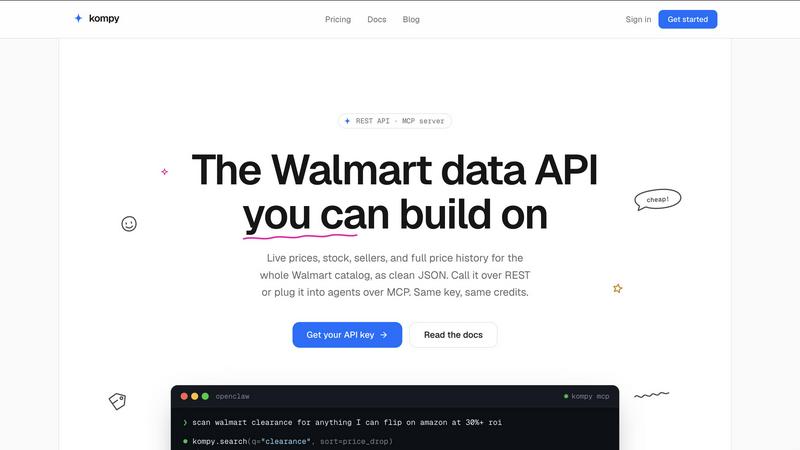
About Kompy
Kompy is a specialized, unified API and MCP (Model Context Protocol) server designed to provide developers, data analysts, and AI agents with structured, reliable, and comprehensive access to Walmart marketplace data. Unlike traditional web scraping, which is fragile, slow, and often blocked by anti-bot measures, Kompy offers a single, robust endpoint for retrieving product details, search results, barcode lookups, seller offers, customer reviews, and full historical price and stock data. The platform returns all data as clean, consistent JSON, eliminating the need for complex parsing logic. Kompy is built for both human developers and autonomous AI agents, supporting direct REST API calls from any programming language or integration with agent frameworks like Claude Code, OpenClaw, Cursor, LangChain, and n8n via its MCP server. The core value proposition is simplicity and reliability: developers can get a complete product record or a detailed price history in under 50 milliseconds, without managing scrapers, proxies, or dealing with rate limits. The service is aimed at ecommerce analysts, resellers, software developers building shopping tools, and AI researchers who need real-time marketplace intelligence. With a straightforward Google sign-in, instant API key generation, and a transparent credit-based pricing model, Kompy scales seamlessly from a side project to a production-level application. The company is actively expanding its coverage beyond Walmart to include more major marketplaces in the future.
Features of Kompy
Unified REST API and MCP Server
Kompy provides a dual-access architecture. Developers can call the same deterministic REST endpoints from any language using standard HTTP requests, receiving predictable JSON shapes with structured error handling. Simultaneously, the platform offers a first-party MCP server that exposes the exact same operations as callable tools for AI agents. This means a developer can use curl or Python for integration, while an agent built on Claude Code or OpenClaw can directly query Walmart data using natural language commands like "search for clearance items with the biggest price drops." Both access methods use the same API key and credit system, ensuring seamless interoperability between human-coded applications and autonomous agent workflows.
Comprehensive Historical Price and Stock Data
One of the most powerful features of Kompy is its continuous recording of the Walmart marketplace. The platform captures hourly snapshots of price, stock availability, and buy-box changes for every SKU it tracks, with per-seller granularity. This creates a full, searchable price history that goes back to the first day the product was tracked. Users can query this historical data via the dedicated history endpoint to analyze trends, identify pricing patterns, or spot the best time to buy or sell. For example, a reseller can see that a Samsung TV dropped from $389 during Black Friday to $447.99 today, providing crucial context for arbitrage decisions. No other Walmart API offers this depth of historical, per-seller data.
Real-Time Product and Search Endpoints
The core product endpoint returns a complete snapshot of any Walmart item, including its name, brand, current price, currency, stock status, seller information, rating, and review count, all captured in real time. The search endpoint allows users to query the live Walmart catalog with support for sorting and filtering, such as sorting by price drop or filtering for clearance items. Both endpoints are optimized for speed, typically returning responses in under 50 milliseconds. This makes Kompy ideal for applications that require up-to-the-minute pricing data, such as dynamic pricing tools, inventory alerts, or competitive analysis dashboards.
Multi-Language and Framework Support
Kompy is designed to work with any modern development stack. The REST API can be called from Python, Node.js, Go, curl, or any other HTTP client without requiring a specific SDK. For AI and automation workflows, the MCP server integrates natively with Claude Code, OpenClaw, Cursor, LangChain, OpenAI Agents SDK, and n8n. This broad compatibility ensures that whether a user is building a simple price tracking script, a complex multi-agent system, or a no-code automation workflow, Kompy fits seamlessly into their existing toolchain. Each response includes a unique request_id for tracing and debugging, adding transparency to every call.
Use Cases of Kompy
Ecommerce Reselling and Arbitrage
Resellers can use Kompy to identify profitable arbitrage opportunities between Walmart and other marketplaces like Amazon. By leveraging the search endpoint with filters for clearance items and price drops, and then cross-referencing with historical price data, a reseller can quickly find products with a high ROI. For instance, an agent can scan for clearance items, check their 30-day price history, and automatically flag products where the Walmart price is significantly lower than the Amazon selling price, factoring in fees. This turns a manual, hours-long research process into an automated, real-time pipeline that can alert the user to new flips as they appear.
AI-Powered Shopping Assistants
Developers can build intelligent shopping agents that use the MCP server to answer natural language queries about Walmart products. An AI assistant can search for specific items, compare prices across sellers, check stock availability, and even provide a summary of recent price trends. For example, a user could ask, "Find me the best deal on a 65-inch 4K TV under $500 that has good reviews and is in stock," and the agent would query the product and search endpoints to return a curated, data-driven recommendation. This enables a new class of conversational commerce applications.
Competitive Price Monitoring and Dynamic Pricing
Businesses that compete with Walmart can use Kompy to continuously monitor competitor pricing and stock levels. By programmatically querying the product endpoint for a list of competitor SKUs at regular intervals, a company can build a real-time dashboard of Walmart's pricing strategy. The historical data endpoint further allows for trend analysis, helping businesses understand seasonal pricing patterns or react quickly to sudden price drops. This data can feed into dynamic pricing engines that automatically adjust a company's own prices to remain competitive while protecting margins.
Data Science and Market Research
Researchers and data analysts can use Kompy to collect large datasets for analyzing the Walmart marketplace. The clean, consistent JSON output makes it easy to ingest data into data lakes, Jupyter notebooks, or BI tools. Common research applications include analyzing the distribution of prices across product categories, studying the relationship between seller ratings and pricing, tracking the lifecycle of product prices from launch to clearance, and building predictive models for future price movements. The availability of per-seller historical data adds a rich layer of granularity for academic or commercial market analysis.
Frequently Asked Questions
How does Kompy differ from traditional web scraping?
Kompy eliminates the fragility, slowness, and maintenance burden of traditional web scraping. Scrapers require custom parsers, handle anti-bot challenges like CAPTCHAs and IP blocking, and break when the website's HTML structure changes. Kompy provides a dedicated API that returns clean, structured JSON directly, ensuring consistent and reliable data access. It is also significantly faster, with typical response times under 50 milliseconds compared to the seconds or minutes scraping can take. Furthermore, Kompy offers features like historical price data that are nearly impossible to obtain through scraping alone.
Can I use Kompy with AI agents like Claude Code or ChatGPT?
Yes, Kompy is built specifically for AI agent integration. It provides a first-party MCP server that any MCP-compatible agent (such as Claude Code, OpenClaw, or Cursor) can connect to. Once connected, the agent can use natural language to call tools like search, product, history, and reviews to query Walmart data directly. For example, you can instruct an agent to "find clearance items with the largest price drops in the electronics category," and the agent will execute the necessary API calls and return the results. You can also use the REST API directly with frameworks like LangChain or the OpenAI Agents SDK.
What data does Kompy provide for a single product?
For a single product, the product endpoint returns a comprehensive snapshot including: the Walmart product ID, product name, brand, current price, currency, stock availability (true/false), average customer rating, total number of reviews, the name of the current seller (buy-box winner), and a timestamp indicating when the data was captured. The response is a clean JSON object with a data field containing the product information and a meta field containing the request ID and latency. Additional details like full specifications or images are available through related endpoints.
How does the credit-based pricing work?
Kompy uses a credit-based system where each API call consumes a certain number of credits based on the endpoint used. For example, a product lookup might cost 1 credit, while a history query might cost 2 credits. Users purchase a monthly subscription that provides a fixed number of credits (e.g., 14,000 credits on the Hobby plan). Unused credits do not roll over to the next month. The system is designed to be transparent with no hidden fees, and users can upgrade their plan at any time. New accounts start with a free credit balance to test the API before committing to a paid plan.
Pricing of Kompy
Kompy offers three transparent, tiered subscription plans designed to scale with your usage. All plans include both REST API and MCP server access, and every new account starts with free credits to test the service. The pricing is credit-based, with no hidden fees or forced upgrades.
The Hobby plan is priced at $49.99 per month and provides 14,000 credits, suitable for individuals getting started with the API. It includes email support.
The Pro plan is the most popular option at $149.99 per month and offers 45,000 credits per month for professionals and small teams. It includes priority support.
The Business plan, at $499.99 per month, is designed for large teams with custom needs. It provides 180,000 credits per month and includes priority support along with custom integrations. Users can compare all plans and features on the Kompy website.
Similar to Kompy

Managed remote build cache for Nx, Lerna, Turbo, Gradle, and Bazel. Reuse artifacts across CI and developer machines.

GeoRank combines interactive map layers with AI to help you compare places worldwide on sunshine, cost, taxes, and visas for relocation decisions.

Decision support framework for high consideration businesses with mix of online and offline channels, content-rich sites, and long customer journeys.

AI sales assistant providing real-time objection handling and tactical phrasing directly during live calls to boost team close rates.

EnsembleData provides real-time social media data APIs for seamless extraction of posts, profiles, comments, and analytics at scale.

Subiq is a subscription management platform that helps small teams track, manage, and reduce SaaS spending by providing a single dashboard for all.

Flyback.ai is an AI-driven platform that evaluates luxury watch listings, providing real-time deal scores and personalized fit analysis for buyers.

Flidget combines drift scoring and AI exit chat to detect churn risk before cancellation and capture the real reason when it happens.